
|
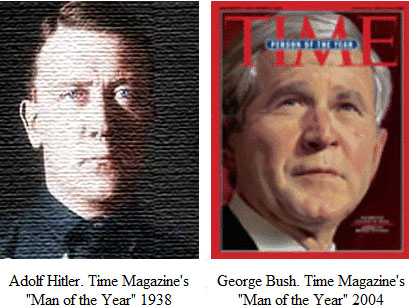
Continuing the Time-honored tradition of picking the person who has had the most "influence on the world" during the course of the year - and thereby manufacturing a certain status for the person in question in the minds of the general public, whether merited or not - for the year 2004, Time magazine nominated George W Bush as their "Man of the Year". In a eulogy to make your stomach churn, filled as it is with nauseating platitudes and obsequious psychophantic panderings, Time said they had chosen Bush for the second time in four years for:
"sticking to his guns (literally and figuratively), for reshaping the rules of politics to fit his ten-gallon-hat leadership style and for persuading a majority of voters this time around that he deserved to be in the White House for another four years. For sharpening the debate until the choices bled, for reframing reality to match his design, for gambling his fortunes - and ours - on his faith in the power of leadership."High praise indeed. Unfortunately none of Time's reasons have any basis in reality. Indeed, Bush resorted to "reshaping the rules", specifically the rules of international law on the sovereignty of other nations and the use of torture on civilians. He sharpened (read 'obfuscated') the debate until the choices bled, and as a result caused massive and unwarranted bloodletting in Iraq and Afghanistan.
What merit can there be in "literally sticking to your guns" when it involves the massacring of thousands of innocent civilians in a war to pillage the resources of other countries? Bush certainly persuaded American voters that he deserved another 4 years, but sadly this "persuasion" took the form of ditching the troublesome and unpredictable democratic process and installing himself as Fuhrer by way of vote rigging.
Yes indeed, Bush fits the mold of previous Time magazine "men of the year" very well. In fact, the parallels between Bush and the current state of the US and another notable "man of the year" exactly 66 years previously are startling.
Those of us alive today who look back at the events of WWII could be mistaken for thinking that Hitler was very obviously a madman and was perceived as such by world public opinion of the day. Nothing could be further from the truth however.
|
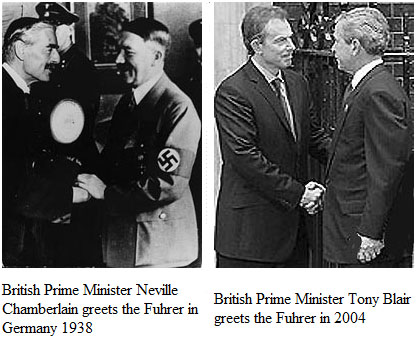
Long after Hitler had installed himself as an outright dictator, built the concentration camps and imposed an overt police state (albeit with the tacit consent of a majority of the population who welcomed his promises of a "reshaping of the rules" and a "sharpening of the debate") he was still entertaining British and American dignitaries at his Austrian chateau and receiving favorable write-ups in the international press. For example, in the November 1938 edition of Homes and Gardens magazine a three page spread was dedicated to, among other things, the tastes in home decor of the man who in just a few short years would be condemned as a genocidal maniac. Like the tone of many commentaries on the German ruler at that time, there was absolutely nothing to suggest to the wider public that Hitler was planning to initiate a war that would leave 65 million people dead. The Homes and Gardens issue stated:
"The Furher is his own decorator designer and furnisher as well as architect. He is constantly enlarging the place building new guest annexes and arranging in these his favorite antiques. It is a mistake to suppose that week-end guests are all, or even mainly, state officials. Hitler delights in the society of brilliant foreigners, especially painters, singers and musicians. As host he is a droll raconteur; we all know how surprised were Mr. Lloyd-George and his party when they accepted an invitation to Haus Wachenfeld (earlier in 1938).Despite all of the warning signs, Hitler, like Bush today, continued to be lauded by the international press as a "revolutionary" for his extremely aggressive and oppressive foreign and domestic policies. The German people themselves, having to contend with the effects of homespun Nazi propaganda as well as international approval of their leader, had considerably less chance of seeing the reality of the situation.
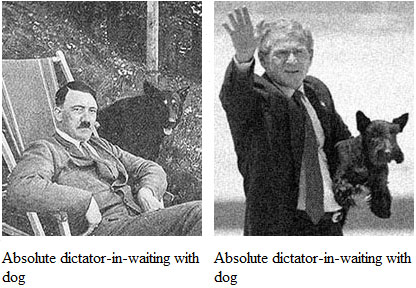
All visitors are shown their host's model kennels where he breeds magnificent Alsatians. Some of his pedigree pets are allowed the run of the house especially on days when Herr Hitler gives a "fun fair" to the local children. On such a day when state affairs are over the squire himself, attended by some of his guests, will stroll into hamlets above and below. This is the only home in which Hitler can laugh and take his ease - or even "conduct tours" by means of the tripod telescope which he himself operates on the terrace for his visitors. "This place is mine" he says. "I built it with the money that I earned." Then he takes you into his library where you note that quite half the books are on history, painting, architecture and music."
|
In his book Backing Hitler, Robert Gellately has this to say about the prevailing sentiment among Germans at the time:
Hitler's appointment as Chancellor on 30 Jan 1933 was followed the next day by the dissolution of the Reichstag. Herman Goering took immediate steps to introduce emergency police measures. Over the next few weeks the Nazis did not need to use the massive violence associated with modern takeovers like the Russian revolution. There was little or no opposition and the historian Golo Mann said of those times that "it was the feeling that Hitler was historically right that made a large part of the nation ignore the horrors of the Nazi takeover...people were ready for it." To the extent that terror was used it was selective and it was initially aimed mainly at communists and other (loosely defined) opposition individuals who were portrayed as "enemies of the people".
[Prior to the passing of the enabling law] Hitler gave a government declaration in which he signaled that he had a social and political agenda that went beyond suppressing Communism, getting back to work and restoring Germany's position in Europe. His stated goals now included "creating a real community of the people" and he alluded to the need for "the moral purification of the body politic".
Citizens were asked to express themselves on 19 August 1934 in a plebiscite on the issue of uniting the offices of head of state and that of the head of government (Chancellor Hitler). around 90 percent supported Hitler. These results disappointed opponents who kept waiting for the people to see the light. The Nazis were clear in their own minds about their popular backing, and Hitler was fond of saying that henceforth the struggle was for the support of the remaining 10 percent. According to the Reichstag elections held on 29 March 1936 the Nazis were well on their way to getting that support, because they received no less than 99.99% of the vote. Certainly by then the elections were heavily tilted in favor of the government which counted spoiled ballots or those left blank as a "yes".
On the night of 27 February 1933 a lone arsonist tried to burn down the Reichstag. Even though Marinus Van der Lubbe, a Dutchman with no particular ties to Communism was caught, Hitler immediately blamed all Communists [...] and insisted on the "Presidential decree for the protection of the people and the state". The decree suspended "until further notice" the constitutional guarantees of personal liberty; made it possible for police to arrest and detain anyone they saw fit; and to impose restrictions on freedom of expression, assembly and association. Police were allowed to exceed all previous legal limits on house searches and could intercept mail and tap telephones.
Most Germans, especially anyone close to the Nazi party, accepted the official version of events about the attempted Communist insurrection and the need to take radical measures. Ian Kershaw concludes that the violence and repression that took place, far from damaging Hitler's reputation "were widely popular". More than 200 telegrams were sent to the Ministry of Justice demanding the death penalty for the culprit who burnt down the Reichstag, and many volunteered for the position of executioner.
The German government insisted that it was responding to a revolutionary threat that called for emergency measures on short-term basis. It kept reassuring the public that, once the crisis passed, Germany's rule of law and freedoms would be restored. It was obvious, however, even at the time when such vague promises were made, that the innovations introduced were going to be permanent features of Hitler's dictatorship. [...] The combination of the Reichstag fire and the Enabling Act gave the Nazi revolution a veneer of legality and made it easier for the citizens to accept the dictatorship.
|
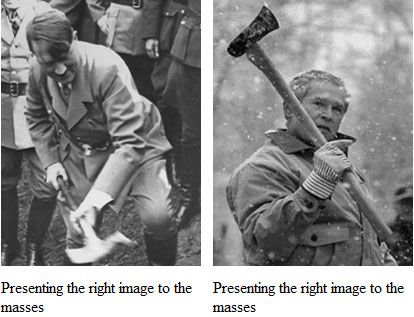
Almost every single aspect of the controls put in place by the Nazi party as related by Gellately in the above excerpt has a direct correlation to the facts on the ground in modern day America, including the attitude of the citizens to those controls. It should be noted that, as regards the burning of the Reichstag, most historians now believe that van der Lubbe was actually duped by the Nazis into setting the fire and probably was even assisted by them without his knowledge.
Of course, like the Nazis, with each stricture put in place the Bush government will attempt to assuage any public concern by issuing either denials of or justifications for their actions. Yet the evidence is all there and indeed has been there for quite some time.
For example, over 15 years ago, Don McGillivray writing in the Vancouver Sun recognised the ideological links between modern day America and Nazi Germany:
Like Bush, Hitler Also Offered a New World Order of PeaceFew people will argue with the fact that the German people were manipulated by the Nazis, but equally few seem prepared to allow for the possibility that they could be vulnerable to the same deception.
Don McGillivray
Vancouver Sun
Monday, January 21, 1991
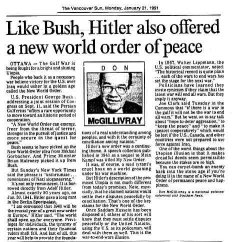
Transcribed from archived image file.
Ottawa - The Gulf War is being fought for a bright and shining Utopia.
People who back it as a necessary war believe victory for the U.S. over Iraq would usher in a golden age called the New world Order.
U.S. President George Bush, addressing a joint session of Congress on Sept. 11, said the Persian Gulf crisis "offers a rare opportunity to move toward an historic period of cooperation.
"A New World Order can emerge freer from the threat of terror, stronger in the pursuit of justice and more secure in the quest for peace."
Bush seems to have picked up the New world Order idea from Mikhail Gorbachev. And Prime Minister Brian Mulroney picked it up from Bush.
But Sunday's New York Times said the phrase is "unfortunate... reminiscent of Nazi sloganeering."
It's not only reminiscent, it is borrowed directly from Adolf Hitler.
Almost exactly 50 years ago, on Jan. 30, 1941, Hitler gave a long rant in the Berlin Sportpalast.
"I'm convinced that 1941 will be the crucial year of a Great New Order in Europe," Hitler said. "The World shall open up for everyone. Privileges for individuals, the tyranny of certain nations and their financial rulers shall fall. And last of all, this year will help to provide the foundations of a real understanding among peoples, and with it the certainty of conciliation among nations."
Hitler's New Order was a continuing theme. A speech collection published in 1941 as a sequel to Mein Kampf was titled "My New Order."
It was, of course, a mad tyrant's cruel hoax on a world groaning under his war machine.
But Hitler's description of the promised Utopia is not much different from today's promises. Note, especially, that he claimed nations would settle their disputes peacefully by conciliation. That's one of the key claims for the New World Order.
Once Saddam Hussein has been disposed of, others of his sort will know that they must settle disputes peacefully, or the United Nations, using the US as its policeman, will deal with them as well. This is the war-to-end-wars illusion.
In 1967, Walter Lippmann, the US political commentator, noted: "The historical record is quite plain... each of the wars to end wars has set the stage for the next war."
Politicians have learned they invite cynicism if they claim that the latest war will end all wars. But they imply it anyway.
Joe Clark said Tuesday in the Commons that "if there is a war in the Gulf it will not be the war to end all wars." But he went on to talk about "hope to deter aggression," to "keep the peace," and "to make it (peace) cooperatively" which would be lost if the US, Canada, and other countries were not prepared to use force against Iraq.
One of the worst things about the Utopian illusion is that it makes dreadful deeds seem permissible because the stakes are so high
You can carpet bomb an enemy back into the Stone Age if you're doing it in the name of a New World Order of permanent peace and happiness.
Why is this?
If you lived in Nazi Germany, do you really think that you would have been able to see past the patriot propaganda and the host of economic and social manipulations to which the German people were subjected?
Why is it that Americans today seem to credit themselves with the ability to recognise a massive government lie when just 70 years ago the German people, and indeed much of the population of the rest of the world, were unable to do so?
With the vast increase in the scope and range of mass media communication in the later half of the 20th century, today it would be much easier for a government to deceive the people en masse than it was back in the 1930's.
People give lip service to the maxim that "those who do not learn from history are doomed to repeat it", but it appears that they do not take that concept seriously. Why is this?
Hitler and the Nazis showed us all how it was done. They showed the world that through the slow propagation of the "big lie", through diversion and promotion of bogus threats to the lives of the citizenry, an entire people can be completely and unconditionally deceived.
Consider the following text from the "Third Reich Roundtable" website:
"The dictatorship, and the whole process of its coming into being, was above all diverting. It provided an excuse not to think for people who did not want to think anyway.Today, the government controls every aspect of the life of the average citizen, whether they know it or not. From the food we put in our mouths to the thoughts we think, there is no facet of life that does not have a government agency assigned to monitor it. This is natural, but is also the crux of the matter.
Nazism gave us some dreadful, fundamental things to think about - we were decent people - and kept us so busy with continuous changes and "crises" and so fascinated, yes, fascinated, by the machinations of the "national enemies", without and within, that we had no time to think about these dreadful things that were growing, little by little, all around us. Unconsciously, I suppose, we were grateful. Who wants to think?
Each step was so small, so inconsequential, so well explained or, on occasion, "regretted," that, unless one were detached from the whole process from the beginning, unless one understood what the whole thing was in principle, what all these "little measures" that no "patriotic German" could resent must some day lead to, one no more saw it developing from day to day than a farmer in his field sees the corn growing. One day it is over his head.
In the case that a government decided to deceive the population in a wholesale manner, is it really reasonable to be so smug as to assume that we would immediately and easily recognise such a deception? Many of our readers, and most Americans seem to think so.
We are not suggesting that it is impossible for a person to know if their government is lying to them, but if we expect to ever know the truth, we must stop blindly accepting everything that we are told, or fleeing into denial at the first sign that our comfort zone might be disturbed. Objective research and analysis is required, there can be no 'sacred cows', nothing can be taboo, all evidence must be weighed up impartially and given its due without pity for ourselves, others, or our illusions.
But among all the resources available to us in this task, one of the most important is history. By scrutinizing the events that make up our world history, we may arm ourselves with the knowledge derived from the hard-won lessons of those that have gone before us. In that respect and in relation to the current US and global, political and social climate, the experiences of the German people under the Nazis contain some crucially important lessons for us to learn. It behooves us all to learn them, before it is too late - again.
"Once the war began, the government could do anything "necessary" to win it; so it was with the "final solution" of the Jewish problem, which the Nazis always talked about but never dared undertake, not even the Nazis, until war and its "necessities" gave them the knowledge that they could get away with it.








...to having the similarities of Hitler-Bush pointed out to them. Beyond simply not being able to see these things for themselves, some people react very negatively when points along these lines are made. A common psycho-defense I have encountered is basically is that it is rude or socially acceptable to bring it up. People have commented to me how tired they are of hearing stuff like that.