
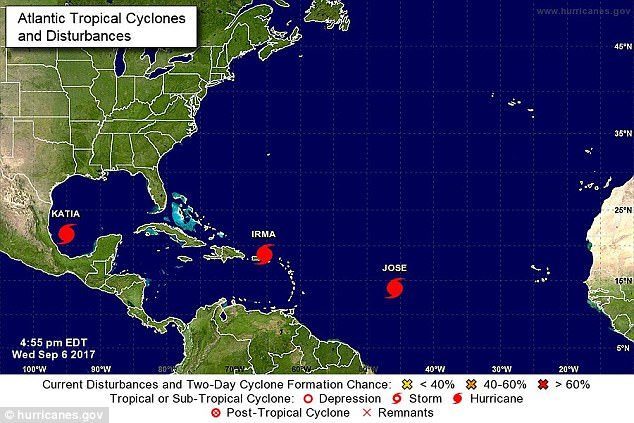
© hurricanes.govTropical storm Katia strengthened into a hurricane off the Mexican coast on Wednesday - marking the first time since 2010 there has been a trio of hurricanes around the Atlantic region.
Winds of up to 75 miles per hour are expected
A third hurricane is set to threaten the US in the space of six days.
Katia, a storm off the Mexican coast, has strengthened into a hurricane, the US National Hurricane Center (NHC) said.
It is 185 miles (295 km) east of Tampico, Mexico, and has maximum sustained winds of 75 miles per hour (120 kph).
In the next 48 hours some additional strengthening is also forecast, the NHC added.
Models so far show it remaining in the southern Gulf in the coming days.
The news comes as tropical storm Jose was upgraded to a hurricane in the Atlantic, far east of Hurricane Irma, which is currently heading towards Florida.
Jose had been expected to become a hurricane and was following Irma in a path towards the Caribbean.
It is too early to determine if Jose might ultimately make landfall in the Caribbean, or in the Americas, as weather projections are difficult when storms are so far out.
Hurricane Irma on the other hand has been setting records with sustained wind speeds of 185 miles per hour for more than 24 hours. In doing so became the only Atlantic hurricane to sustain that powerful wind speed for so long.
Irma has clobbered hit islands with pounding winds, rain and surging surf and officials in Florida have called for evacuations ahead of the storm's expected landfall there.




Comment: While climate scientists are now saying Harvey "should serve as a warning", they are not considering the importance of atmospheric dust loading and the winning Electric Universe model in their research. Such information and much more, are explained in the book Earth Changes and the Human Cosmic Connection by Pierre Lescaudron and Laura Knight-Jadczyk. Increasing cometary and volcanic dust loading of the atmosphere (one indicator is the intensification of noctilucent clouds we are witnessing) is accentuating electric charge build-up, whereby we can expect to observe more extreme weather and planetary upheaval as well as awesome light shows and other related mysterious phenomena.
See also: Study: Tornado outbreaks are increasing - but scientists don't understand why. A coauthor of this paper states "What's pushing this rise in extreme outbreaks is far from obvious in the present state of climate science."