
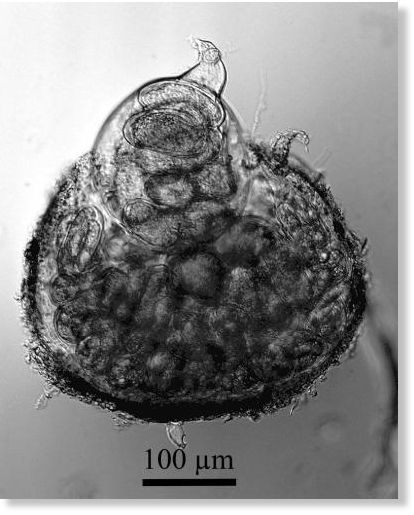
© Samad Ashrafi This image is of a Meloidoderita salina female with surrounding gelatinous matrix, both filled with eggs.
The female nematode worm of Meloidoderita salina deposits its eggs in two different structures. One of them is called egg mass which is an external gelatinous matrix, the other one is a cystoid, which is a swollen uterus containing some eggs. Cystoid are harder and stronger than gelatinous matrix. On the surface of the cystoids of Meloidoderita salina, nematologists observed a specific and unique hexagonal beaded pattern.
"This discovery is probably the first observation of a real hexagonal pattern in the group of nematode worms so far, and further research is needed to find out its unknown origin", said Prof. Dr. Gerrit Karssen, one of the senior members of the team.
A tidal salt marsh, a transition zone between land and water, is a highly divers ecosystem. In MSMB, where this new nematode species was found, a large part of its area are tidal salt marshes in which a high number of ecological studies were done, although nematode worms have been mostly neglected.
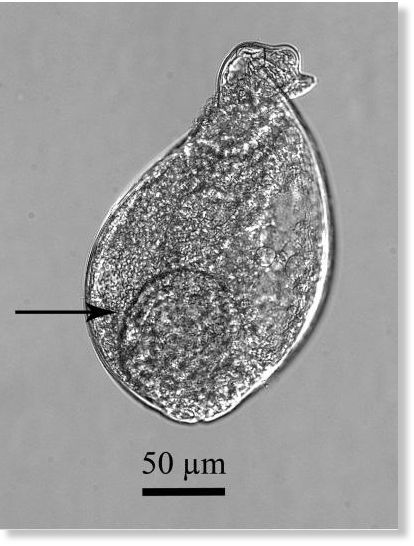
© Samad AshrafiThis image shows a young Meloidoderita salina female with a developing uterus (arrow).
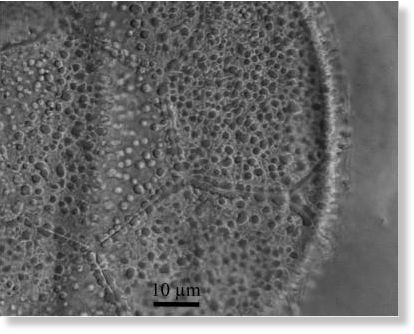
© Samad AshrafiThis image shows the hexagonal beaded pattern, observed on the surface of cystoids of Meloidoderita salina.
The nematologists who described this nematode worm predict it is likely to find Meloidoderita salina on other halophytic plants, grown in similar salt marsh areas.
Original Source
Ashrafi S, Mugniéry D, van Heese EYJ, van Aelst AC, Helder J, Karssen G (2012) Description of Meloidoderita salina sp. n. (Nematoda, Sphaeronematidae) from a micro-tidal salt marsh at Mont-Saint-Michel Bay in France. ZooKeys 249: 1 - 26. doi:10.3897/zookeys.249.4138
About ZooKeys
ZooKeys is a peer-reviewed, open-access journal launched to support free exchange of ideas and information in biodiversity science, issued by Pensoft Publishers. All papers published in ZooKeys can be freely copied, downloaded, printed and distributed at no charge for the reader. ZooKeys implemented several cutting-edge innovation in publishing and dissemination of science information and is considered a technological leader in its field.



No Surprises & Finding Nemo-Toad!
First, such natural patterns are common throughout nature. Non biological examples abound: The circle - 2 dimensions, - e.g., a rainbow would be if it wasn't cut off by the ground; or, in three dimensions, ther first and most obvious would be a sphere. . Cylinders are common too, in the shape of a tree trunk or in its internal piping mechanisms.
Also, there's plenty of hexagonal crystals, (halite?) -which is based at a molecular level rather than cellular level. Biological examples of tendencies towards such types of organization are also commong - e.g. hesagons are common. Think of a construction site where a bunch of plastic pipes have been stacked over time. Their plasticity will naturally result in a "honeycomb shape" - (a honeycomb being itself another eample).
& Next: "Finding Nemo-Toad,"
Originally, Finding Nemo was going to be called Finding Nemo-Toad. It was originally going to be the story of a suicidal attempt to catch up with a nematode threatening the life of a heroic toad named Nemo. (Bad, weak, joke. Sorry.)
But Wait! There's also a new documentary about the failings of AmeriKa's "Emergency Services department," and itheir failing to do their jobs after Katrina and Sandy. It will focus on your typically surly, groping DHS employees. It will be called...
FEMA-Toads!
Whatever. Sorry.
R.C.