Science & Technology
Anton Wylie
The Register
Sun, 18 Nov 2007 19:56 CST
But what's a Comet, anyway?
|
| ©REUTERS/NASA, ESA, and H. Weaver/The Johns Hopkins University Applied Physics Laboratory/Handout
|
| A Hubble image (R), taken November 4, 2007, shows the heart of Comet 17P/Holmes. The central portion of the image has been specially processed to highlight variations in the dust distribution near the nucleus. About twice as much dust lies along the east-west direction (the horizontal direction) as along the north-south direction (the vertical direction), giving the comet a "bow tie" appearance. The composite color image at left, taken on November 1, 2007, by an amateur astronomer shows the complex structure of the entire coma, consisting of concentric shells of dust and a faint tail emanating from the comet's right side. The normally sedate Comet Holmes made a bright splash in the sky about two weeks ago, unexpectedly becoming a million times brighter than normal overnight and causing a stir among astronomers.
|
Katharine Sanderson
Nature
Mon, 19 Nov 2007 17:49 CST
|
| ©NASA/ Aurore Simonnet, Sonoma State University
|
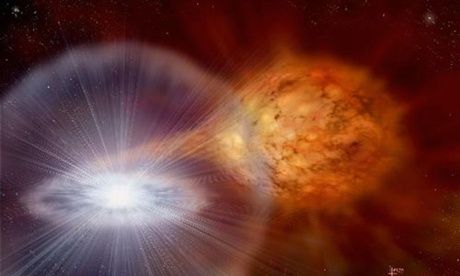
| The source of high-energy rays, or not?
|
High-energy cosmic rays might not be from active galactic nuclei after all.
The origin of ultra-high-energy cosmic rays is one of the great mysteries of cosmology. Last week a team reported that they thought they had tracked down the source. But the first check on that answer, by another team with different data, has failed to support it.
NASA/Goddard Space Flight Center
Thu, 01 Aug 2002 14:54 CDT
Satellite data since 1998 indicates the bulge in the Earth's gravity field at the equator is growing, and scientists think that the ocean may hold the answer to the mystery of how the changes in the trend of Earth's gravity are occurring.
Before 1998, Earth's equatorial bulge in the gravity field was getting smaller because of the post-glacial rebound, or PGR, that occurred as a result of the melting of the ice sheets after the last Ice Age. When the ice sheets melted, land that was underneath the ice started rising. As the ground rebounded in this fashion, the gravity field changed.
"The Earth behaved much like putting your finger into a sponge ball and watching it slowly bounce back," said Christopher Cox, a research scientist supporting the Space Geodesy Branch at NASA's Goddard Space Flight Center, Greenbelt, Md.
University of Exeter
Mon, 19 Nov 2007 14:19 CST
The flood believed to be behind the Noah's Ark myth kick-started European agriculture, according to new research by the Universities of Exeter and Wollongong, Australia. Published in the journal Quaternary Science Reviews, the research paper assesses the impact of the collapse of the North American (Laurentide) Ice Sheet, 8000 years ago. The results indicate a catastrophic rise in global sea level led to the flooding of the Black Sea and drove dramatic social change across Europe. The research team argues that, in the face of rising sea levels driven by contemporary climate change, we can learn important lessons from the past.
University of Texas at Austin
Mon, 19 Nov 2007 13:50 CST
Research announced this week by a team of U.S. and Japanese geoscientists may help explain why part of the seafloor near the southwest coast of Japan is particularly good at generating devastating tsunamis, such as the 1944 Tonankai event, which killed at least 1,200 people. The findings will help scientists assess the risk of giant tsunamis in other regions of the world.
Geoscientists from The University of Texas at Austin and colleagues used a commercial ship to collect three-dimensional seismic data that reveals the structure of Earth's crust below a region of the Pacific seafloor known as the Nankai Trough. The resulting images are akin to ultrasounds of the human body.
The results, published this week in the journal Science, address a long standing mystery as to why earthquakes below some parts of the seafloor trigger large tsunamis while earthquakes in other regions do not.
Science Daily
Mon, 19 Nov 2007 00:00 CST
Astronomers are searching for gravitational waves in space, a feat that would literally change what we know about the cosmos. Using new tools to look at the universe, says Patrick Brady, often has led to discoveries that change the course of science. History is full of examples.
|
| ©LIGO Laboratory
|
| Aerial view of the The Laser Interferometer Gravitational-wave Observatory in Hanford, WA, USA.
|
terradaily.com
Sun, 18 Nov 2007 23:37 CST
Geoscientists are beginning to unravel the complex web of interactions among climate change and geological processes that alters coastlines on which a sizeable percentage of Earth's inhabitants live. As debates over sustainable coastal development heat up, a new publication from the Geological Society of America focuses on development of integrated predictive computer models of coastal change.
Coastline Changes: Interrelation of Climate and Geological Processes reflects the many forces at work in coastal change. They include sea-level rise due to melting glaciers, depletion of groundwater reservoirs, and thermal expansion of gradually warming ocean water. Some of the underlying contributing factors include greenhouse gas additions to the atmosphere, vertical tectonic motions, sedimentary processes, and changes in atmospheric pressure systems and ocean currents, waves, and tides.
marsdaily.com
Sun, 18 Nov 2007 23:12 CST
With ESA's Mars Express, scientists continue to gain new insight into the mysterious Martian environment. Some of the most exciting results are being sent back by the MARSIS (Mars Advanced Radar for Subsurface and Ionospheric Sounding) experiment. MARSIS transmits low frequency radio waves towards the planet's surface and records the echoes of the different layers.
Although Mars is sometimes described as the most Earth-like of all the planets, there are many differences between the two worlds which scientists are trying to understand. One of the less familiar aspects of both planets is that they possess an ionosphere - a layer of ionised (electrically charged) particles - in their upper atmospheres.
|
| ©unknown
|
| After some two years of operation, an international team of scientists has been able to analyse more than 750 000 echoes from MARSIS in order to make the first direct measurement of the global distribution of electrons in the Martian ionosphere - or the total electron content (TEC).
|
New Scientist
Wed, 24 Feb 1999 15:14 CST
A chunk of rock some 50 metres across has been found circling the Sun in an orbit close to Earth's. The object, which was discovered on 10 February by an automated asteroid-hunting telescope in New Mexico called Linear, is probably a chip off the Moon, say astronomers.
After six nights of observations, Gareth Williams of the Harvard-Smithsonian Center for Astrophysics in Cambridge, Massachusetts, calculated that it circles the Sun every 1.09 years. Its nearly circular orbit is just nine million kilometres farther from the Sun than the Earth's.
Georgia Institute of Technology
Sun, 18 Nov 2007 14:50 CST
Honeybees somehow manage to efficiently collect a lot of nectar with limited resources and no central command - after all, the queen bee is too busy laying eggs to oversee something as mundane as where the best nectar can be found on any given morning. According to new research from the Georgia Institute of Technology, the swarm intelligence of these amazingly organized bees can also be used to improve the efficiency of Internet servers faced with similar challenges.
|
| ©Georgia Institute of Technology
|
| Honeybees maximize efficiency with dance communication. Click on image for larger version.
|
Comment: Enjoy our latest Forum's Topic:
Speculations about the Comet 17P/Holmes