
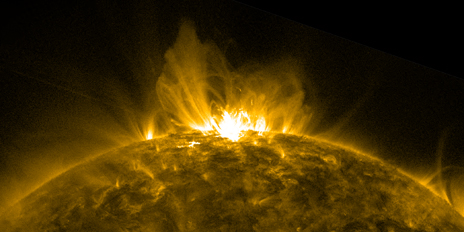
© Credit: Nasa/SDOThis solar flare was shot with one of the cameras on the NASA SDO satellite on 10 June 2014.
The shorter the interval between two explosions in the solar atmosphere, the more likely it is that the second flare will be stronger than the first one. ETH Professor Hans Jürgen Herrmann and his team have been able to demonstrate this, using model calculations. The amount of energy released in solar flares is truly enormous - in fact, it is millions of times greater than the energy produced in volcanic eruptions. Strong explosions cause a discharge of mass from the outer part of the solar atmosphere, the corona. If a coronal mass ejection hits the earth, it can cause a geomagnetic storm. Heavy storms can disrupt satellites, radio traffic and electrical plants. When in autumn 2003 one of the strongest solar eruptions in history was registered, there was a power failure in southern Sweden and air traffic had to be redirected as communications above the Polar Regions broke down.
ETH scientists have examined the processes that take place when explosions occur on the Sun's surface. They were able to accurately reconstruct the statistical size distribution and temporal succession of the solar flares with a computer model. "The agreement with measurements from satellites is striking", state the researchers in the scientific journal Nature Communications. Hans Herrmann, Professor at the Institute for Building Materials, reveals that the Sun was not actually his subject of focus at all. The theoretical physicist and expert in computer physics has developed a method to examine phenomena from a range of diverse fields. Similar patterns to those in solar flares can also be found in earthquakes, avalanches or the stock market.




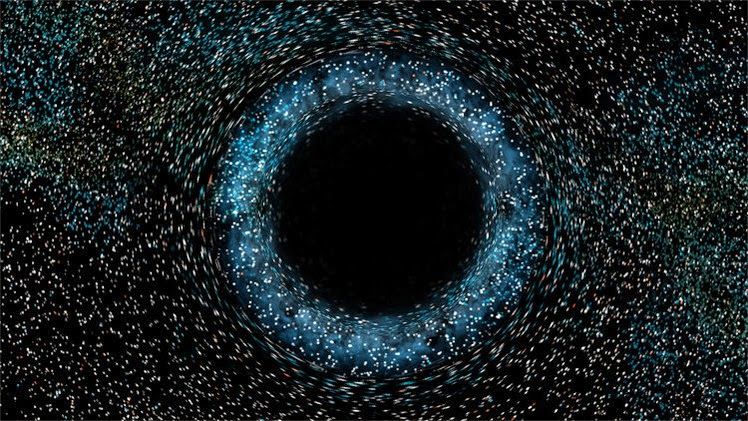
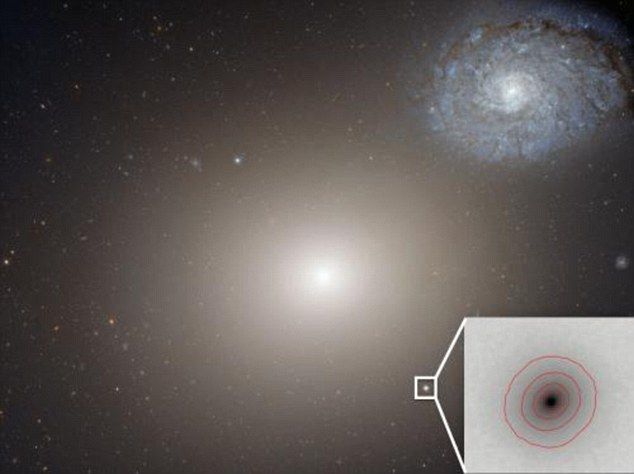

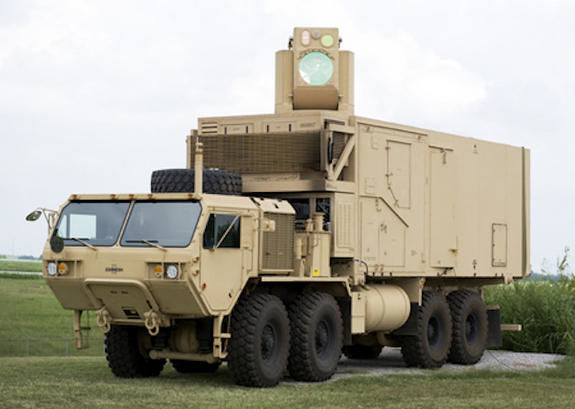







Comment: The astronomers used adaptive optics technology to study the galaxy and its massive black hole. Using data from NASA's Hubble Space Telescope along with the Gemini North 8-meter optical and infrared telescope on Hawaii's Mauna Kea, they captured the dwarf galaxy and the black hole's mass. Normally, images from telescopes on the ground are blurred out by the 'twinkling' of the stars caused by the refraction of light in the atmosphere. With adaptive optics, a flexible mirror is used to undo the affects of the atmosphere and get a sharper image. Since there were no bright stars next to M60-UCD1, the team used a laser to create their own "fake" stars in the upper atmosphere to use for the adaptive optics process. This allowed them to study the motions of the stars at many points within the very small object. By observing the motions of the stars at the center of the ultra-compact dwarf compared to in its outskirts, they were able to separately weigh the stars in the galaxy and the black hole.