
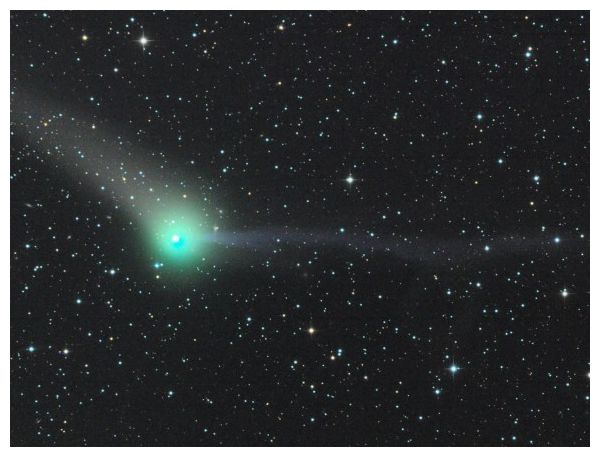
© Rolando LigustriComet C/2012 K1 PanSTARRS photographed on September 26, 2014. Two tails are seen – a dust tail points off to the left and the gas or ion tail to the right.
This new visitor from the Oort Cloud making its first passage through the inner solar system, C/2012 K1 was discovered in May 2012 by the Pan-STARRS 1 survey telescope atop Mt. Haleakala in Hawaii at magnitude 19.7. Faint! On its the inbound journey from the Oort Cloud, C/2012 K1 approached with an orbit estimated in the millions of years. Perturbed by its interactions with the planets, its new orbit has been reduced to a mere ~400,000 years. That makes the many observing opportunities PanSTARRS K1 has provided that much more appreciated. No one alive now will ever see the comet again once this performance is over.


















Comment: See also: Peer review: the myth of the noble scientist