
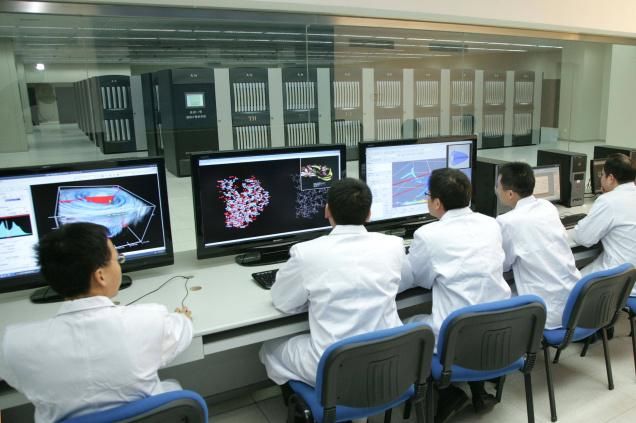
© Xinhua Operators check China's fastest super computer "Tianhe" meaning Milky way in Changsha on Oct. 29
According to the New York Times, the Tianhe-1A performs 2.5 petaflops, with a "flop" equaling 10^15 floating point mathematical calculations. Chinese scientists assembled the Tianhe-1A from American-made chips from companies like Intel and Nvidia, but networked those chips into a single computer with proprietary software.
Although the scientists assembled the computer under a joint Ministry of Education/Ministry of National Defense program, the exact use of the Tianhe-1A remains a mystery. Many supercomputers are used to solve complex problems relating to physics, economics or defense, while others are used in business applications.
Currently, a number of US institutions are working on assembling even faster systems, but due to the time and complexity involved in making the fastest machine known to man, the Tianhe-1A will get to retain its title for at least the next few years.



Reader Comments
to our Newsletter