
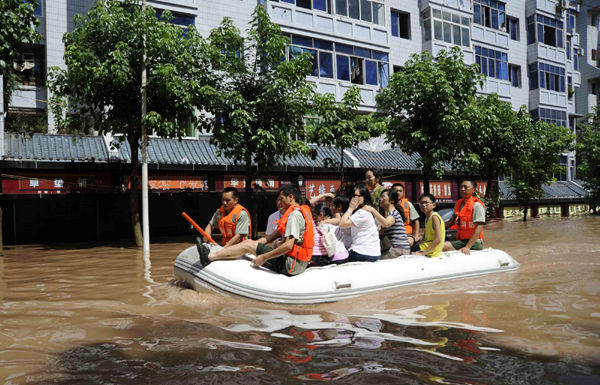
© XinhuaSoldiers transfer people trapped by flood water on a rubber boat in Guang'an, Southwest China's Sichuan Province on July 19, 2010.
At least 347 people are missing, Liu Ning told reporters in Beijing on Wednesday.
Ninety-percent of the casualties were caused by mountain floods, mudslides and landslides triggered by heavy downpours. About 645,500 houses had collapsed, he said.
More than 230 rivers were above warning levels; 25 of them saw their highest levels ever, he said.
More than 100 cities flooded, he said.
Liu cited torrential downpours between June 13 and June 27, and heavy rain on July 8 in southern China as particularly damaging.
"In southern China, the rainfall is 30 to 100 percent higher than the historical average," he said.
The Three Gorges Dam saw its biggest peak runoff and the rains resulted in "various disasters hitting many regions," he said.
The floods have affected 117 million people in 27 provinces and seven cities.

© XinhuaAn aerial photo taken on July 19, 2010 shows the flood-stricken Guang'an, Southwest China's Sichuan province. The most severe flood since 1847 hit the city, with more than 250,000 people affected.
He estimated the cost at 142.2 billion yuan, or $21 billion.
Meteorologists have predicted six to eight typhoons will hit China this year, bringing further flooding.
Many problems were discovered in the small reservoirs.
"There are many weak links. We need to reinforce many medium-size and small dams," Liu said.
But, he added, repairs made since the floods of 1998 have improved the country's capacity to deal with flooding.



Reader Comments
to our Newsletter