
Scientists are starting to recognise that the evolution of life on Earth has been affected, if not largely shaped, by its celestial environment. We now recognise that throughout its history the Earth has been bombarded by comets, small asteroids, meteorites (small rocky or iron bodies) and smaller particle and dust (meteor) showers. Over the years, astronomers have detected a substantial population of such small bodies out there in the Solar System, confirming that the threat of their impact with the Earth is a significant one. Current estimates, for example, suggest that between 10 and 30 impacts similar to the one that occurred in Tunguska in Siberia in 1908 have happened over recorded history, with perhaps one or more exploding with a force equivalent to that produced by 500 to 1000 megatonnes of TNT.
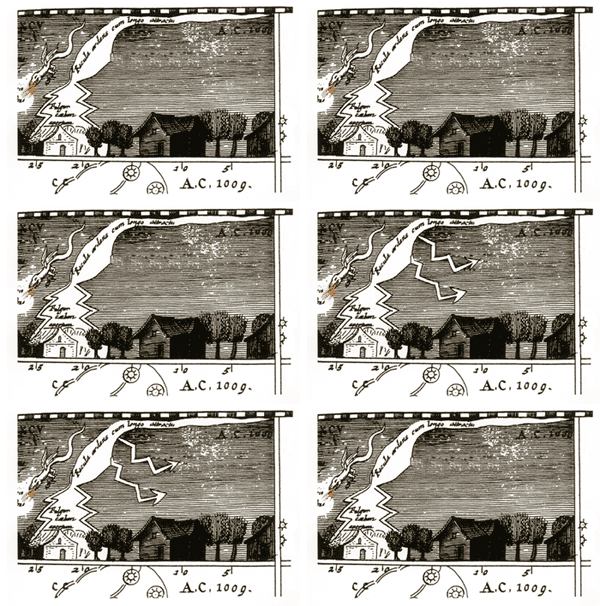
|
| ©Frontiers |
| A mediæval representation of a meteorite fall as a serpent in the sky |
The potential hazards vary in size - from asteroids less than a kilometre wide to comets several hundred kilometres across. There is no known upper limit to the size of comets. In assessing current and near-future risks, we must therefore pay attention to the rare, giant comets that enter short-period, Earth-crossing orbits on timescales of 100,000 years. Such comets, which are made of a mixture of ice and dust, disintegrate as they approach the Sun. As they do, they generate a dense swarm of meteors which may include short-lived concentrations of dust along with streams of sub-kilometre bodies. These concentrations spread out along the orbit of the comet and are generally invisible except when the Earth intercepts the track and the particles manifest themselves as shooting stars. With the Infrared Astronomical Satellite IRAS, however, which operated in the 1980s, such trails of material were also detected in the infrared, one of them following Comet Encke - a short-period comet (orbital period 3.3 years) first observed in 1786.
If a giant comet were thrown into a short-period, Earth-crossing orbit, its disintegration under the effect of sunlight would release a copious amount of dust into the inner planetary system. Ploughing through such dust, the Earth would acquire a reflective blanket and cool by up to about 5 degrees, possibly sliding into a new ice age. Even after this phase, brief, sharp climatic coolings would be expected during epochs when the Earth passed annually through the comet's meteor stream. Precession of the cometary orbit, analogous to the slow wobble of a spinning top, is guaranteed to lead to epochs when the orbits of Earth and comet intersect. Passing through the 'IRAS trail', annual meteor storms of huge intensity would then be expected, with a correspondingly enhanced risk of a Tunguska-like impact, perhaps concentrated into brief but devastating swarms.

|
| ©Frontiers |
| Fifth-century celestial serpents These represent the conflict between Zeus and Typhon. The winged-serpent motif, which was widespread throughout antiquity, may have its origins in cometary activity |
In fact, a number of entities in the inner part of the Solar System, such as the Taurid meteor stream seen in November - the bulk of meteor dust responsible for the so-called zodiacal light and Comet Encke itself (associated with the Taurids) - are thought to be the remnants of a very large comet. It seems that this object was actively disintegrating as recently as 5000 years ago, although it may be very much older. The night sky at that time, and probably for some millennia after, would have looked very disturbed, lit up by a bright zodiacal light, with recurring cometary fragments drifting through the constellations, and with a brilliant firework display recurring annually in the form of the associated meteor storm.
Evidence for a giant comet
Is there any evidence for this giant comet in the terrestrial record? One of the most puzzling and widespread features of early societies is their preoccupation with the sky. People have assumed that this was driven by the need for a calendar for both agricultural and ritual purposes. However, this explanation does not account for the doom-laden nature of much cosmic iconography and early sky-centred cosmic religions associated with these societies. For example, some of them involve celestial combat myths in which winged serpents battle it out in the sky before one or other crashes to Earth. Numerous prophecies of doom, from Zoroaster to the Book of Revelation, clearly show celestial impact motifs: the Persian prophet Zoroaster (c. 500 BC) predicts a world-end in which "Ahriman (Satan) will make a comet strike the Earth causing a huge conflagration"; the Book of Revelation describes a huge burning mountain falling from the sky, dropping hail and fire on the Earth, while the Sun and Moon are darkened by smoke pouring from the abyss; Sodom and Gomorrah were destroyed by a rain of fire from Heaven, and so on. Cometary as well as meteor motifs are also found in these myths (for example, Revelation has a huge, red, multiple-headed dragon in the sky) and were recognised as such by ancient writers.
Other hints of an interest extending beyond the practical need for a calendar are to be found in the omen astrology of the Babylonians, which was largely fireball-based (a fireball is an extremely bright meteor), and in the widespread occurrence of icons apparently depicting comets, such as the omega symbol found throughout the Near East. The ancient swastika may be another such - for example, it explicitly represents a cometary type in a Chinese classification scheme depicted in a Han dynasty tomb dated 168 BC. This symbol is of great antiquity, going back to at least 1400 BC, and is found from China through India to the New World.
|
| ©Frontiers |
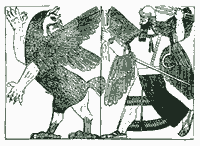
| The Marduk-Tiamat conflict from Babylonian mythology, dated around 1400 BC. Tiamat, representing primaeval chaos, gives birth to giant snakes, a horned serpent, assorted dragons and the like in preparation for a war with Marduk and his host. In the battle Tiamat is distended and splits in two. Marduk, victorious, constructs the heavens from her skin, creates constellations for the gods and regulates the year. The deity goes back to the third millennium BC |
Unless these speculations are backed up by 'hard evidence', however, cosmic interpretations of history are likely to remain controversial. Such evidence may be slowly emerging. Tree-ring studies of Irish oaks, made by Mike Baillie of Queen's University, Belfast, reveal that there was an abrupt climatic downturn around 2354 - 2345 BC. Digs carried out by the archaeologists, Courty and Weiss at Tell Leilan in Northern Syria, have revealed that, also around the same time, a catastrophic environmental event took place. Their detailed analysis reveals evidence not only of widespread destruction, but more specifically the disintegration of mud-brick constructions by 'a blast from the sky'. Around this time also, there was a near-simultaneous collapse of Bronze Age civilisations, and evidence from many other sources of widespread environmental disturbance in the late third millennium BC; but the dating of the latter events is poor, and whether we can see in them a cosmic disturbance of the Comet Encke kind is still uncertain.
The concept that an asteroid killed the dinosaurs has seeped into popular culture over the past 15 years or so. Recently, the question: "Could it happen to us?," has also become a matter of increasing public interest. Within the past year, a spate of popular books and movies has drawn attention to the issue: it seems that the perception of 'humanity at risk from the sky' is destined to become a part of current culture. The responsibility of the scientist concerned with the celestial hazards is, of course, to assess them as realistically as possible. In making this assessment, it seems that useful information may be obtainable from a well-informed study of our early history.
Bill Napier is an astronomer at the Armagh Observatory in Northern Ireland.
E-mail: wmn@star.arm.ac.uk



Reader Comments
to our Newsletter