
|
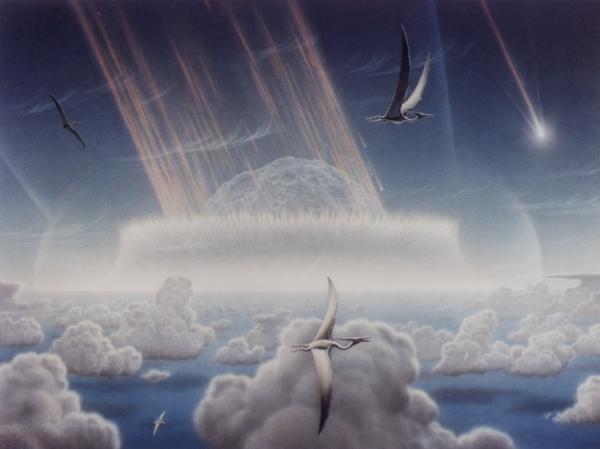
| ©Artby Don Davis / Courtesy of NASA |
| A large body of scientific evidence now exists that support the hypothesis that a major asteroid or comet impact occurred in the Caribbean region at the boundary of the Cretaceous and Tertiary periods in Earth's geologic history. Such an impact is suspected to be responsible for the mass extinction of many floral and faunal species, including the large dinosaurs, that marked the end of the Cretaceous period. |
Scientists at the Cardiff Centre for Astrobiology built a computer model of our solar system's movement and found that it "bounces" up and down through the plane of the galaxy. As we pass through the densest part of the plane, gravitational forces from the surrounding giant gas and dust clouds dislodge comets from their paths. The comets plunge into the solar system, some of them colliding with the earth.
The Cardiff team found that we pass through the galactic plane every 35 to 40 million years, increasing the chances of a comet collision tenfold. Evidence from craters on Earth also suggests we suffer more collisions approximately 36 million years. Professor William Napier, of the Cardiff Centre for Astrobiology, said: "It's a beautiful match between what we see on the ground and what is expected from the galactic record."
The periods of comet bombardment also coincide with mass extinctions, such as that of the dinosaurs 65 million years ago. Our present position in the galaxy suggests we are now very close to another such period.
While the "bounce" effect may have been bad news for dinosaurs, it may also have helped life to spread. The scientists suggest the impact may have thrown debris containing micro-organisms out into space and across the universe.
Centre director Professor Chandra Wickramasinghe said: "This is a seminal paper which places the comet-life interaction on a firm basis, and shows a mechanism by which life can be dispersed on a galactic scale."
The paper, by Professor Napier and Dr Janaki Wickramasinghe, is to be published in the Monthly Notices of the Royal Astronomical Society.
Adapted from materials provided by Cardiff University, via EurekAlert!, a service of AAAS.



Victor Clube has been saying this for years now...