
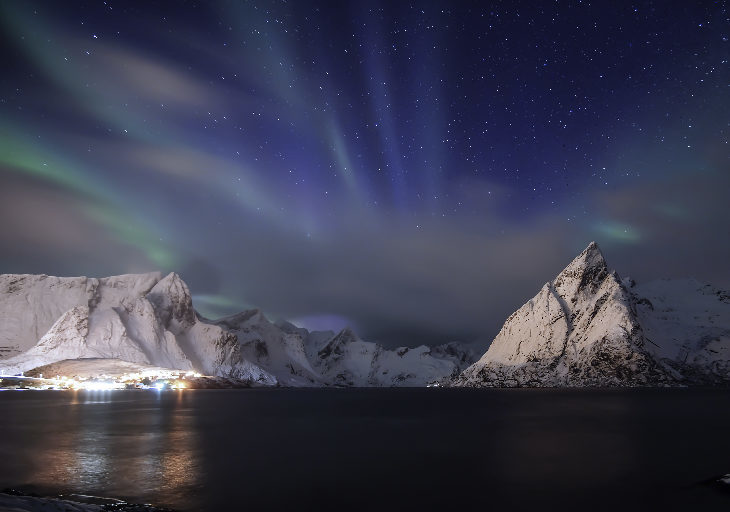
© Taken by Matthew Steinberg on February 18, 2020 @ Reine, Lofoten Islands NorwayAfter snow, sleet, and heavy wind all day, the clouds parted for a 2 hour display of spectacular pale green, blue, and purple auroras over the mountains of Reine.
"After snow, sleet, and heavy wind all day, the clouds parted for a 2 hour display of spectacular pale green, blue, and purple auroras over the mountains of Reine," says photographer Matthew Steinberg.
Blue auroras are rare. Auroras are usually green, and sometimes red. Those are the colors produced by oxygen when it is excited by electrons raining down from space. Blue is a sign of nitrogen. Energetic particles striking ionized molecular nitrogen (N2+) at very high altitudes (> 400 km) produces a cold azure glow of the type captured in Steinberg's photo. Usually the blue is faint, but on Feb. 18th it was strangely intense.

© Taken by Matthew Steinberg on February 18, 2020 @ Reine, Lofoten Islands Norway
"I couldn't believe my eyes," says photographer Markus Varik, a longtime aurora tour guide who previously thought he had seen it all. "This strange rippling band formation unfolded overhead. It was so different than the usual aurora arcs. Truly magic! Let's hope for some more strange shapes tomorrow!"
Indeed, it could happen. A G1-class geomagnetic storm is underway, and more Arctic auroras are in the offing.
Stay tuned. Aurora alerts: SMS Text.





Comment: Just a day before this Space Weather reported that, although there were no sunspots, no solar flares and no gusts of solar wind, there was the surprising appearance of an aurora display which was also attributed to this 'crack' in Earth's magnetic field:
- "The Dunes": NEW type of aurora discovered, and the unexpected physics behind it
- Brocken spectre: Rare weather phenomenon captured on film by walker in Wales
- Mysterious "cloud rosettes" only visible from space captured by NASA off coast of western Australia
- Weird 'electrical surge' detected running through ground in northern Norway - Auroras follow
- Stunning iridescent clouds snapped above skies of Siberia's Belukha mountain
- Strange but beautiful skies: Noctilucent 'tornado' cloud, auroras, double and twin rainbow plus a midnight rainbow
Also check out SOTT radio's: