
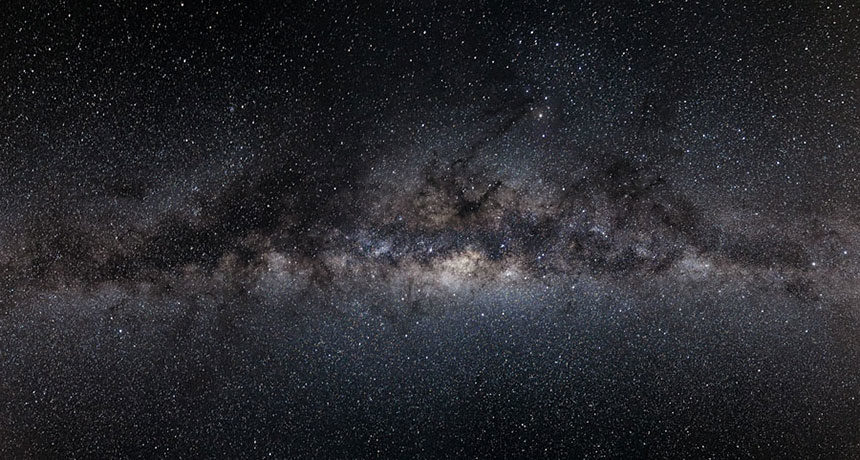
© John Colosimo (colosimophotography.com)/ESOThe center of the Milky Way, shown in this photograph from the Paranal Observatory in Chile, may be swarming with thousands of small black holes.
Astrophysicist Charles Hailey of Columbia University and his colleagues spotted the black holes thanks to the holes' interactions with stars slowly spiraling inward, the team reports in Nature on April 4. Isolated black holes emit no light, but black holes stealing material from orbiting stars will heat that material until it emits X-rays.
In 12 years of telescope data from NASA's orbiting Chandra X-ray Observatory, Hailey and colleagues found 12 objects emitting the right X-ray energy to be black holes with stellar companions. Based on theoretical predictions of how many black holes are paired with stars, there should be up to 20,000 invisible solo black holes just in that small part of the galaxy.
Hide and seek
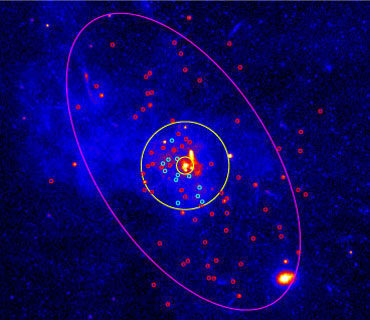
Scientists used the Chandra X-ray telescope to seek black holes (circled in blue) in the inner 3.26 light-years of the Milky Way (circled in yellow). The small red circles denote other objects that emit X-rays, like neutron stars or white dwarfs, that are found scattered around more of the galaxy.
Hide and seek
Scientists used the Chandra X-ray telescope to seek black holes (circled in blue) in the inner 3.26 light-years of the Milky Way (circled in yellow). The small red circles denote other objects that emit X-rays, like neutron stars or white dwarfs, that are found scattered around more of the galaxy.
Scientists used the Chandra X-ray telescope to seek black holes (circled in blue) in the inner 3.26 light-years of the Milky Way (circled in yellow). The small red circles denote other objects that emit X-rays, like neutron stars or white dwarfs, that are found scattered around more of the galaxy.
"It was always kind of a mystery," Hailey says. "If there's so many that are supposed to be jammed into the central parsec [about 3.26 light-years], why haven't we seen any evidence?" Finding the 12 was "really hard," he admits.
It's unclear how the black holes got to the galaxy's center. Gravity could have tugged them toward the supermassive black hole. Or a new theory from Columbia astronomer Aleksey Generozov suggests black holes could be born in a disk around the supermassive black hole.
The researchers ruled out other objects emitting X-rays, such as neutron stars and white dwarfs, but acknowledged that up to half of the sources they found could be fast-spinning stellar corpses called millisecond pulsars rather than black holes. That could add to the debate over whether a mysterious excess in gamma rays at the galactic center is from pulsars or dark matter (SN: 12/23/17, p. 12).
"The theorists are going to have to slug it out and figure out what's going on," Hailey says.




Isn't it also possible for "regular" stars to attract/capture material from closely orbiting companions and also generate x-rays?