
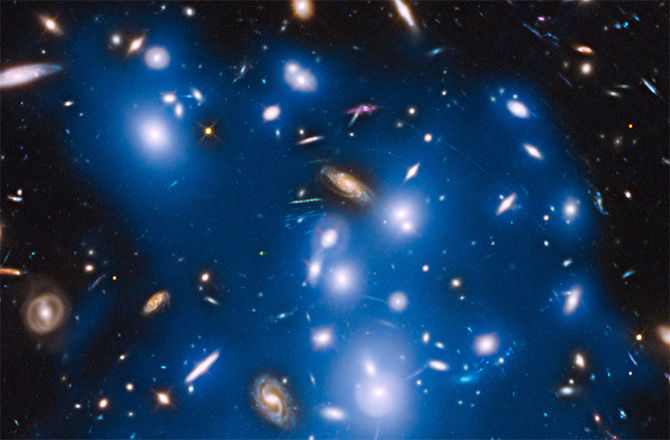
© NASA, et al.
Abell 2744, or "Pandora's Cluster," consists of 500 galaxies over 4 billion light-years away from Earth. The stunning array of galaxies of all shapes and sizes are a sight to behold. But in this case, scientists studying this Hubble observation aren't admiring the beautiful elegance of the spiral galaxies or arcs of light bent by gravitational lensing, they're focused on the long-lost stars cast adrift in intergalactic space, released like tiny sparkles after an immense galactic smashup that occurred billions of years ago.
The blue glow has been detected by Hubble's sensitive optics and represent cosmic forensic evidence of the galactic violence - it is caused by countless billions of stars that are no longer gravitationally bound to their galaxies, forever drifting alone.
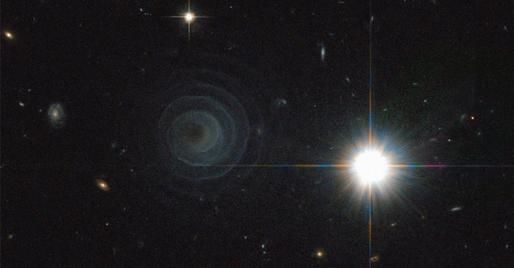
© NASA/ESA/HSTHubble's Ghost Spiral In 2010, the Hubble Space Telescope imaged a ghostly pinwheel spiral surrounding a binary star system called LL Pegasi. This bizarre cosmic phenomenon is caused by one of the stars dying, venting huge amounts of gas and dust into space. As the stars orbit one another every 800 years, the material expands into space like water being sprayed from a spinning garden sprinkler.
When Abell 2744 was forming, huge numbers of galaxies coalesced under a powerful mutual gravitational well. As each galaxy careened toward one other, intense tidal forces would have ripped some of the galaxies to shreds. Computer models have predicted that this mechanism likely occurs in large clusters of galaxies and, in the case of Abell 2744, over 200 billion stars were scattered throughout the cluster, contributing to 10 percent of the cluster's brightness.
"The results are in good agreement with what has been predicted to happen inside massive galaxy clusters," said lead author Mireia Montes also of the IAC.
Interestingly, Hubble wasn't being used to study this ghostly glow. As a part of the Frontier Fields project, Hubble's sensitive optics used large galactic clusters like Abell 2744 to study the phenomenon of gravitational lensing. The arcs of light in this observation are examples of lensing artifacts where light from galaxies behind the clusters is being warped and magnified by the cluster's immense gravity.
But for Montes' team, it was the glow of ancient stars inside the cluster that was of interest, a near-infrared glow that Hubble's instruments are extremely sensitive to.
As Frontier Fields continues to use galactic clusters as natural lenses into the furthest most Cosmic distances, the researchers will continue to study these glowing clusters, gaining a better idea as to how these gravitational behemoths formed and the fate of galaxies long dead.


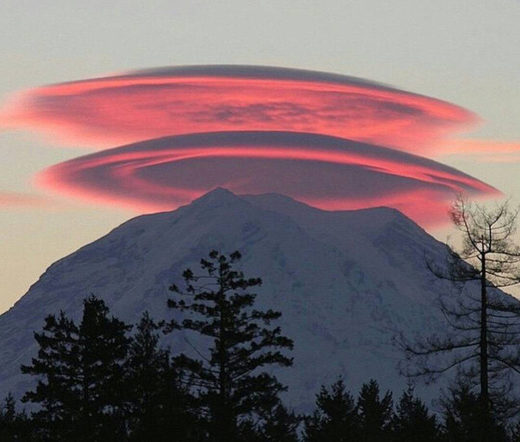
Such beauty in the universe (multiverse?). We are learning a lot and we also get to see this beautiful cosmos we are part of!