

© James P. Blair, National GeographicThe Indus civilization was first identified at Harappa, once a city of 80,000 people.
Unable to decipher the Indus script, archaeologists have pored over beads, slivers of pottery, and other artifacts for insights into one of the world's first city-building cultures.
Now scientists are turning to long-silent witnesses: human bones. In two new studies of skeletons from Indus cemeteries, researchers have found intriguing clues to the makeup of one city's population - and hints that the society there was not as peaceful as it has been portrayed.
Peaceful or not, the Indus civilization accomplished great things. At its peak, its settlements spanned an area greater than that of ancient Egypt, a contemporary culture. Indus jewelry was so coveted that examples have been found as far as Mesopotamia, some 1,500 miles (2,500 kilometers) away. Indus cities boasted blocks of houses built on a grid pattern and drains that funneled sewage from homes to dumping grounds outside the city walls.
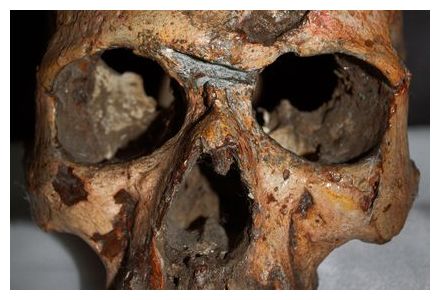
© Gwen Robbins SchugThis skull of an adult male shows traces of a broken nose and a blunt-force injury.
Most likely the newcomers came to Harappa from elsewhere in the far-flung Indus area, perhaps for trade. But they may also have come to cut another kind of deal - marriage. Many of the outsiders, surprisingly, are men buried near women native to Harappa. The findings are preliminary, but they suggest men moved in with their brides, even though in South Asia women traditionally move to their husband's homes. Confirmation of these early results, says lead author Mark Kenoyer of the University of Wisconsin - Madison, would point to a "system where women were powerful."
The new study is pioneering, says Indus expert James Shaffer of Case Western Reserve University, and offers "one of the few real insights we have" into the structure of Harappan society. If the study is correct, Harappa's unusual gender roles could mean that social structure in the Indus region was radically different from that of other ancient cultures, Shaffer says. In Mesopotamia, for instance, ancient texts show that women were usually subordinate to men.
Experts have long thought that the Indus region was indeed vastly different from ancient Egypt and Mesopotamia in one respect: the level of violence. Based on the lack of evidence for mass destruction of any Indus cities, and the lack of depictions of soldiers or killing, the Indus is often described as a "peaceful realm." But recent scrutiny of another group of Harappan skeletons tells a darker story.
Bones from about 1900 to 1700 B.C. - more than a millennium later than those examined by Kenoyer - make it clear that at least some Harappan residents were subjected to savage violence. The skull of a child between four and six years old was cracked and crushed by blows from a club-like weapon. An adult woman was beaten so badly - with extreme force, according to researchers - that her skull caved in. A middle-aged man had a broken nose as well as damage to his forehead inflicted by a sharp-edged, heavy implement.
Of the 18 skulls examined from this time period, nearly half showed serious injuries from violence, researchers reported in a recent paper in the International Journal of Paleopathology. The rate of skull injuries tied to violence is the highest recorded in the prehistory of South Asia, the researchers say. It may be no coincidence that at the time of these burials the Indus civilization was beginning to disintegrate and parts of Harappa were being abandoned, for reasons that scholars are still debating.
The results run contrary to "the myth of the peaceful Indus civilization," says Appalachian State University's Gwen Robbins Schug. "Violence ... [was] part of life at Harappa." Schug carried out this study with help from Kelsey Gray, a graduate student, and Veena Mushrif-Tripathy, from Deccan College in Pune, India.
Schug's conclusions divide outside experts. Nancy Lovell, a professor emeritus at the University of Alberta who has also studied Harappan skeletons, says the study's findings are "a really important contribution, because the tendency has been to think of Harappa as being fairly ... peaceful." Shaffer argues, however, that the violence reported in the new paper is not unexpected in a crowded city. Schug agrees but says her findings contradict previous opinions that Harappa was an oasis of serenity.
The analysis of more skeletons in the future may settle the matter, but for now, the Indus people are keeping their long-held secrets.




...these civilizations are much much much older......at least the non-sense of a violent 'aryan' invasion has stopped......