
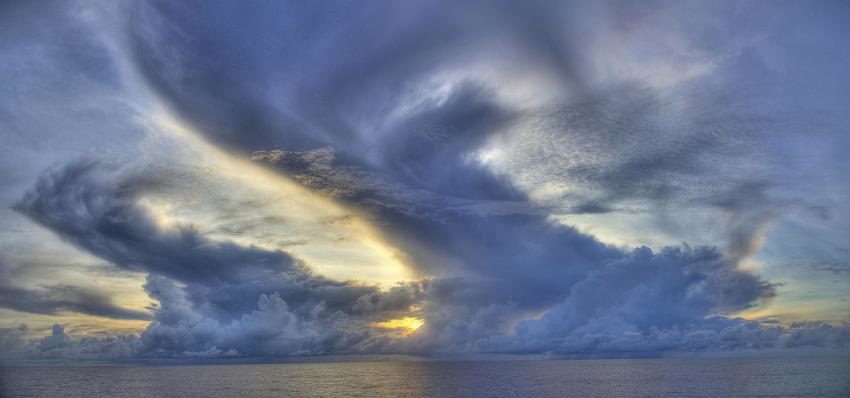
© Owen Shieh, University of HawaiiNew evidence suggests that high-energy particles from space known as galactic cosmic rays affect the Earth's climate by increasing cloud cover, causing an "umbrella effect."
To tackle this problem an international team of scientists around Meteorology Professor Bin Wang at the International Pacific Research Center, University of Hawaii at Manoa, examined climate data to see what happened in the Northern Hemisphere during the last three decades, a time during which the global-mean surface-air temperature rose by about 0.4°C. Current theory predicts that the Northern Hemisphere summer monsoon circulation should weaken under anthropogenic global warming.
Wang and his colleagues, however, found that over the past 30 years, the summer monsoon circulation, as well as the Hadley and Walker circulations, have all substantially intensified. This intensification has resulted in significantly greater global summer monsoon rainfall in the Northern Hemisphere than predicted from greenhouse-gas-induced warming alone: namely a 9.5% increase, compared to the anthropogenic predicted contribution of 2.6% per degree of global warming.
Most of the recent intensification is attributable to a cooling of the eastern Pacific that began in 1998. This cooling is the result of natural long-term swings in ocean surface temperatures, particularly swings in the Interdecadal Pacific Oscillation or mega-El Niño-Southern Oscillation, which has lately been in a mega-La Niña or cool phase. Another natural climate swing, called the Atlantic Multidecadal Oscillation, also contributes to the intensification of monsoon rainfall.
"These natural swings in the climate system must be understood in order to make realistic predictions of monsoon rainfall and of other climate features in the coming decades," says Wang. "We must be able to determine the relative contributions of greenhouse-gas emissions and of long-term natural swings to future climate change."



Reader Comments
to our Newsletter