
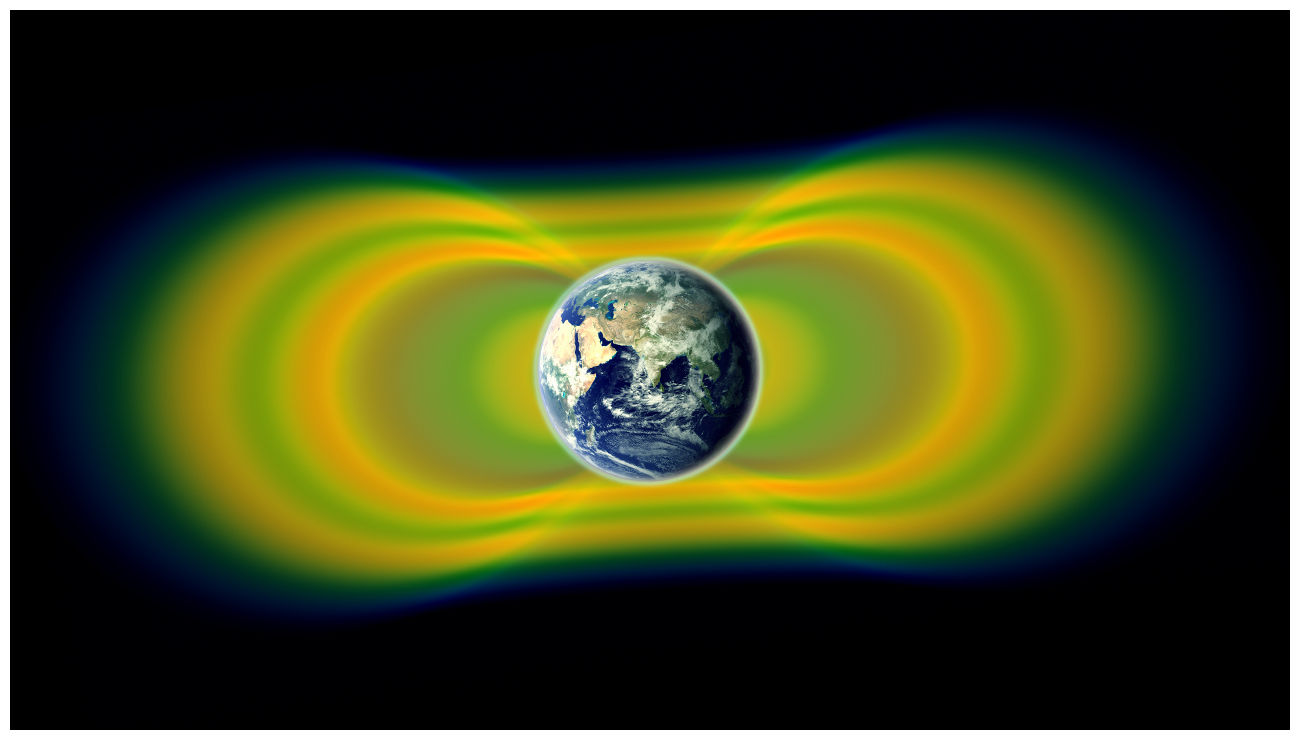
© NASA/Van Allen Probes/Goddard Space Flight CenterTwo giant swaths of radiation, known as the Van Allen Belts, surrounding Earth were discovered in 1958. In 2012, observations from the Van Allen Probes showed that a third belt can sometimes appear. The radiation is shown here in yellow, with green representing the spaces between the belts.
NASA's twin Van Allen space probes, which are studying the Earth's radiation belts, made the cosmic find. The surprising discovery - a new, albeit temporary, radiation belt around Earth - reveals how much remains unknown about outer space, even those regions closest to the planet, researchers added.
After humanity began exploring space, the first major find made there were the Van Allen radiation belts, zones of magnetically trapped, highly energetic charged particles first discovered in 1958.
"They were something we thought we mostly understood by now, the first discovery of the Space Age," said lead study author Daniel Baker, a space scientist at the University of Colorado.
These belts were believed to consist of two rings: an inner zone made up of both high-energy electrons and very energetic positive ions that remains stable in intensity over the course of years to decades; and an outer zone comprised mostly of high-energy electrons whose intensity swings over the course of hours to days depending primarily on the influence from the solar wind, the flood of radiation streaming from the sun.
The discovery of a temporary new radiation belt now has scientists reviewing the Van Allen radiation belt models to understand how it occurred.
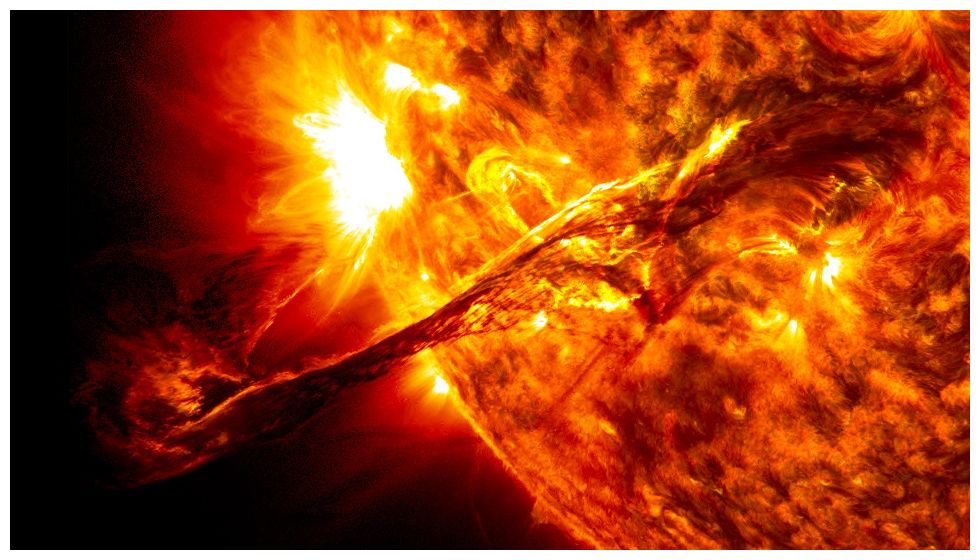
© NASA/SDO/AIA/Goddard Space Flight CenterOn Aug. 31, 2012, a giant prominence on the sun erupted, sending out particles and a shock wave that traveled near Earth. This event may have been one of the causes of a third radiation belt that appeared around Earth a few days later, a phenomenon that was observed for the very first time by the newly-launched Van Allen Probes. This image of the prominence before it erupted was captured by NASA's Solar Dynamics Observatory.
Radiation rings around Earth
The giant amounts of radiation the Van Allen belts generate can pose serious risks for satellites. To learn more about them, NASA launched twin spacecraft, the Van Allen probes, in the summer of 2012.
The satellites were armed with a host of sensors to thoroughly analyze the plasma, energetic particles, magnetic fields and plasma waves in these belts with unprecedented sensitivity and resolution.
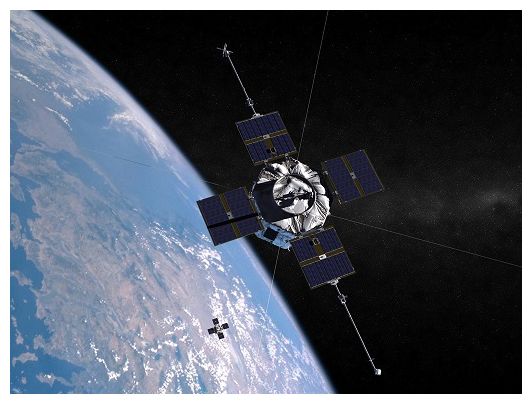
© NASAThe Radiation Belt Storm Probes Mission, part of NASA's Living With a Star program, will provide unprecedented insight into the physical dynamics of the radiation belts.
"The feature was so surprising, I initially foolishly thought the instruments on the probes weren't working properly, but I soon realized the lab had built such wonderful instruments that there wasn't anything wrong with them, so what we saw must be true," Baker said.
This newfound radiation belt then abruptly and almost completely disappeared on Oct. 1. It was apparently disrupted by an interplanetary shock wave caused by a spike in solar wind speeds.
"More than five decades after the original discovery of these radiation belts, you can still find new unexpected things there," Baker said. "It's a delight to be able to find new things in an old domain. We now need to re-evaluate them thoroughly both theoretically and observationally."
A radiation mystery
It remains uncertain how this temporary radiation belt arose. Van Allen mission scientists suspect it was likely created by the solar wind tearing away the outer Van Allen belt.
"It looks like its existence may have been bookended by solar disturbances," Baker said.
Future study of the Van Allen belts can reveal if such temporary rings of radiation are common or rare.
"Do these occur frequently, or did we get lucky and see a very rare circumstance that happens only once in a while?" Baker said. "And what other unusual revelations might come now that we are really looking at these radiation belts with new, modern tools?"
The scientists detailed their findings online Feb. 28 in the journal Science.



an instance of the plasma phenomena: Double Layers ?
"
Double Layers
Irving Langmuir discovered that one of the most important properties of plasma is its ability to isolate electrically one section of itself from another. The isolating wall is made up of two closely spaced layers, one consisting of positive charges and the other of negative charges. Langmuir called it a double sheath. Today it is called a double layer (DL). Because plasmas are excellent conductors, there will not be a significant voltage drop across them while they are carrying current.
If there is a significant voltage difference between two locations within a plasma, a DL will form between them and most of the voltage difference will be contained in it. In other words, a DL is where the strongest electric field in any plasma will be found. Plasmas have an almost magical ability to isolate themselves from foreign intruders. If anything is inserted into a plasma, a DL will surround it and isolate it from the plasma. This effect makes it difficult to insert voltage-sensing probes into a plasma in order to measure the electric potential at any specific location. It is this ability to isolate an intruder and surround it with a protective sheath (as human blood can) that probably inspired Irving Langmuir to use the term ‘plasma’ in the first place – and then to develop his ingenious probe that enables us to measure such voltages in the laboratory.
Scott, Donald E. (2006-06-01). The Electric Sky (Kindle Locations 1655-1665). Mikamar Publishing. Kindle Edition. "
That this was an enveloping and "isolation from foreign intruder" ?