
Police fired tear gas at protesters as supporters and opponents of President Mohamed Morsi clashed in Cairo. Over 100 people were reportedly injured as sporadic clashes continued into the night, while protesters organized a sit-in on Tahrir Square.
"I've witnessed very heavy police tactics. Officers used a lot of tear gas and threw rocks down on protesters from buildings. I've also seen Molotov cocktails being thrown back and forth," Cairo-based journalist Bel Trew told RT.
According to the Ministry of Health, at least 140 people have been injured in clashes between Morsi's supporters and opponents on Friday, Al Arabiya reports.
A coalition of 26 political movements opposing the Egyptian president has started a week-long sit-in protest on Cairo's Tahrir Square.
There were reports of police and security forces trying to break up the protest with tear gas on several occasions during the night.
Demonstrations took place in several cities throughout the country after the leader signed a controversial decree expanding his powers.

© Agence France-Presse/ Mahmoud KhaledAn Egyptian man walks by a burning Egyptian police truck during a demonstration against Egypt's Islamist President Mohamed Morsi on November 23, 2012 in Cairo
Thousands of demonstrators threw stones and chunks of marble at each other outside an Alexandria mosque after Friday prayers. Anti-Morsi protesters threw firecrackers at supporters of the Brotherhood, who used prayer rugs to shield themselves.
Protesters both for and against President Morsi also rallied in the streets of Cairo, Egypt. Supporters of Morsi chanted, "The people support the president's decree" in front of the presidential palace, AP reported.
The demonstrations follow a call by the Egyptian opposition to protest what they called a 'coup' by Morsi.

© twitter.com user @3araab
Morsi recently issued a declaration granting his office wide-ranging powers, effectively neutralizing Egypt's judicial system and preventing it from challenging his authority. The declaration prompted Morsi's Coptic Christian assistant, Samir Morcos, to resign. Al-Arabiya has reported that Morsi's Aid, Sakina Fouad, has also resigned in protest.
"What we're seeing here is massive criticism of the president and quite a lot of fear that he's becoming a new dictator. Because right now, he actually has more powers than Mubarak ever did," Trew said.
Opposition leader Mohammed ElBaradei said that Morsi had become "a new pharaoh" with the powers he had granted himself, significantly violating democratic principles.
"The Egyptian political community is getting more complicated and dangerous...we have two separate camps right now...people have a lot of anger towards the Muslim Brotherhood and the ruling party in general," human rights activist Shimaa Helmy told RT.
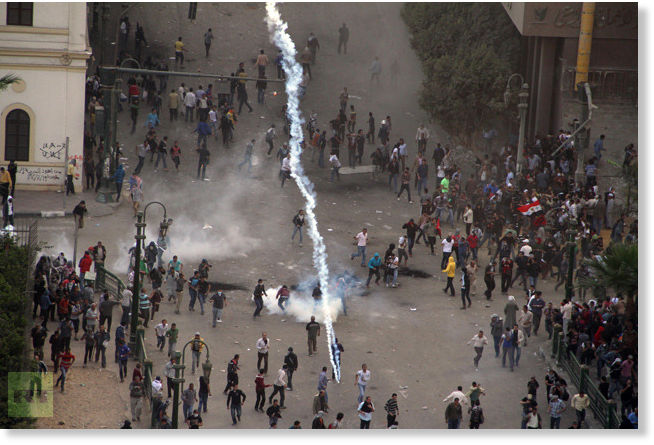
© Agence France-Presse/ Ahmed MahmoudProtesters demonstrating against Egypt's Islamist President Mohamed Morsi run from tear gas fired by Egyptian riot police during clashes in Cairo's landmark Tahrir square on November 23, 2012
"I think President Morsi is now on a slippery slope, and it shows you how fragile, delicate this whole movement is that was launched a couple of years ago for so-called democracy," Freeman said. "They are not really giving democratic rights to the people. Until the people are given real economic development - until they are given real freedom - this is going to continue to be a problem."
Washington has acknowledged the decree, saying that it has raised concerns for many Egyptians and the international community.
"We call for calm and encourage all parties to work together and call for all Egyptians to resolve their differences over these important issues peacefully and through democratic dialogue," State Department spokeswoman Victoria Nuland said in a statement.
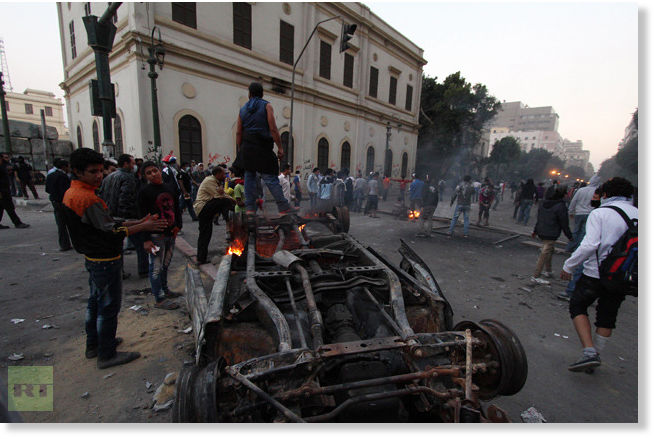
© Agence France-Presse/ Ahmed MahmoudEgyptian protesters stand near a burnt out car during clashes with riot police following a demonstration against Egypt's Islamist President Mohamed Morsi in Cairo's landmark Tahrir square on November 23, 2012
"I will never be biased. I will never be against anyone - any Egyptians - because we are all together and we need to give the momentum to the freedom and democracy and the transfer of power. And in order to be able to take care of everything you like, I like to be honest and take care of everything you care about because I like to support what you want to have: Stability and safety," he said.
Despite the controversy surrounding Morsi and the Muslim Brotherhood, many said there would be little to no political structure in Egypt if the party didn't exist.
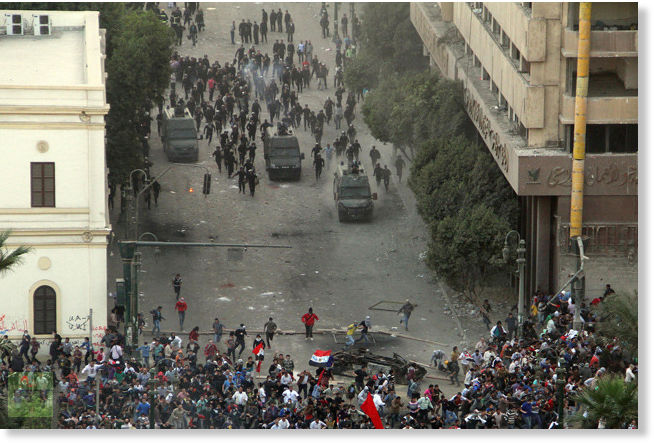
© Agence France-Presse/ Ahmed Mahmoud
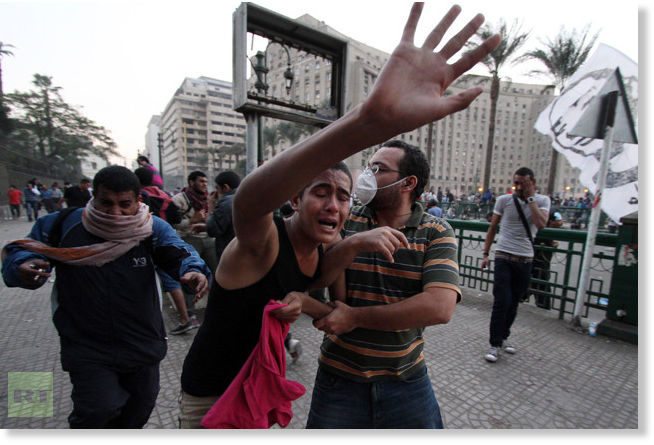
© Agence France-Presse/ Ahmed MahmoudProtesters run for cover as they suffer from tear gas inhalation from canisters fired by Egyptian riot police during clashes following a demonstration against Egypt's Islamist President Mohamed Morsi in Cairo's landmark Tahrir square on November 23, 2012
Meanwhile, the United Nations said the decree raised serious human rights concerns.
"We are very concerned about the possible huge ramifications of this declaration on human rights and the rule of law in Egypt...we also fear this could lead to a very volatile situation over the next few days, starting today in fact," UN Human Rights spokesperson Rupert Colville said in a statement on Friday.
Morsi said that the move was vital to protecting the revolution that ousted Mubarak two years ago, and to cement a democratic transition for Egypt.
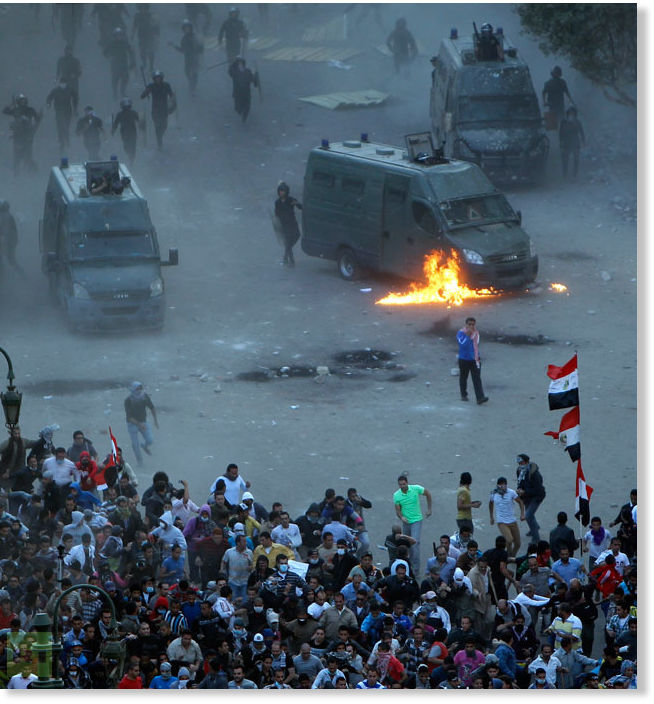
© Reuters / Mohamed Abd El GhanyFlames burn around a police vehicle after protesters threw a molotov cocktail at it during clashes at Tahrir square in Cairo November 23, 2012.



With you Hostess, the Secretary of State, we go from the frying pan of Gaza to the fires of Egypt. That didn't take long.
If ya aren't wondering what went on at that meeting table (side deals included), then it's about time ya did. Coincidence? In a pig's eye.