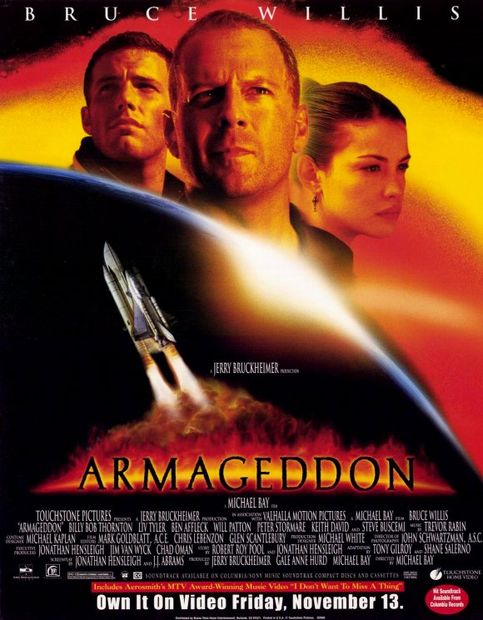
Fantasy vs Reality: no, Bruce Willis can't save the day, and neither can your government.
A British astronaut will be part of a team to fly to space to investigate a cosmic rock, and if the asteroid is found to be on collision course for Earth, he would be the one to deflect it.
Major Tim Peake is part of a NASA team due to fly by the mid-2020s,
The Sun reported.
He and three colleagues from the Extreme Environment Missions Operations could be flown to deflect the asteroid.
"Earth has close calls all the time. The work we are doing is without a doubt going to help prevent a catastrophic collision with one of them," Peake, a 40-year-old former Army Air Corps officer, was quoted as saying.
In February, a 45-metre-wide rock got closer than the artificial satellites around the earth, and in November 2011, a 360-metre-wide one came between earth and the moon.
The team has spent 12 days simulating weightless conditions in a deep sea research station off Florida, US.
The team's main aim is to travel to an asteroid in a shuttle, spend up to 30 days on a smaller spacecraft so that they can take samples from it and place sensors.
Source: IANS
Comment: This notion of saving Earth from incoming asteroids/meteors/comets has already been thoroughly debunked, but it doesn't seem to stop them putting these stories about there to calm people:
Can Bruce Willis save us from asteroid 'Armageddon'? No, and neither can your government
In the 1998 movie "Armageddon," Bruce Willis plays an oil-drilling platform engineer who leads a team that lands on an asteroid aimed at Earth, drills a hole into its center and explodes a nuclear device that splits the asteroid, saving the planet.
Could it actually happen? Definitely not, say physics graduate students at the University of Leicester in England.
Leaving aside the question of whether we have spacecraft that could transport the drilling team to intercept the asteroid, the group of four students concluded that we simply don't have a big enough bomb to split the asteroid so that the two halves would pass by the Earth.
Ben Hall, Gregory Brown, Ashley Back and Stuart Turner devised a formula to calculate how much energy would be needed to split an asteroid of the size depicted in the film. They reported in two related papers in the University of Leicester Journal of Special Physical Topics that it would require 800 trillion terajoules of energy to split the asteroid in two with both pieces clearing the planet. Unfortunately, the largest nuclear bomb known, a Russian monster known as Big Ivan, yields only 418,000 joules. Hence, they said, the project would require a bomb a billion times as powerful to save the Earth.



Someone or something is protecting us from these doomsday meteor/asteroids; check it out:
www.youtube.com/watch?NR=1&v=-octPHs9gcs&feature=endscreen