
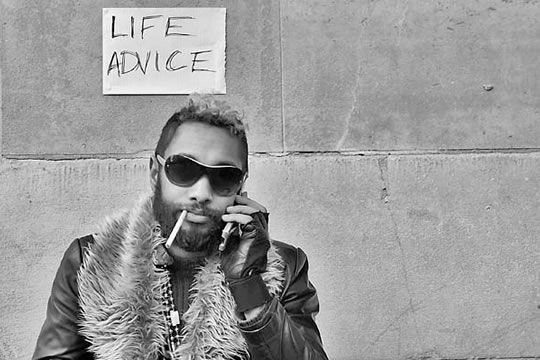
© PryereWhat would this guy do? Perspective-taking offers a way around the egocentric bias.
The egocentric bias strikes in the boardroom, in schools, in hospitals and everywhere where two or more people are gathered together and one turns to the other and says: "What do you think?"
It's the reason why every person and every generation has to make its own mistakes. People have a tendency not to listen until after it's too late.
This is a real shame because a lot of the time other people have really important insights or experience that we don't have ourselves (e.g. The Impressive Power of a Stranger's Advice). We can't hope to know everything ourselves.
So how can we force ourselves to properly weigh other people's advice?
An approach that's recently come to the fore in psychological research, and popular culture, is perspective-taking. You simply imagine someone who is like you faced with the same question and then you ask yourself what they would do.
It's the secular equivalent of the Christian question: "What would Jesus do?"
Now it's been tested in psychological research by Yaniv and Choshen-Hillel (2012). Across three studies they had some participants make choices from their own perspective and some from the perspective of another person who is similar to themselves.
What they found was that taking another imaginary person's perspective had the desired effect of encouraging participants to take other people's advice.
It's a fascinating finding but it only tests people's judgements in a relatively simple situation: guessing the amount of calories in a foodstuff. We'll have to wait for further research to look at more complicated or nuanced decisions.
Still, the procedure is so simple it's unlikely to do any harm. Plus anything that helps us think outside ourselves is very likely to be helpful since there are quite a few other studies which have found robust benefits for perspective-taking.




Hubbard found that people were not always willing to take advice about "how to solve your problem" because thinking about their problems gives most people something interesting to do.
One of his simpler handlings for this was to have people invent problems until they had so many of them that they could solve the more serious ones and still have plenty left over.
Pretending the problem belongs to someone else is another way to do this. If it's not my problem, I am more willing to solve it.