
The eclipse will also be seen from eastern Asia and the northern Pacific. It starts in Asia at 20:56 (8.56pm) Universal Time (UT) on May 20, 2012, and ends in the US at 02:49 (2.49am) UT on May 21, 2012.
Check out when the eclipse starts all over the world
The Eclipse's Path
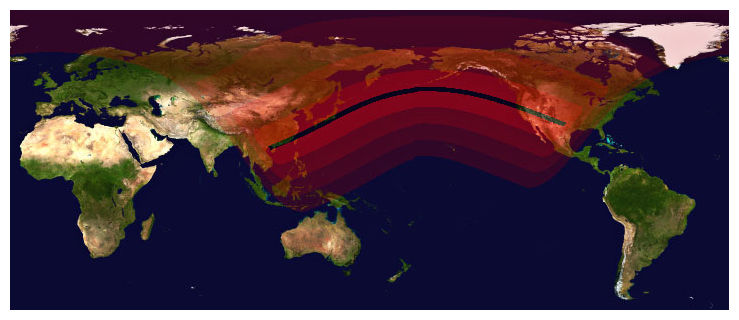
© timeanddate.comThe dark strip in the center indicates the best locations for viewing the eclipse. Here the moon will appear in the center of the sun's disk. The eclipse will also be visible in the areas that are shaded red, but to a lesser degree. The fainter the red shading the less the sun will appear to be covered.
Time zone converter
The World Clock's Time Zone Converter helps you find when the eclipse will occur in your local time. Universal Time (UT), a timescale based on the earth's rotation, is about 0.58 seconds behind Coordinated Universal Time (UTC) during most of May 2012. UTC is in the time zone converter.
Can I see the eclipse?
Asian cities that will see the eclipse include: American/Canadian cities that will see the eclipse include: *The annular eclipse will only be partially seen in some places.
You can check out the weather in the above World Clock city pages closer to the eclipse's date. The eclipse will be seen in some more cities found in the Extended World Clock. Some national parks in western USA, as well as the Grand Canyon in Arizona, will be hotspots where people can witness the eclipse. See our tips on viewing an eclipse.
When will the eclipse occur?
The penumbral eclipse (P1) starts on the east of the International Date Line at 20:56:07 UT on May 20, 2012. The partial eclipse (U1) starts at 22:06:16 UT.
The total eclipse (U2) starts at 22:11:46 UT. The point of greatest eclipse occurs south of Kiska and Buldir in Alaska at 23:52:46 UT. It is visible for 5 minutes and 46 seconds in this area.
The total eclipse (U3) ends at 01:33:42 UT on May 21, 2012, followed by the end of the partial eclipse (U4) at 01:39:10 UT. The penumbral eclipse (P4) ends at 02:49:21 UT.
Other eclipses in 2012
The annular solar eclipse is one of 4 eclipses in 2012. Other eclipses for the year are:
- A partial lunar eclipse on June 4, 2012
- A total solar eclipse on November 13-14, 2012
- A penumbral lunar eclipse on November 28, 2012.





Something keeps saying one ring to rule them all, about this.