
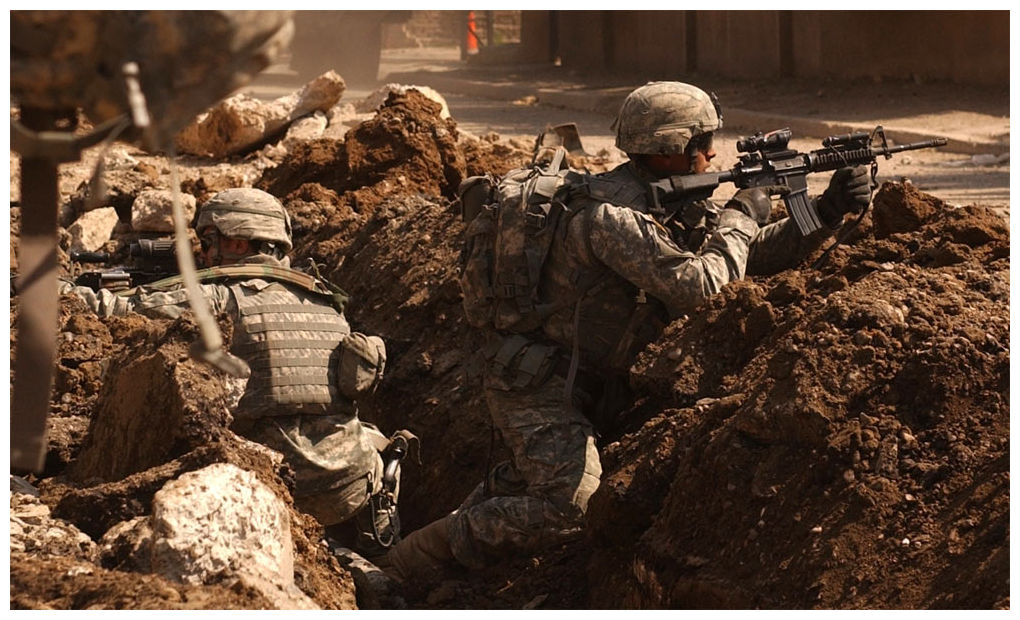
© U.S. Army | Staff Sgt. Sean A. FoleySoldiers occasionally get a sixth sense feeling about battlefield dangers. Here, Sgt. Auralie Suarez and Pvt. Brett Mansink take cover during a firefight with anti-Iraqi forces in the Al Doura section of Baghdad, March 7.
Ordinary soldiers have sometimes shown a battlefield sixth sense that has saved lives in Afghanistan and Iraq. Now the U.S. military wants to better understand that "spidey sense" and train troops to tap their inner superhero instincts.
The U.S. Office of Naval Research pointed to sixth sense research about how "humans can detect and act on unique patterns without consciously and intentionally analyzing them," according to a special notice posted on Feb. 29. It hopes to encourage such intuition in the brains of new soldiers, Marines and other troops with little or no battlefield experience.
Having intuition allows for split-second detection of patterns in the midst of uncertain scenarios - a possibly life-saving action in the face of an ambush or area rigged with roadside bombs.
But intuition stands apart from step-by-step, time-consuming analytical thinking because it happens both rapidly and subconsciously. A soldier may see, smell or hear something that gets subconsciously organized within hundreds of milliseconds to create the "feeling or impression of a solution" leading up to a sudden insight about the battlefield situation.
The U.S. military also pointed to studies suggesting a sixth sense can arise from "implicit learning" - absorbing information without being aware of the learning process - rather than building up expertise through years of practice. Ordinary examples of implicit learning include bike riding, learning new languages or developing intuition about how other people may act.
First, the Office of Naval Research (ONR) plans to measure the workings of both intuition and implicit learning. Next, it would create a working model of such thinking that could also reflect individual soldiers' differences, adapt to new situations, and account for the influence of battlefield stress or fatigue.
In the end, virtual battlefield simulations could help train soldiers' intuitions as well as collect information about their performance, ONR explained in its special notice. The U.S. military already uses game-like simulators to prepare soldiers for battlefield scenarios or even to help veterans suffering from post-traumatic stress disorder (PTSD).



Reader Comments
This means to me that they are preparing to "unblack" the old "supersoldier" programs that have been going on for years.
The most credible whistle blower about those programs has been Duncan O'Finioan with his close friend Miranda Kelly.
Michael Prince (who used to go by James Casbolt) also has a lot of fantastic stories to tell along these lines.
And now we can add Bill Brockbrader to the list.
But the theory behind how "higher abilities" work is really screwed up.
The body can do things reactively - without "thinking" - to avoid danger, etc., and this is the traditional subconscious. It is a fast system that bypasses "conscious" - or analytical - thought.
But that is all achieved through programming.
There is a whole other basis for such actions, and it could probably better be characterized as "superconscious."
The difference is that it is not performed by the body on a bypass of the analyzer, but instead by the being bypassing its own analyzer.
It works to the degree that a being can bring its attention into present time. As the being becomes more and more aware of present time, it will discover all sorts of abilities to perceive things that are going on in the environment that we normally don't notice. When the being can go exterior, this means it suddenly has a very good 360-degree awareness of surroundings, with a radius roughly proportional to the amount of free attention it can muster up.
This includes sights, sounds, smells, magnetic and electronic phenomena, and of course an awareness of what is going on in the minds of other beings in the area.
Of course this would be of benefit to a soldier!
But there is every reason to believe that traditional fighting groups (the Samurai are probably the best known) knew about these abilities and sought to cultivate them. Their failure in this regard is one reason that warfare has descended into the materialistic and degraded activity that we see today.
The point is: Such abilities would benefit anybody! So why let the ONR have all the fun? Hubbard wrote about all this stuff in the 1950s. And the Navy, at that time, tried to get him to work for them instead of the public. He refused. So now the basic technologies for developing these abilities are available to anyone who reaches for them. I am sure the ONR and a bunch of other groups have been using his work for all these years. It is actually evident in the material that has been released by people like Prince and Brockbrader.
That's why I find this announcement a bit insincere. Who are they trying to fool?
You, too, can develop "spidey sense." The technology has been on our bookshelves for about 60 years now.
This reminds me of an article that I read that said scientists were trying to figure out what makes a cat purr.
They were unable to find out as every time the "testing" took place the cat stopped purri