
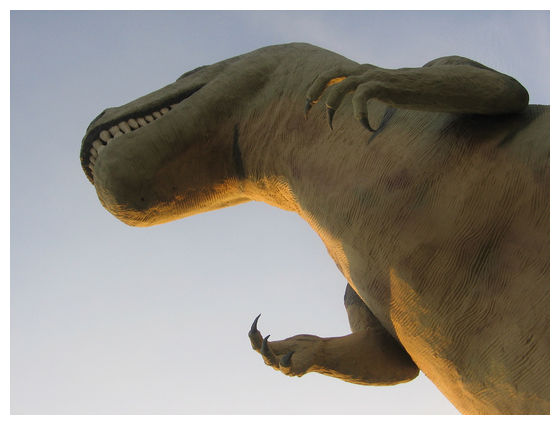
© Mr Kimberley / FlickrYou have to go back to the time of the dinosaurs to see where Earth is heading.
Why have mass extinctions of species occurred since the late Proterozoic (from 580 million years ago) and repeatedly through the Phanerozoic? Integral to these extinctions were abrupt changes in the physical and chemical properties of the atmosphere, ocean and land, inducing environmental changes at a pace to which many species could not adapt.
The best documented example to date is the 65 million years-old K-T boundary asteroid impact and extinction event. But several other mass extinctions were associated with volcanic eruptions and asteroid/comet impacts (see Figure 1).
Instantaneous effects of impacts (initial fireball flash as the asteroid or comet enters the atmosphere, crater explosion, seismic shock, tsunami waves, incandescent ejecta, dust plumes, greenhouse gas release from carbon-rich limestone and shale) occurred over periods ranging from seconds to weeks and months.
As shown in figure 1, Phanerozoic history (since about 540 million years ago) is marked with a number of mass extinction events. About 80% of genera were lost at the ~251 Ma Permian-Triassic boundary event. This was a consequence of both volcanic eruptions (known as the Siberian Norilsk traps) and an asteroid impact near Araguinha, Brazil (Araguinha: 40 km-diameter; 252.7+/-3.8 Ma).
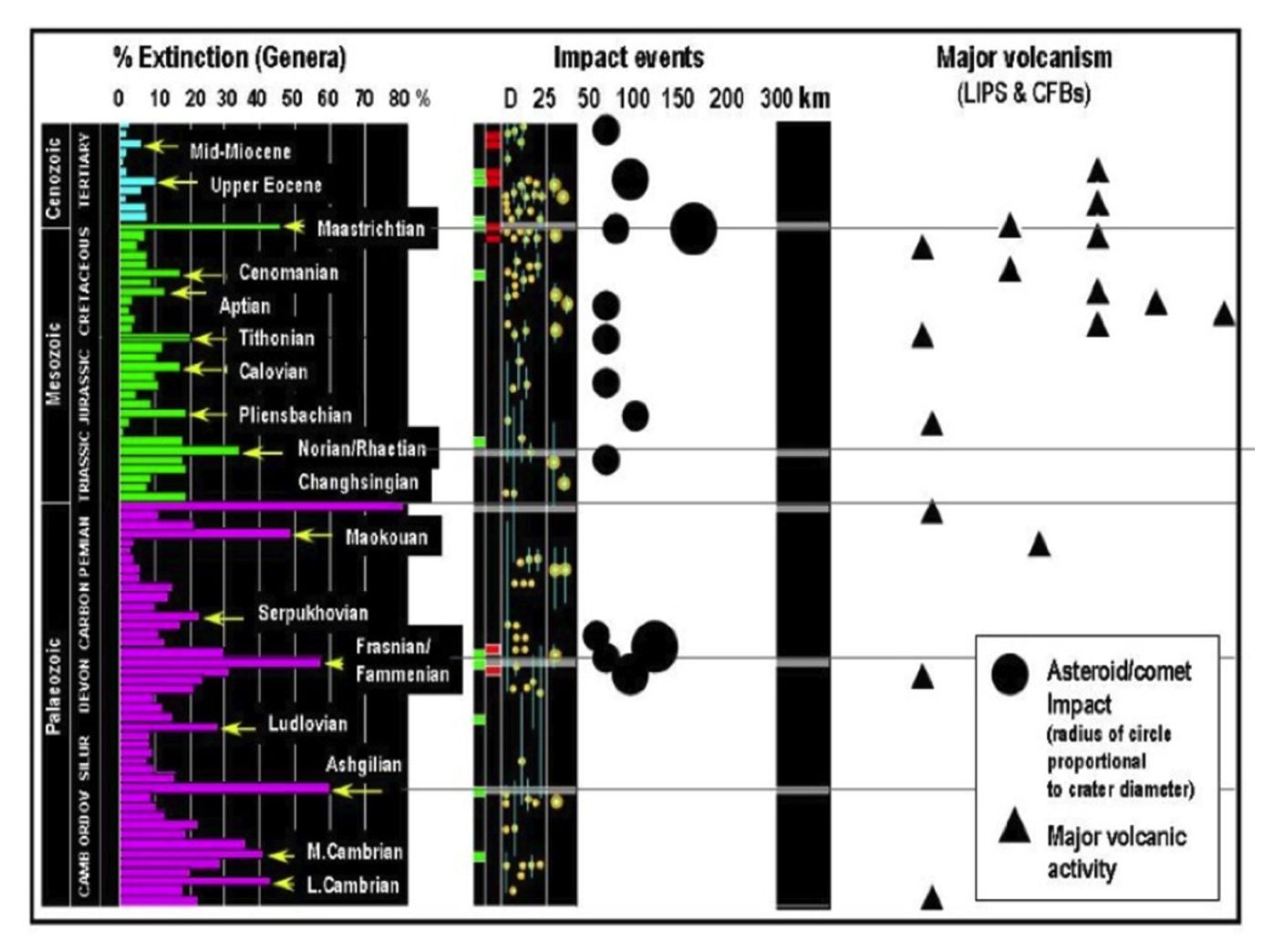
© Andrew Glikson, after Keller (2005)Figure 1: Phanerozoic genera extinction rates, extraterrestrial impact events (circles denote relative magnitude of impacts) and major volcanic events.
These mass extinction events came on top of more gradual geological processes. These included plate tectonic movements, continental rifting and associated increases in volcanism and mountain building. There were intermittent build up and precipitation of volcanic aerosols and the longer term accumulation and sequestration of atmospheric greenhouse gases (see Figure 2).
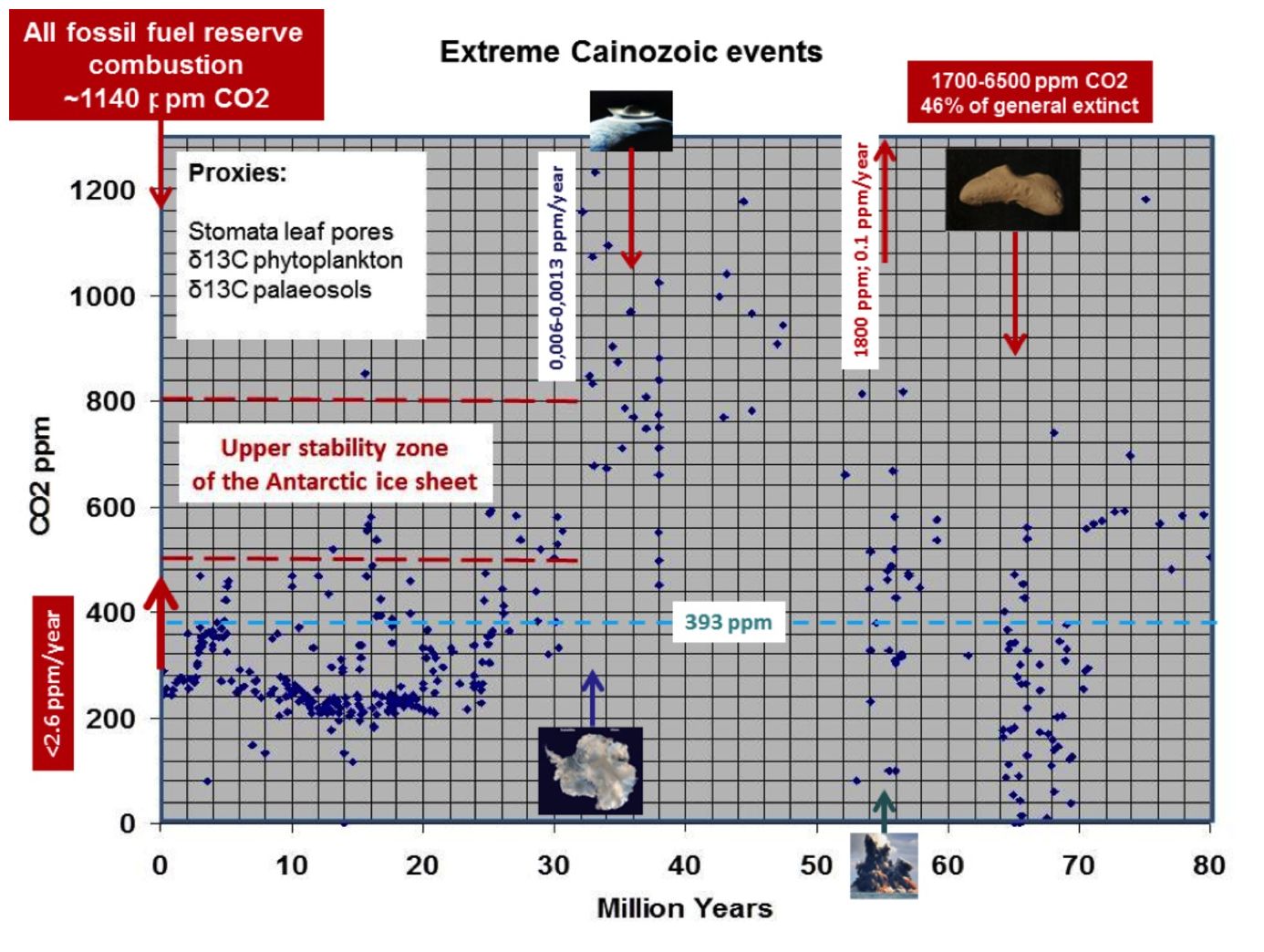
© Andrew GliksonFigure 2. Evolution of atmospheric CO2 over the last 80 Ma as measured by multiple proxies (stomata leaf pores, 13C in phytoplankton, 13C in paleosols) (data after D. Royer, with permission). Main features: (1) a low-CO2 late Cretaceous (~70-65 Ma) period terminated by the K-T impact, raising CO2 to ~1700-6500 ppm; (2) high-CO2 Eocene (~50-32 Ma) period terminated by a ~35 Ma impact cluster followed by opening of the Drake Passage, formation of the circum-Antarctic cold current and the Antarctic ice sheet, leading to low-CO2 (~200-500 ppm) Oligocene to present climates.
For the first time in planetary history a species has mastered combustion, first of carbon products of the biosphere, then of fossil carbon products hundreds of millions of years old. This has magnified its oxygenating capacities by many orders of magnitude. For example, whereas human respiration uses about two to seven calories each minute, driving a car commonly uses more than 1000 calories a minute and operating a power plant more than one million calories a minute.
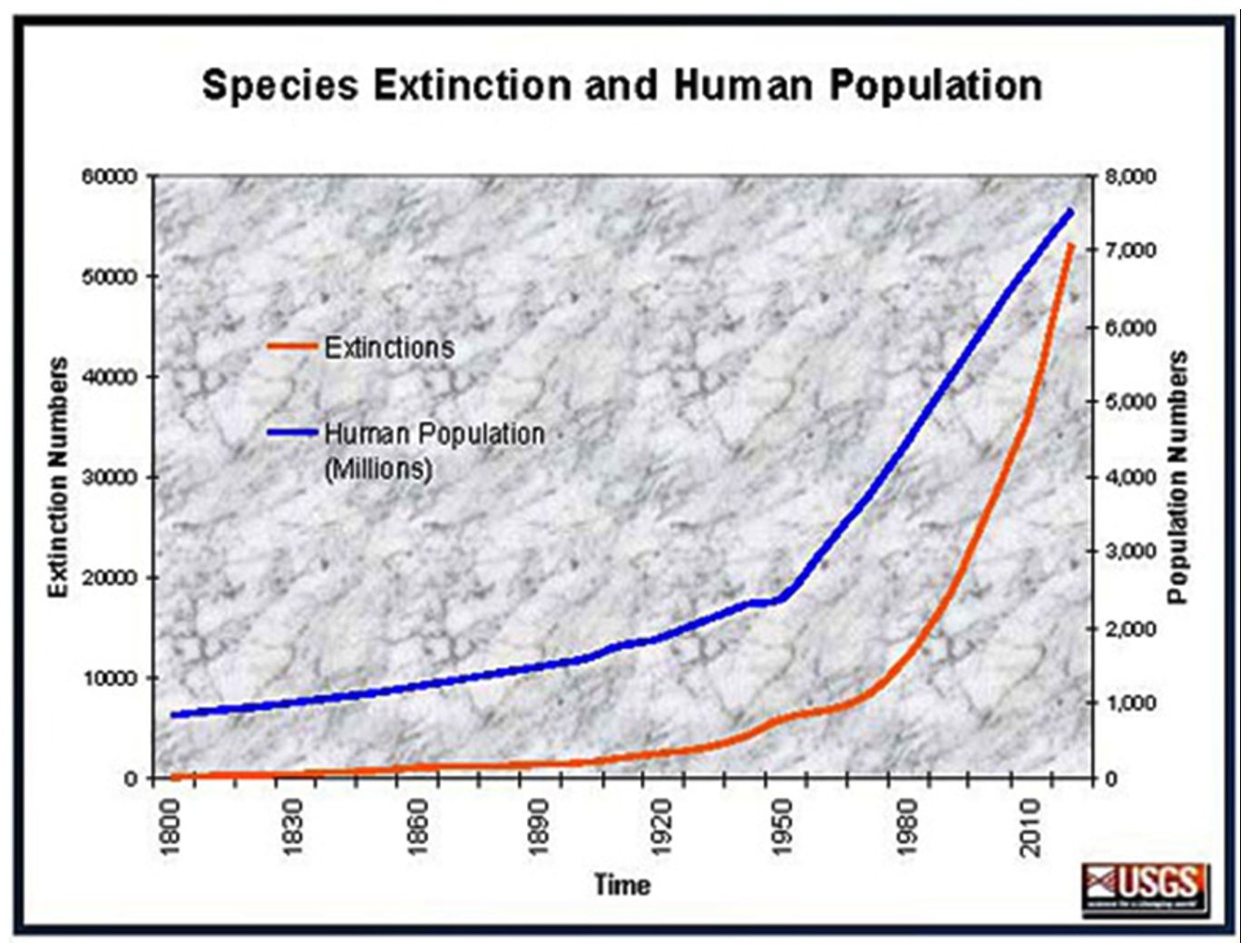
© Andrew Glickson/Democracy in ActionFigure 3: The rise in human population and in the number of extinct species between 1800 and 2010.
"The human population is 6.8 billion and growing every second. The sheer force of our numbers is dominating the planet to such a degree that geologists are contemplating renaming our era the 'Anthropocene': the epoch where the human species is the dominant factor affecting land, air, water, soil, and species."
"We now absorb 42 percent of the planet's entire terrestrial net primary productivity. We use 50 percent of all fresh water. We've transformed 50 percent of all land. We've changed the chemical composition of the whole biosphere and all the world's seas, bringing on global warming and ocean acidification. Most importantly, we raised the extinction rate from a natural level of one extinction per million species per year up to 30,000 per year. That's three per hour."
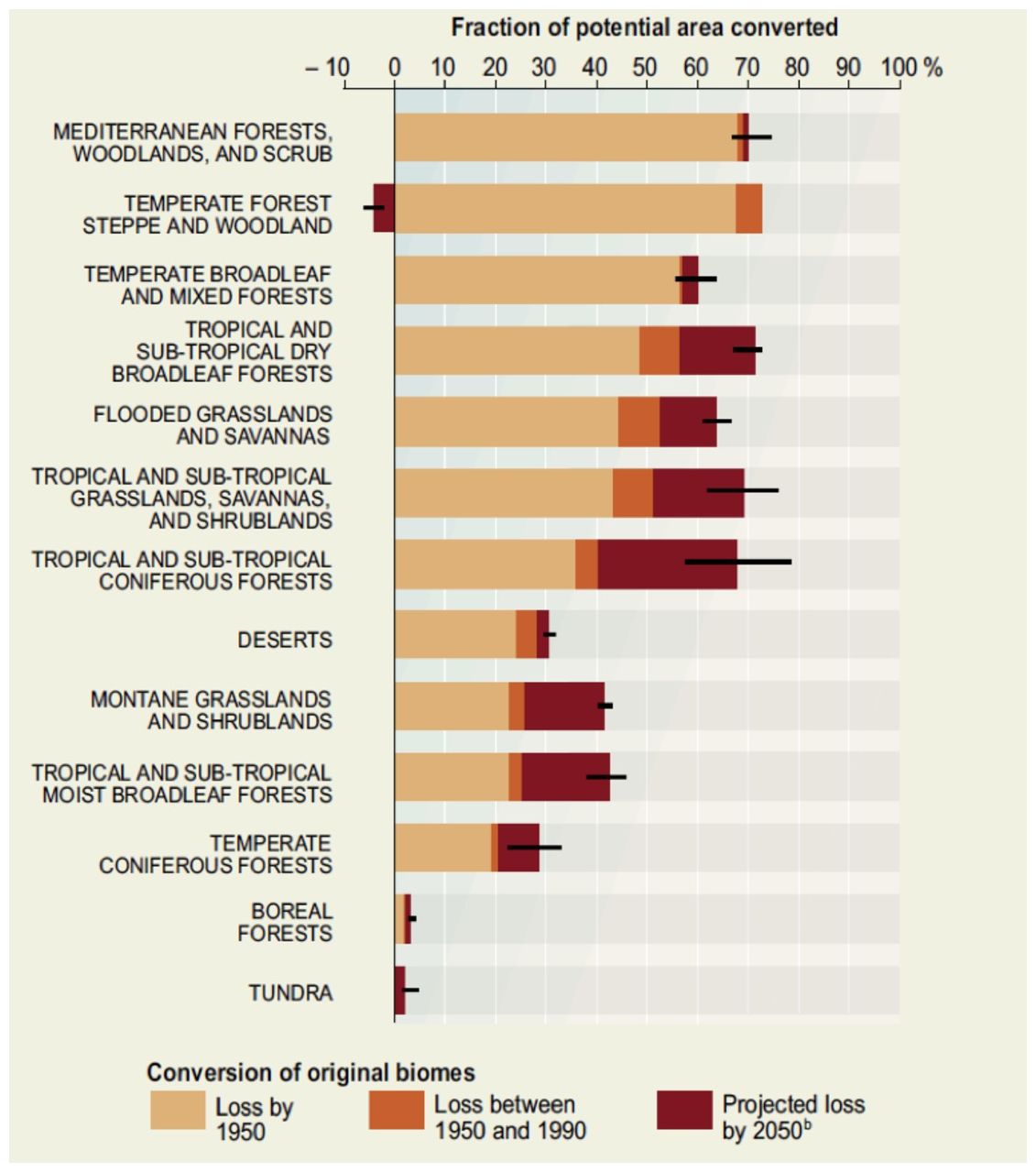
© Ecosystems and Human Well-being Synthesis A Report of the Millennium Ecosystem AssessmentFigure 4: Loss of original biomes (major regional group of distinctive plant and animal communities best adapted to the region's physical natural environment, latitude, elevation, and terrain) by 1950, during 1950 and 1990 and projected loss by 2050.
The splitting of the atom increases potential release of entropy by 14 to 15 orders of magnitude for a 1 megaton TNT-equivalent device. Only a species capable of controlling these devices would be able to avoid the catastrophic consequences of the release of such levels of energy into the biosphere.
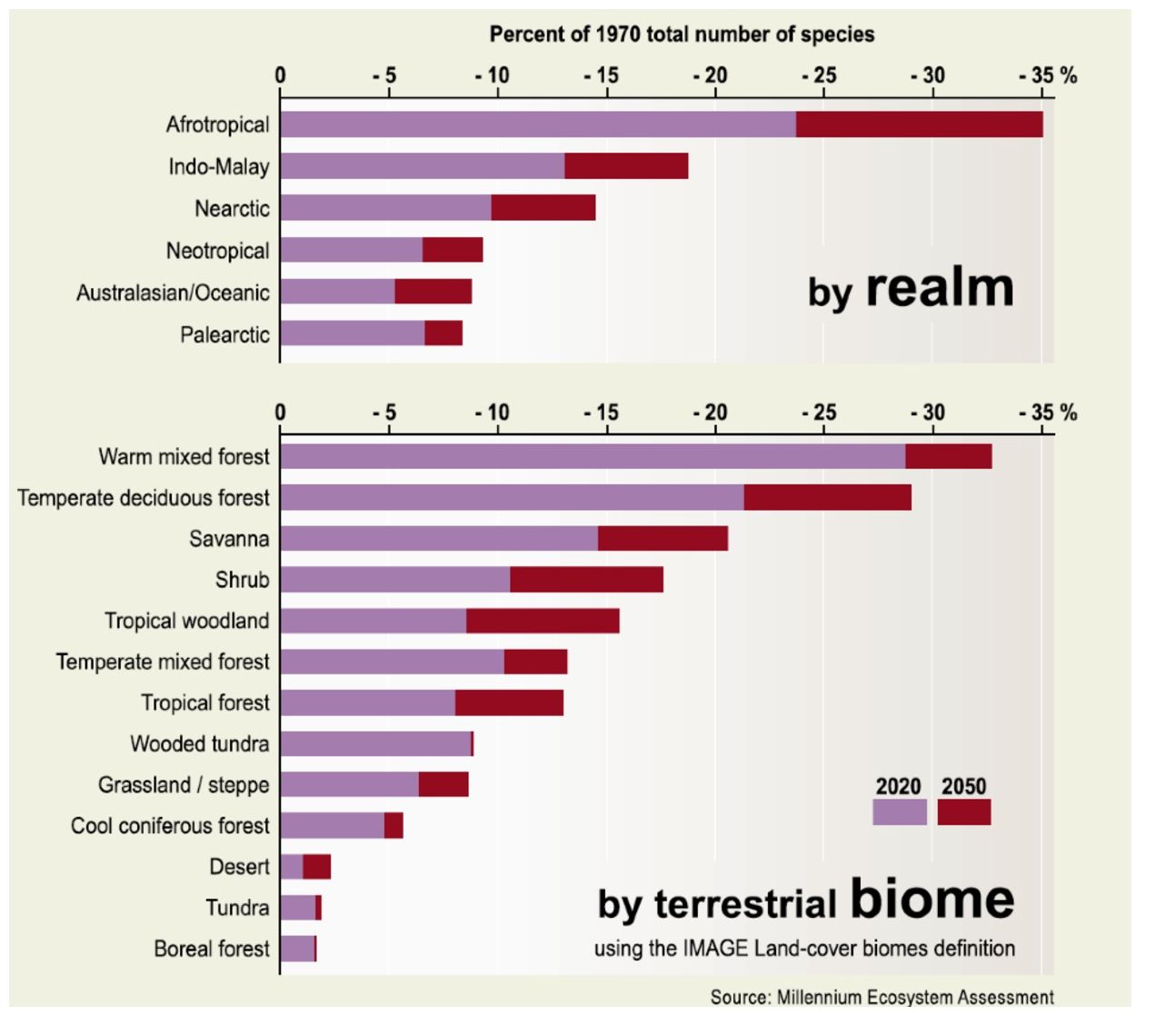
© Millennium Ecosystem AssessmentFigure 5: Relative Loss of Biodiversity of Vascular Plants between 1970 and 2050 as a Result of Land Use Change for Different Biomes and Realms in the Order from Strength Scenario.
As shown in Figure 6, if we compare the current rise of more than 2ppm/year to the mean rise in atmospheric CO₂ of +0.43 ppm/year since 1750, the only recorded rise of similar magnitude occurred 55 million years ago. At this time, the release of some ~2000 GtC carbon as methane took place at a rate of ~0.1 ppm/year.
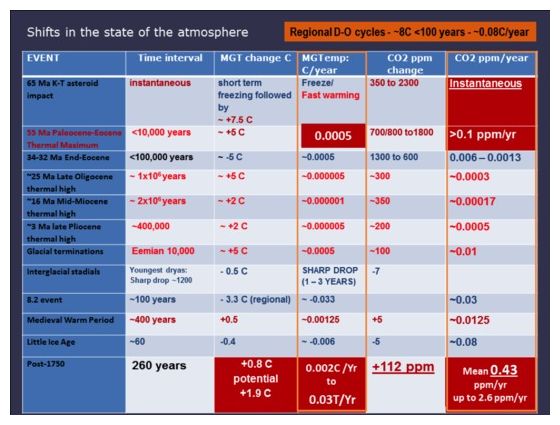
© Andrew GliksonFigure 6: Summary of rates of temperature changes, temperature changes per year, CO2 changes and CO2 rates per year during Cainozoic events.
Throughout geological history many species succeeded in adapting to slow to moderate environmental changes. Some survived the most extreme environmental events. Burning the world's fossil fuel reserves of more than 2000 GtC, analogous to the magnitude estimated for the 55 Ma-old Paleocene-Eocene Thermal event, is leading Earth's climate and habitats into uncharted territory.



Man small, Earth big, Sun humongous, Solar System immense, Galaxy irrepressible.
If Greedy men don't wipe us out with genocidal war over sandpile and dunghill bragging rights, the Ice Age will put an end to the mess.