
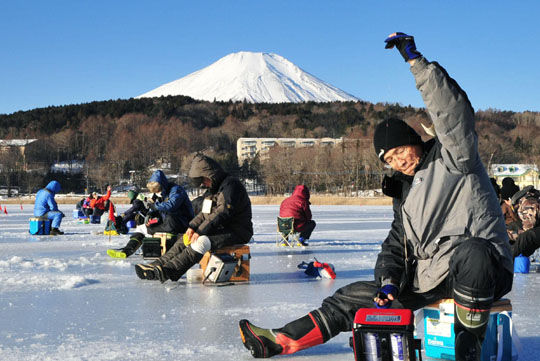
© Kyodo PhotosIce fishermen cast lines Friday in Lake Yamanaka in Yamanashi Prefecture.
The country experienced severe cold weather Friday and morning temperatures dropped to record lows at 38 locations nationwide, the Meteorological Agency said.
From Tohoku to Kyushu, 16 prefectures recorded their lowest temperatures ever, including the town of Kusu in Oita Prefecture, where the mercury fell to minus 14.7 degrees, and Mashiki, Kumamoto Prefecture, where the temperature plunged to minus 8.4.
Temperatures were below zero early Friday at more than 90 percent of 927 observation points across Japan, the agency said.
The lowest figure was minus 32.6 in Esashi, Hokkaido.
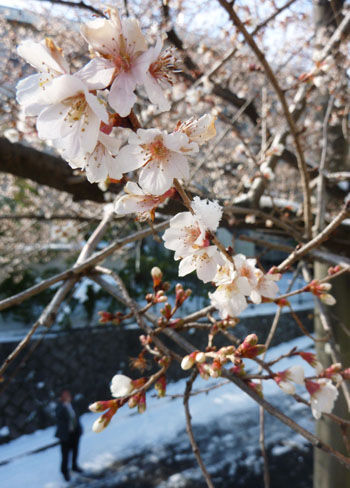
© Japan TimesIn the pink: Cherry trees (above) bloom in Nagoya despite the extreme cold Friday.
The cold should ease early next week but is likely to return around Wednesday, it forecast.
"There is a possibility of heavy snow again" next week and people should continue to be cautious, agency forecaster Koji Ishihara said.
According to the agency, the cold weather is expected to continue through April because of the La Nina phenomenon, in which the temperature of the sea surface off Peru drops.
"Based on our forecast, February's temperatures nationwide will be lower" than in normal years, Ishihara said. "We project low temperatures will continue through March and April, excluding Hokkaido and the Tohoku region."
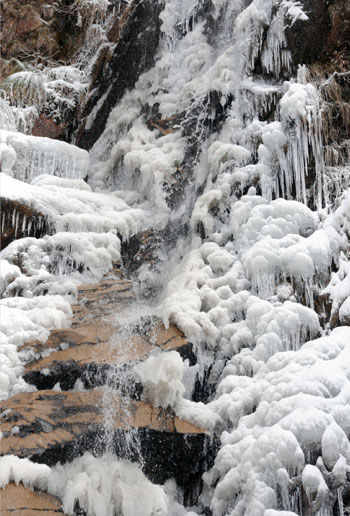
© Japan TimesThe Ryuo waterfall (below) is mostly frozen Thursday in Hino, Tottori Prefecture.



Climatic effects
A study presented at the annual meeting of the American Geophysical Union in December 2006 found that even a small-scale, regional nuclear war could disrupt the global climate for a decade or more. In a regional nuclear conflict scenario where two opposing nations in the subtropics would each use 50 Hiroshima-sized nuclear weapons (about 15 kiloton each) on major populated centers, the researchers estimated as much as five million tons of soot would be released, which would produce a cooling of several degrees over large areas of North America and Eurasia, including most of the grain-growing regions. The cooling would last for years, and according to the research could be "catastrophic"