
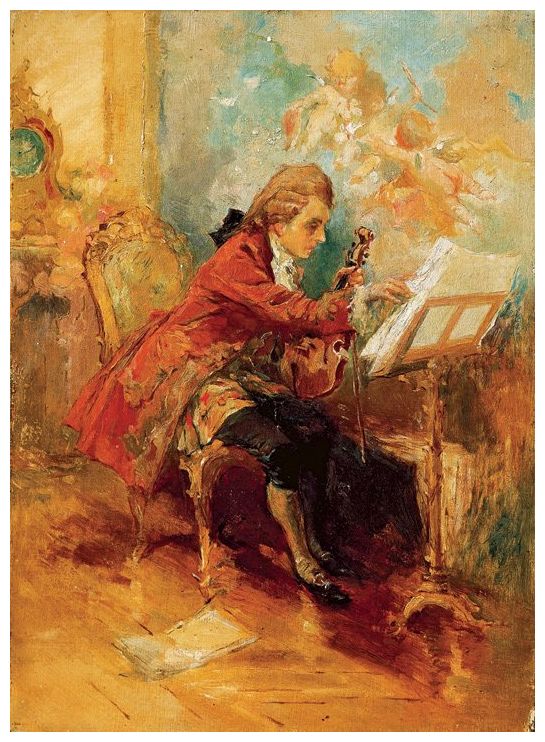
© DEA/G. Dagki Orti/Getty ImagesMozart
Yes, but no more than listening to Justin Bieber. The misconception that there's something unique about Mozart's ability to increase brainpower began in 1993, with a paper in Nature. Neurobiologists Gordon Shaw, Frances Rauscher and Katherine Ky of the University of California at Irvine found that students who listened to 10 minutes of a Mozart sonata demonstrated a temporary increase in spatial-temporal reasoning, as measured by an IQ test.
The public seized on the romantic idea that listening to Mozart would make them smarter, and Don Campbell, a teacher and music educator from Texas, capitalized on the notion with an international bestseller, The Mozart Effect.
But Glenn Schellenberg, a professor of psychology at the University of Toronto, says that there is no Mozart effect. Any number of experiences besides listening to music might improve cognition. Most people find the music of Mozart pleasant to listen to, and it might increase dopamine levels in the brain, which is generally thought to improve cognition. But "eating chocolate might have the same effect," Schellenberg says.
In 2010, a team of Austrian researchers analyzed the results from 39 attempts to replicate the Mozart effect. In most, a group of subjects listened to a Mozart sonata before testing their spatial intelligence. Scientists then compared the results against a control group that had not heard music. The researchers' findings were neatly summed up in their paper's title: "Mozart Effect Schmozart Effect."
Which isn't to say that listening to music can't give the brain a boost. Catherine Noelle O'Shea and David Wolf of the University of Texas Health Science Center in Houston recently found that doctors who listened to Mozart before screening patients for colon polyps found more polyps than those who didn't. Classical music probably made the doctors feel good, thereby improving cognition. If the doctors had been Bieber fans, it might have been better to play them some of his hits.




...functions better with the aid of well-ordered music.
[Link]
The ancients knew this was so. Here is what Aristotle said:
"Music directly imitates the passions or states of the soul...when one listens to music that imitates a certain passion, he becomes imbued withthe same passion; and if over a long time he habitually listens to music that rouses ignoble passions, his whole character will be shaped to an ignoble form."
Yes, there is some kind of Mozart Effect, if you will. No, listening to Mozart (or any other good music) will not make you smarter. The fact that the title question is falsely or misleadingly framed makes it reasonable to wonder if there is another agenda at work. Either way, good music assists and elevates the mind, heart, and soul, whereas disordered music drags us down by arousing our lower passions via the syncopated, jungle beat. Because music immediately affects the emotions, we easily become strongly attached to whatever music we like, whether or not it is good music that is good for us. Godspeed.