LAURA KNIGHT-JADCZYK AND JOE QUINN
Since the 9/11 attacks, no book has provided a satisfactory answer as to WHY the attacks occurred and who was ultimately responsible for carrying them out - until now.
· Riding the Wave: The Truth and Lies About 2012 and Global Transformation by Laura Knight-Jadczyk
No Kindle? Get the FREE Amazon Kindle Reader software for your computer, phone, or tablet!
| Current total: 194,061 € | Status: Level 2 |
I see a dynamo, a generator of electricity. Charged particles, check, rotation, check, magnetic field (the Earth's), check. That means there's a lot of electrical potential generated, and that's discharged in the form of lightning, of course.
But why haven't we managed to figure out how to capture that lightning yet? Ben Franklin famously tried to do it with a kite, and although he was probably very lucky not to have actually caught a lightning bolt, he had a good idea. There's immense power in thunderstorms. We should be able to harness it, capture it and store it. Aside from the capital needed to build the large aparatus necessary, it would be essentially free power.
We apparently understand lightning fairly well, in terms of what it is and how to protect equipment, structures and people against damage from it. [Link]
The link above posits the average lightning strike as creating an average potential of 7.5kV (up to 15kV, apparently) and average peak current of 30kA in a range from 9kA up to 400kA (yikes!).
Bear in mind here that a relatively few Amperes (A) of electrical current through any organism can kill it, if it passes through vital organs like the brain, spinal cord, heart, liver, etc. All electricians get shocks, and some will wet a fingertip and touch a connector to see if it's live rather than bother with a fumbling for a test light, at least with 110V circuits. 220V circuits are said to be safer, as they knock a person away (unless they grab it). I got too close to a 400V lead that delivered mere milliamps of current in a high school electronics shop once, working on a power supply unit. It put a row of holes in my right index finger as it threw me back several feet. Electronics repair people must have similar stories.
So, big power, kV and kA. How about big capacitors? Even just capturing part of lightning strikes in those big voltage and current spikes emanating from a tall lightning rod into the Earth ground would be useful. Or capture it all, by insulating the tower's base.
Why are we not doing this? Building big capacitors and circuitry to bleed off charge to large batteries or compressed air storage can't be beyond our technology. Can't we fab diodes and other parts with enough voltage and current capacity to manage this?
Or is it that case that the power utilities would rather sink money into nuclear power, which has the 'benefit' of generating an even flow of electricity, even though it poisons the planet, inexorably?
Hydropower, i.e. dams, also has its downside. The impounded pools behind dams silt up over generations, and the cost of that is deferred, of course. Maybe the silt can be recovered at great cost to combine with animal waste and refurbish the lost topsoil.
Wind power is also problematic. Aside from its variability, it has a bad aspect of chopping up the birds. You might scoff, but still.
Sea power has promise, but the ocean tends to destroy things.
We live on this electrical planet, so let's take some free energy.
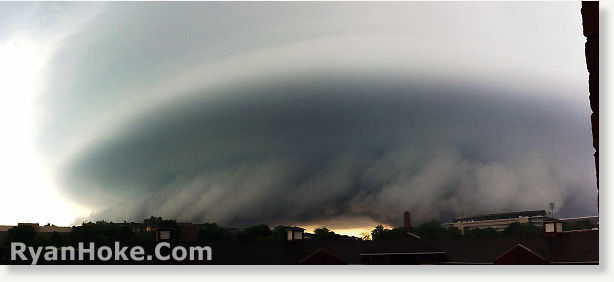
Gosh that's a scary looking storm!
griffen said:
"We live on this electrical planet, so let's take some free energy."
Once you factor in development costs, there just ain’t no such animal as free energy. But cheap is possible.
Lightening is too unpredictable to make a viable power source. And it’s potentially too destructive. So it remains a phenomenon to cover, and hide from.
It isn't coming from lightening, but here at my house we've got enough solar panels up on the roof that we can disconnect from the commercial power grid if we want. We have more than enough electricity for all our needs. And with zero emissions. Our batteries are a bank of 20 aircraft batteries that were salvaged after getting old enough to be condemned for further aircraft use. They might be too old to fly in airplanes anymore. But they still hold a good charge. And they’ll light a house for many years to come
We got a great price on the solar panels.The whole system cost us less than $16,000 installed. There are no moving parts to maintain. The solar panels make a nice looking roof when that roof is designed for them. And the system would work anywhere the sun shines.
The economic freedom of a home power system like ours is a no-brainer. But you won’t hear the big power companies encouraging their domestic use customers to become independent power producers. Lower demand from domestic consumers for the power they produce would drive down the price they can get from their remaining commercial customers.
that is one beautiful cloud/storm system!