
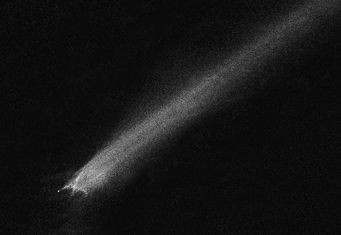
© NASA / ESA / D. Jewitt (UCLA)At first astronomers though the object designated P/2010 A2 was a comet, but this Hubble Space Telescope image, taken January 29, 2010, with the Wide Field Camera 3, suggests that it wasn't behaving like a normal comet.
Still, planetary astronomers acknowledge the existence of a handful of legitimate comets in the asteroid belt, and initially it appeared that the count had risen to five when the LINEAR survey spotted something with a tail last January 6th. Within hours it earned the designation P/2010 A2, indicating its stature as a periodic comet.
But this one seemed odd from the get-go, particularly due to its lack of a coma (cloud) surrounding its presumed nucleus and due to an orbit wholly within the inner asteroid belt. Suspicions grew deeper when David Jewitt (UCLA) and others wrangled some time on the Hubble Space Telescope to get a better look. The Hubble image revealed a bizarre X-shaped feature, strange striations in the dust tail, and (again) no hint of a coma.
The nucleus, only 24th magnitude in the Hubble view, corresponds to a modestly reflective object about 400 feet (120 m) across. "It's completely asteroidal," Jewitt told a gathering of planetary scientists last week. Seeing Hubble's view, he realized it was "some kind of rock that looks like a comet."
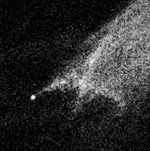
© NASA / ESA / D. Jewitt (UCLA)Enlarging a Hubble Space Telescope image taken January 29, 2010, shows the unusual crisscrossing filaments of the comet-like object designated P/2010 A2. Note the how one strand extends to the "nucleus' at left.
With the release today of a new series of Hubble images (choreographed by Jewitt's team) and an additional view from the European Space Agency's Rosetta spacecraft, it's now clear that P/2010 A2 resulted from an asteroid's abrupt breakup in early 2009 - a full year before astronomers picked up the pieces.
The eight Hubble images, taken this year between January 25th and May 9th, reveal a straight dust tail that gradually dimmed as the object drifted farther from Earth. It's crisscrossed with streaks that appeared to have be arcs of dust shed by the mysterious X and pushed outward by solar radiation pressure. According to team member Jessica Agarwal (European Space Agency), the 100,000 tons of ejected dust is mostly millimeters to centimeters in size - far coarser than the usual cometary fluff. No one can yet explain how the X-shaped feature came about.
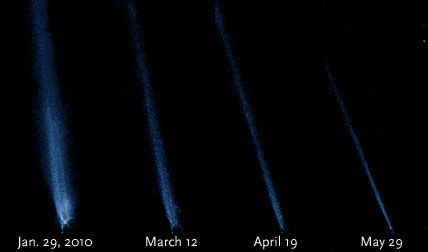
© NASA / ESA / D. JewittFour Hubble Space Telescope images, taken over a five-month period, show the odd-shaped debris that likely came from a collision between two asteroids and created "comet" P/2010 A2.
But the smart money is backing an outright collision. At the same meeting, Colin Snodgrass (Max-Planck-Institute for Solar System Research) and others deconstructed images of P/2010 A2 taken by the ESA's Rosetta spacecraft on March 16th. En route to its flyby of the large asteroid 21 Lutetia, Rosetta was positioned 10° above the object's orbit plane.
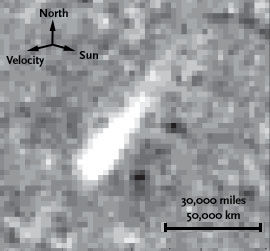
© ESA / OSIRIS team / C. SnodgrassRosetta's snapshot of P/2010 A2, taken March 16, 2010, clearly shows that the tail of dusty particles is neither aligned opposite the projected direction of the comet's motion nor in the direction opposite the Sun.
If an impact really was the cause, and because the debris remained visible a year after the fact, Jewitt notes that a similar small-scale smashups should occur annually. "One of these should be happening and observable at all times," he concludes. "The door is open to real-time disruption studies."
Detailed articles from the Snodgrass and Jewitt teams appear in the October 14th issue of Nature. Read a Hubble press release about the results here and one from Rosetta here.



Reader Comments
to our Newsletter