
With the ITER (International Thermonuclear Experimental Reactor) project ramping up, the international community's largest effort to date is about to launch, but key problems remain that could stop the project. Among the most pressing issues are containment and control of the plasma field. While critical advances in ultra-strong steels may help with the containment problems, control of the plasma -- an ultra-hot electrically charged broth of hydrogen isotopes -- remained problematic.
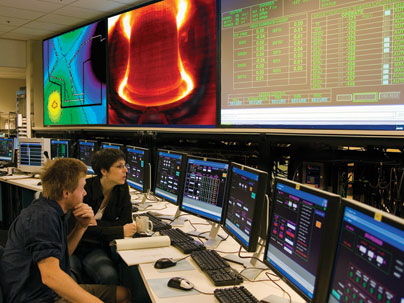
© P. Rivenberg/M.P. McNally, MITGraduate students Rachael McDermott and Eric Edlund hard at work performing experiments on the Alcator C-Mod tokamak; MIT researchers have unlocked a potentially game-changing technique to improve fusion power.
The result is that the plasma can be circulated inside the magnet field to push it towards the center of the tube, reheating it before it can cool too much by the chamber walls and short circuit the reaction. Further, the radio waves even help to reduce plasma turbulence which leads to loss of efficiency in fusion reactions.
The breakthrough has thus far lived up to vigorous testing at MIT's Alcator C-Mod tokamak-style fusion reactor, a world class design operating at MIT since 1993. The reactor is the largest in operation at any university and it has the highest magnetic field and the highest plasma pressure of any reactor in the world -- all ideal conditions to test the limits of the breakthrough.
Physicist Earl Marmar, division head of the Alcator Project at the MIT Plasma Science and Fusion Center (PSFC), and his researcher leaders, physicist Yijun Lin and principal research scientist John Rice discovered and tested the new phenomena and were shocked at its potential. Current control methods would not be able to handle larger reactors like ITER, but this method could. States Mr. Marmar, "People have been trying to do this for decades."
Mr. Lin states, "Some of these results are surprising to theorists."
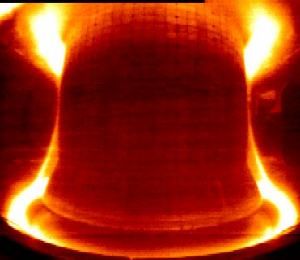
© Massachusetts Institute of Technology Controlling Alcator's plasma, pictured here, has been a critical goal for researchers as lack of plasma control has prevented fusion reactions in the past from being energetically profitable. MIT researchers think they've finally come up with a way to harness the plasma to their whims.
And now the method is finally working, although the theory is no closer to explaining why. Mr. Lin states, "Our results are just in time for this."
And that's not the only breakthrough from MIT. Another key worry is that runaway reactions could damage the reactor. If the plasma became out of control, it could eject a beam of high energy electrons, which could literally melt through the steel wall. While heavy shielding would protect the researchers, this could lead to weeks of repairs, turning it into the next LHC.
However, MIT researchers Dennis Whyte and Robert Granetz have developed a high tech fire-extinguisher, in essence, to extinguish the beam. In the case of an out of control reaction, they found that inject argon or neon gas will allow the electric energy to be absorbed and transformed into harmless light, preventing reactor damage. This phenomenon apparently works by making the magnet fields of the beam more disorganized, breaking it up. The results are incredible -- the world's brightest light flash -- approximately the light level of a trillion-watt bulb in ITER. This flash would be approximately equivalent to the entire power output of the U.S.
However, thanks to these improvements, the output of ITER may be even more impressive. With these upgrades in store, scientist may be able to tweak ITER to produce self-sustaining and energetically profitable fusion for the first time.



Reader Comments
to our Newsletter