
|
| ©NASA |
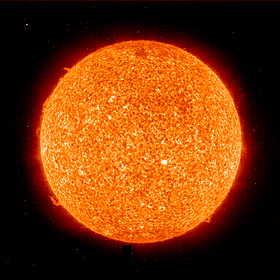
| Periods of inactivity are normal for the sun, but this period has gone on longer than usual. |
That's good news for people who scramble when space weather interferes with their technology, but it became a point of discussion for the scientists who attended an international solar conference at Montana State University. Approximately 100 scientists from Europe, Asia, Latin America, Africa and North America gathered June 1-6 to talk about "Solar Variability, Earth's Climate and the Space Environment."
The scientists said periods of inactivity are normal for the sun, but this period has gone on longer than usual.
"It continues to be dead," said Saku Tsuneta with the National Astronomical Observatory of Japan, program manager for the Hinode solar mission. "That's a small concern, a very small concern."
The Hinode satellite is a Japanese mission with the United States and United Kingdom as partners. The satellite carries three telescopes that together show how changes on the sun's surface spread through the solar atmosphere. MSU researchers are among those operating the X-ray telescope. The satellite orbits 431 miles above ground, crossing both poles and making one lap every 95 minutes, giving Hinode an uninterrupted view of the sun for several months out of the year.
Dana Longcope, a solar physicist at MSU, said the sun usually operates on an 11-year cycle with maximum activity occurring in the middle of the cycle. Minimum activity generally occurs as the cycles change. Solar activity refers to phenomena like sunspots, solar flares and solar eruptions. Together, they create the weather than can disrupt satellites in space and technology on earth.
The last cycle reached its peak in 2001 and is believed to be just ending now, Longcope said. The next cycle is just beginning and is expected to reach its peak sometime around 2012. Today's sun, however, is as inactive as it was two years ago, and scientists aren't sure why.
"It's a dead face," Tsuneta said of the sun's appearance.
Tsuneta said solar physicists aren't like weather forecasters; They can't predict the future. They do have the ability to observe, however, and they have observed a longer-than-normal period of solar inactivity. In the past, they observed that the sun once went 50 years without producing sunspots. That period coincided with a little ice age on Earth that lasted from 1650 to 1700.
Tsuneta said he doesn't know how long the sun will continue to be inactive, but scientists associated with the Hinode mission are ready for it to resume maximum activity. They have added extra ground stations to pick up signals from Hinode in case solar activity interferes with instruments at other stations around the world. The new stations, ready to start operating this summer, are located in India, Norway, Alaska and the South Pole.
Establishing those stations, as well as the Hinode mission, required international cooperation, Tsuneta said. No one country had the resources to carry out those projects by itself.
Four countries, three space agencies and 11 organizations worked together on Hinode which was launched in September 2006, Tsuneta said. Among the collaborators was Loren Acton, a research professor of physics at MSU. Tsuneta and Acton worked together closely from 1986-2002 and were reunited at the MSU conference.
"His leadership was immense, superb," Tsuneta said about Acton.
Acton, 72, said he is still enthused by solar physics and the new questions being raised. In fact, he wished he could knock 22 years off his age and extend his career even longer.
"It's too much fun," he said. "There's so much exciting stuff come up, I would like to be part of it."
A related article on the Hinode mission is located [HERE]
Evelyn Boswell, (406) 994-5135 or evelynb@montana.edu




Actually, the emphasis suggests that it is not such a small concern at all.