
|
| ©Johns Hopkins University Bloomberg School of Public Health |
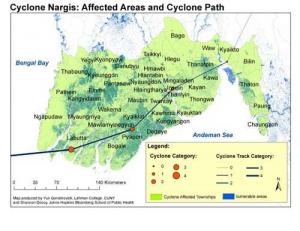
| Cyclone Nargis: Affected areas and cyclone path. |
"We estimate that 20 percent of the population in the four affected administrative divisions could be affected by Cyclone Nargis," said Shannon Doocy, PhD, an assistant professor with the Center for Refugee and Disaster Response, who developed the vulnerability estimates with colleagues from the Bloomberg School's Center for Public Health and Human Rights, and from Lehman College. "These are rough estimates, but our calculations could be of great help to relief agencies that are trying to provide aid on the ground."
According to the calculations, the Ayeyarwady region was hardest hit, with 1.8 million people affected; another 1.1 million were potentially affected in the Yangon administrative division. At least 100,000 people in both the Bago East and Mon divisions were also affected. The United Nations estimates that as many as 220,000 are missing following the cyclone and that 63,000 to 101,000 people were killed.
Major health threats for cyclone survivors include waterborne diseases such as typhoid, which has already been reported in some areas and potential outbreaks of dysentery from cholera and E. coli. Measles outbreaks, which are common in settings of mass displacement, are a concern for children and a possible threat. Mosquito-borne diseases, particularly malaria and dengue fever, are prevalent in Burma and are also significant health risks.
"Right now, the risk of disease outbreaks in Burma is especially high - much more so than we've typically seen with tropical cyclones in past decades - because the humanitarian assistance so far has been delayed and woefully inadequate in scale," said Chris Beyrer, MD, MPH, director of the Center for Public Health and Human Rights.
"The military regime continues to rebuff offers of assistance from the international community more than a week after the storm, and they continue to restrict visas, limit international observers, and insist upon relying solely on its own response, which by all accounts, is markedly inadequate." Beyrer added that international guidelines on human rights and natural disasters cite the right of all affected populations to evacuation and other lifesaving measures, protection against negative impacts of natural hazards, and access to adequate food, water, shelter, sanitation and health services.
In addition to estimating the population vulnerability, the Bloomberg School is working with its partners based in the region to provide assistance to the Burmese people. Eight, five-person relief teams are working in Rangoon, Burma's largest city, and in the country's delta region. These teams, which are trained by Hopkins personnel in rapid assessment and response, are assisting with water purification and the distribution of food, clothing, medicines and other essentials.
The researchers were supported by a grant from the Human and Social Dynamics Program at the National Science Foundation.
Adapted from materials provided by Johns Hopkins University Bloomberg School of Public Health.


Reader Comments
to our Newsletter