
|
| ©Mariana Felix |
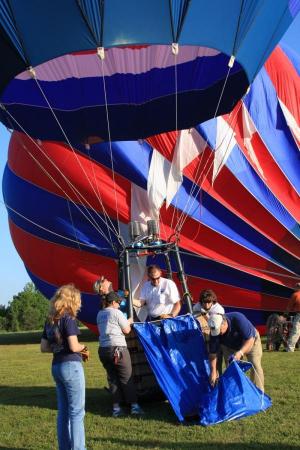
| UA Huntsville graduate students and staff attach a bundle of asphalt shingles to Randy Sedlak's balloon as part of an experiment to help scientists improve tornado forecasting. |
The payloads dropped by the balloons were similar to the types of debris thrown into the air by tornados that touch the ground. Scientists at UAHuntsville's Earth System Science Center hope the Doppler radar data collected will be a first step toward programming National Weather Service Doppler radar to recognize tornado debris, so more timely and precise tornado warnings might be issued.
"We still have to inspect and analyze the data," said Dr. Walt Petersen, a UAHuntsville research scientist, "but there is a real possibility that we got useful data. We have to go back through and take out the balloons' radar signatures. We should be able to do that and, if we can, whatever is left was the debris."
"I'm just glad to finally do something useful through ballooning," said Dave Knoblock, a hot-air balloon pilot from Montgomery, Ala., whose payload included scrap lumber and wooden shutters.
A dozen balloon pilots and their ground crews volunteered to take part in the experiment, but marginal wind conditions at the experiment site grounded most of the aircraft.
"We did learn more about how we might pursue this in the future," Petersen said. "The experiment provided us with several questions we can answer and several we might not be able to answer. We're trying to do something difficult. We're trying to simulate a tornado."
The balloon experiment was the follow-up to a Feb. 6 tornado in nearby Lawrence County, Alabama. Debris from that killer storm was picked up by an experimental weather radar jointly operated by UAHuntsville and WHNT-TV.
Two of Petersen's UAH graduate students, Chris Schultz and Elise Johnson, monitored the radar that morning from the safety of their temporary operations center -- the bathroom in Schultz' apartment, "in case we had to dive into the bathtub."
Schultz later suggested to Petersen that there might be a debris signature associated with the Lawrence County storm.
That was the first time a significant tornado hit within range of the advanced radar unit at the Huntsville (Ala.) International Airport put into service in late 2004. Other storm-related debris sightings using similar radar technology near Enterprise, Ala., and at the National Severe Storms Laboratory in Norman, Okla., have been rare, so every sighting adds substantially to the paltry information previously available.
The Advanced Radar for Meteorological and Operational Research (ARMOR) was developed jointly, with UAHuntsville and WHNT collaborating to upgrade a decommissioned former National Weather Service Doppler radar unit.
ARMOR is a dual polarimetric radar, while most other weather radar units are single polarity. Dual polarization gives ARMOR the ability to gather more data about the size and shape of particles in the air. Initially it was thought that the dual polarization capability would help scientists learn more about severe storms, identify hail or snow, and better estimate rainfall. The ability to recognize flying debris wasn't something scientists expected.
If computers can be programmed to recognize debris in the radar data, that programming might be a standard feature when the National Weather Service upgrades its existing nationwide NEXRAD radar network to dual polarimetric capabilities beginning in 2009.
While the debris feature might not reduce the number of false tornado warnings, it could add a level of urgency and precision to warnings when tornadoes do occur, Petersen said.
"The real advantage would be the precision," he said. "These events are usually going to be associated with large scale mesocyclones, so tornado warnings would probably already have been issued. But those large-scale rotation features can cover several miles.
"With this debris signal, we might be able to pinpoint the precise spot where a tornado is on the ground. It would be great to be able to say, 'The tornado is right there, at that town.' If you could automate a system to do that, it would be quite handy and useful."
ARMOR picked up the radar reflection of debris thrown as much as two miles into the air by the tornado. The funnel-shaped plume first shows up on the radar screen above the Pinhook community, close to the time that the tornado was rated as very intense (EF-3 on the extended Fujita scale).
"There's nothing else we can come up with to explain this," Petersen said. "Things match up so well, this is not coincidence. We think our first impressions were correct, that this is indeed a debris signature."
The data analysis and related work are supported by funding secured by U.S. Sen. Richard Shelby for the Tornado and Hurricane Observations and Research Center (THOR) test bed facility at The University of Alabama in Huntsville.
Adapted from materials provided by University of Alabama Huntsville.



Reader Comments
to our Newsletter