
Spanish palaeontologists have dug up the remains of a 1.2-million-year-old humanlike inhabitant of Western Europe. The fossil find shows that members of our genus, Homo , colonized this region far earlier than many experts had thought.
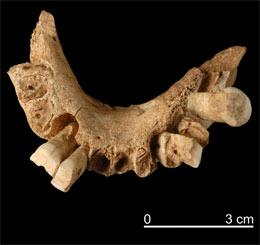
The primitive hominin - represented by just a fragment of jawbone bearing a handful of wobbly-looking teeth - lived in what is now the Sierra de Atapuerca region of northern Spain, an area already known as a treasure trove of early human remains.
|
| ©EIA/Jordi Mestre |
| The petite jaw suggests the oldest-found European was probably female. |
The new fossil, uncovered by an experienced team of palaeoanthropologists led by Eudald Carbonell of the Universitat Rovira i Virgili in Tarragona, is by far the oldest human bone ever found in the region. The previous oldest fossils have been perhaps 800,000 years old, leading some anthropologists to believe that primitive humans did not reach Western Europe until around half a million years ago.
Now it seems that the earliest inhabitants of modern-day Spain lived there much longer ago. And like many of today's Spaniards, it seems they were enthusiastic meat-eaters - Carbonell and his team also uncovered primitive stone tools and animal bones bearing signs of butchery. They report the find in this week's Nature.
Georgian journey
The new discovery gives weight to the theory that Homo reached Europe not long after leaving Africa almost 2 million years ago. The oldest known hominin fossils outside Africa are aged at around 1.7 million years, and come from Dmanisi, in the former Soviet republic of Georgia.
|
| ©EIA/Jordi Mestre |
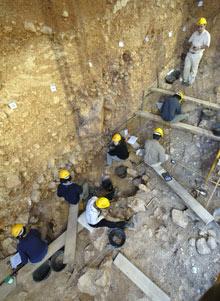
| The Sierra de Atapuerca region of northern Spain is a treasure trove of early human remains. |
The Dmanisi fossils belong to Homo erectus , the prodigious species that experts believe set off eastwards from Africa and went on to colonize much of Asia. The new fossil adds credence to the idea that, after reaching Asia, some of these travellers doubled back and headed west into Europe, suggests Carbonell's colleague, José Bermúdez de Castro of the National Centre for Human Evolution Research in Burgos.
Somewhere along their journey, the founders of the Atapuerca population evolved into a distinct species. The Spanish team has provisionally assigned the newfound fossil to Homo antecessor ('pioneer man'), a species that they suggest could be the last common ancestor of Neanderthals and Homo sapiens . The newly discovered individual's petite jaw suggests she was probably female.
Early Europe
Stone tools of about the same age or older - about 1.5 million years old - have been previously found in France, Italy and Spain, says Chris Stringer, who studies human evolution at the Natural History Museum in London. This is the first verifiable human material of this vintage, backing up claims that the nearby tools were made by primitive humans.
|
| ©EIA/Jordi Mestre |
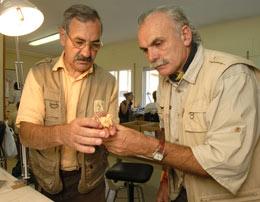
| José Bermúdez de Castro and Eudald Carbonell examine their find. |
"When combined with the emerging archaeological evidence, it suggests that southern Europe began to be colonised from western Asia not long after humans had emerged from Africa - something which many of us would have doubted even 5 years ago," Stringer says.
"There has been controversy over hominids in Western Europe before 1 million years ago, and this should lay that to rest," says Tim White, a palaeoanthropologist at the University of California, Berkeley. But he says he is still unsure whether that population descended from west Asians or not. "There's a lot of time and distance between [the Dmanisi] collection and this one mandible in Western Europe," he says.
And our picture of human migration could change again. Perhaps fossil-hunters will one day find the remains of yet-hardier pioneers who managed to find a way through northern Africa directly into Europe, White suggests. "A single discovery can change the picture. We just don't know."



Reader Comments
to our Newsletter