sott.net


Featured Book:

2500 Strand: Growing up in Hermosa Beach, California, during World War II

NEW!! Available Now!


SOTT Focus Listing

· SOTT Focus articles listed by author


Latest Topics on the Signs Forum
· Air Force Aims for 'Full Control' of 'Any and All' Computers
[ Cyre2067 ]
· Polycarpe de la Rivière
[ jlarka ]
· Of Shoes and Ships and Sealing Wax
[ lory ]
· Dream from the beggining of my past
[ Emiyash ]
· rEvolver
[ noise ]
· State forces aboriginal child to undergo chemotherapy
[ PepperFritz ]
· Some families starting to question "Hyper-Parenting"
[ PepperFritz ]
· When Myelin Is The Cause, Might Nicotine Be the Cure?
[ shagawa ]

Firefox 2
This site best viewed
with Mozilla Firefox

SuperSearch Help


Fred Guterl
Discover Magazine
Tue, 11 Mar 2008 08:16 EDT

Science & Technology

Sometime in August 2011, a boxy space probe called Dawn will settle into orbit around one of the most underrated and overlooked objects in the solar system, a giant oblong asteroid named Vesta. After lingering for almost 10 months of study, Dawn will depart for Ceres, the biggest asteroid of all. Ceres is so large that it was recently promoted to the rank of dwarf planet, putting it on a par with Pluto and highlighting its status as a key planetary missing link.

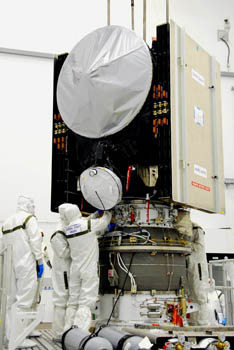
Dawn Probe
©NASA
Dawn Probe

Vesta and Ceres are the big enchiladas of the asteroid belt, a loose collection of rubble left over from the earliest days of the solar system. They are interesting because they're like time capsules. "These two bodies are building blocks," says Chris Russell, the principal investigator for the Dawn mission. It was asteroids like these that "came together to make the rest of the planets. It might have taken millions of Vestas and Cereses to make Earth. We want to understand how the building blocks were different from one another and how they came together to build the planets. Vesta and Ceres represent an important stage in the history of the solar system."

Vesta and Ceres, along with the rest of the material in the aster­oid belt, would have coalesced into a planet too, were it not for Jupiter's powerfully disruptive gravity. Ceres is 585 miles wide and contains more than a quarter of all the mass in the asteroid belt. It was the first asteroid discovered, spotted by Italian astron­omer Giuseppe Piazzi in 1801. Vesta, the second-largest asteroid, was discovered six years later. For a few years, both were regarded as bona fide planets, but scientists soon discovered many more small bodies in similar orbits. In the mid-1800s these objects were reclassified as "asteroids" and largely dismissed as bit players. It has taken a century and a half to shift that view.


Discuss on SOTT Forum


Reader Comments
 
(Register to add your comments!)


Donate to Signs

Donate once - or every month! Click here to learn how you can help!

Have a question or comment about the Signs page? Discuss it on the Signs of the Times news forum with the Signs Team.

Emails sent to Signs of the Times, Ark, Laura, or Cassiopaea become the property of Quantum Future Group, Inc and may be republished without notice.

Some icons appearing on this site were taken from KDE-look.org, Afterglow, Mayosoft, Everaldo, IconDrawer, VisualPharm, IconFactory, Klukeart, Icons-land, and TpdkDesign.net
.

Remember, we need your help to collect information on what is going on in your part of the world!
Send your article suggestions to: SOTT e-mail address


Original content copyright 2008 by Signs of the Times. See: Fair Use Policy

560 people have viewed this page since Thu, 13 Mar 2008

ATOM Feed   RSS

[Valid Atom 1.0]   [Valid RSS 2.0]