
Chondrites are stony chunks of asteroid, likely common in space, that contain materials similar to those found in Earth's crust.
|
| ©Reuters/STR New |
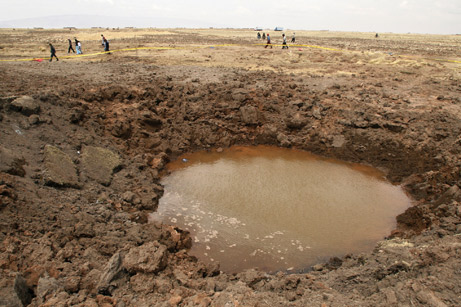
| A meteor slammed into the southern Peruvian town of Carangas on September 16, 2007, leaving a 50-foot-deep (15-meter-deep) crater, seen here two days after the impact. New investigations of the crash site reveal that the meteor stayed as one piece during its journey through Earth's atmosphere, challenging previous views that such objects break apart and scatter before hitting the ground, experts say. |
Scientists have thought that the objects break up into flattened clusters of particles that spread out like a pancake as they plunge into Earth's atmosphere, said Peter Schultz, a geology professor from Brown University who studies meteorite impacts.
This would cause the pieces to burn up in the atmosphere or slow down and drop to the ground like rocks dropped from an airplane.
The fragments would make holes in the ground like pits - but not craters, according to Schultz.
Yet "the [Peruvian] meteorite kept on going at a speed about 40 to 50 times faster than it should have been going," defying the theory, Schultz said.
In fact it came down intact as a giant fireball at about 15,000 miles (about 24,000 kilometers) an hour, creating a 50-foot-deep (15-meter-deep) crater.
This unusual occurrence had some scientists wondering if the Peruvian crater might have been caused by something different, or even faked, Schultz said. "At the time, rumors were flying."
So he traveled to Peru to look at the crater, which is located in the village of Carangas, near the Bolivian border.
The Real Thing
The most likely alternative was that the impact was simply the largest of a widely strewn field of meteor fragments, and the scientists found only only one crater.
The fabricated-meteorite-crater theory was then ruled out when Schultz's team found "shock" features and intricate mixing of the meteoritic dust in the surrounding rock, indicating that something had indeed crashed into it.
The question is how the meteor-which Schultz estimates to have been roughly the equivalent of a three- to six-foot-long (one- to two-meter-long) boulder-managed to stick together and retain its speed, rather than dispersing into a shotgun blast of small fragments.
In research presented today at the Lunar and Planetary Science Conference in League City, Texas, Schultz and colleagues suggested that the fragments might have been trapped and smoothed into an aerodynamic shape by the shock wave created by their movement through the atmosphere.
He compares it to the way sediments in a streambed can be shaped by flowing water.
"Rather than flying apart," he told National Geographic News, "[perhaps] it shaped into a needle and pierced the atmosphere."
Owen B. Toon, an atmospheric scientist at the University of Colorado at Boulder who was not involved in the study, finds it "quite interesting."
"We know from impacts such as Tunguska [a Russian crater from a 1908 impact] that fairly large objects [half a football field in diameter] can blow up in the atmosphere and leave no crater or obvious debris field on the ground," he said by email.
"The behavior is related to the strength of the material, since iron objects of this size leave a large crater behind. Hopefully Peter [Schultz] will learn more about the crater and impactor in this article so that we can understand better how it reached the surface."
Protection Needed
Regardless of what happened, Schultz wants to see the crater protected for future research.
Humans rarely see a meteorite landing, he said-for instance, "Meteor Crater [in Arizona] is 50,000 years old."
(See a photo of Meteor Crater.)
Furthermore, the Peruvian meteor's surprising arrival raises the question of how many more meteors may have crashed into Earth in a similar fashion.



Reader Comments
to our Newsletter