
|
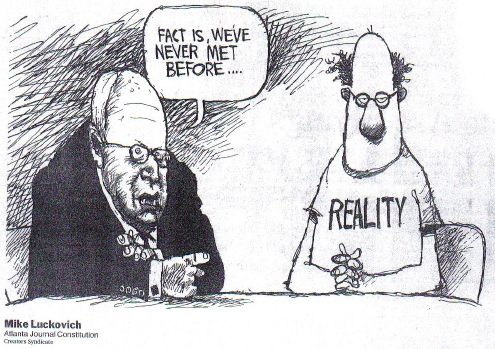
| ©Atlanta Journal Constitution |
We have already established in the first articles in this series that the insiders are psychologically deviant. What do we mean?
A healthy world view is one that sees the world as it is. Only by seeing the world as objectively as possible can we come up with plans and strategies that fit the facts and that enable us to navigate successfully. If our understanding of reality is wrong, then success can only be subject to chance. Such a view is understood in the sciences. It is obvious that an hypothesis or an experiment that does not take into account the reality being tested will fail. Of course, even failures help us to learn about the world; we eliminate erroneous possibilities and theories. Our knowledge can thus advance, but only if we recognize the error of our ways.
It is no different in everyday life. If we misjudge the speed of a car coming at us as we cross the street, we may not live to learn from the experience. If we mistake an enemy as a friend, we could lose our savings, our homes, or our jobs. So let's take as our definition of healthy perception that which gives us an objective as possible view of the world.
Unfortunately, we all have blind spots and ideas about the world that are wrong and that influence our perceptions. Often they are based upon limited information or a cherry-picking of facts. We pick the data to suit our desired conclusion. Our desires of what we want or how we wish the world to be deform our world view, replacing objective information with subjective information. Some of these are political or economic ideologies that we seek to impose on the world: belief in a free market or in a controlled market, for example; belief in State's rights or in a strong federal government; belief that a particular form of government is the best. Our views, and therefore our perceptions, become rigid and unable to respond to a fluid and ever-changing reality.
Then, there is the influence of emotions. We all have had experiences where we were tired or angry, and we didn't see the world as it is. Perhaps we misunderstood someone who was talking to us, projected onto them our own anger. Or we have an emotional investment in some idea, cause, or ideology. We can also react based upon programs instilled in us when we were children, defence mechanisms that may have had their use when we were young and dependent, but which only harm us when they kick in as adults. These programs are other types of filters that distort our perceptions.
These are all forms of deviant thought because they deviate from reality; they do not match the world as it really is. In recent years, even the idea that there is an objective and knowable world has been put into question. We are told that we all live in our own realities and that these are somehow sacrosanct. The idea that the world is knowable and that this knowledge can be communicated to others is rejected.
The effect of deviant thought is to move us away from an objective assessment of reality and to encourage our individual, subjective views of the world where we take things to be as we wish them to be, not as they are. We learn to ignore the world as it really is and replace it with a vision comprised of slogans ("We're bringing democracy to Iraq", "America is the land of the free", "Looking out for number one") and wishful thinking ("Jesus is returning and will save me", "Our leaders would never do that"). Plans and actions that are based upon a subjective, and therefore erroneous, understanding of the world can only lead to greater and greater chaos.
And isn't that exactly where our leaders have been taking us for as long as we can remember?
Psychopaths have their own conception of reality. They believe it can be declared by fiat, by the power of their words.
Psychologist Amos Gunsberg wrote a harrowing appraisal of psychopaths called "Beyond Insanity". He describes an encounter with a client:
I asked a psychotherapy client to look at a chair which was situated about six feet away near a wall. I then asked her to describe the chair. She did, in rather complete detail, except for the legs. THE CHAIR SHE DESCRIBED HAD NO LEGS!His article is a worthy read, frightening as it might be, so frightening that many prefer to ignore or ridicule it. Gunsberg succinctly sums up the reality of the psychopath when he writes:
I pointed this out, and asked how the chair could be suspended in air, with no legs to support it. She said: "I put it there." I asked: "If you look away, will it fall to the floor?" She said: "No. If I look away, the chair is no longer there." I asked: "If you look away . . . and it turns out the chair is still there?" She ignored the question.
For them, whatever they "declare" is what's real. What WE call reality is not real to them. THEY "pronounce" what is to be considered real.Compare the psychopath's view of reality, as described above, with this story from the ultimate insiders, the Bush White House. In 2004, former Wall Street Journal reporter and author Ron Suskind wrote in The New York Times Magazine:
"In the summer of 2002, after I had written an article in Esquire that the White House didn't like about Bush's former communications director, Karen Hughes, I had a meeting with a senior adviser to Bush. He expressed the White House's displeasure, and then he told me something that at the time I didn't fully comprehend - but which I now believe gets to the very heart of the Bush presidency.Notice any similarities between the Bush aide and the client in Gunsberg's office? Are you beginning to get a feel for what we are up against?
"The aide said that guys like me were 'in what we call the reality-based community,' which he defined as people who 'believe that solutions emerge from your judicious study of discernible reality.' I nodded and murmured something about enlightenment principles and empiricism. He cut me off. 'That's not the way the world really works anymore,' he continued. 'We're an empire now, and when we act, we create our own reality. And while you're studying that reality - judiciously, as you will - we'll act again, creating other new realities, which you can study too, and that's how things will sort out. We're history's actors ... and you, all of you, will be left to just study what we do.'"
The insiders, that is, psychopaths and other pathological types, are not like us. And they know it. You might well say that they live in their own reality. The trouble is, they are working very hard to make that reality our reality, and they are succeeding.
As long as we remain blind to the reality of their existence and just how different they are from the rest of us, we will never live in a healthy world.







one could be forgiven for wondering whether or not the legless chair, cited in the article above, really does exist when nobody's looking at ... oh... I think I should stop now :p)