
"This finding shows that nature may be richer than we suspected, with more than one way to make a white dwarf explode," said Harvard graduate student and first author Malcolm Hicken.
The paper describing this discovery appeared in the November 1 issue of The Astrophysical Journal Letters.
Astronomers characterize an observed supernova based on whether its spectrum shows evidence of hydrogen (Type II) or not (Type I). In Type II, a massive, short-lived star undergoes core collapse and explodes. In the conventional picture for Type Ia, the most common supernovae lacking hydrogen, a white dwarf star collects gas from a companion star until it undergoes catastrophic nuclear fusion and blasts itself apart.
The new find, supernova 2006gz, was classified as a Type Ia due to the lack of hydrogen and other characteristics. However, an analysis combining CfA data with measurements from The Ohio State University suggested that SN 2006gz was unusual and deserved a closer look.
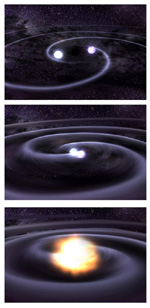
|
| ©CfA Press Release |
Most importantly, SN 2006gz showed the strongest spectral signature of unburned carbon ever seen. Merging white dwarfs are expected to have carbon outside their densest regions. The powerful explosion from the inside then should push off the outmost carbon-rich layers.
The spectrum of SN 2006gz also showed evidence for compressed layers of silicon. Silicon was created during the explosion and then compressed by a shock wave that rebounded from the surrounding layers of carbon and oxygen. Computer models for merging white dwarfs predict both the carbon and silicon spectral signatures.
Additionally, SN 2006gz was brighter than expected, indicating that its progenitor exceeded the 1.4 solar mass Chandrasekhar limit - the upper bound for a single white dwarf. Only one other potential example of a super-Chandrasekhar supernova has been seen: SN 2003fg. While observations of that event were suggestive, the data from SN 2006gz are much stronger.
"Our case is different. Although 2006gz is also extra bright, the chemistry we see, particularly unburned carbon, is well observed and very unusual," said Harvard astronomer Robert Kirshner, a member of the discovery team.
In addition to providing the first example of a new way to make supernovae, SN 2006gz holds implications for the field of cosmology. Type Ia supernovae typically have a narrow spread in brightness, which makes them useful as "standard candles" for calculating cosmic distances. It was the study of Type Ia supernovae that led to the discovery of dark energy, the mysterious force causing the expansion of the universe to accelerate.
If Type Ia supernovae are more varied than previously expected, then astronomers must be extra cautious when using them to study the cosmos.
"Supernova 2006gz stands out from normal Type Ia objects and wouldn't be included in cosmology studies," commented Hicken. "But we have to be careful not to mistake a double white dwarf explosion for a single white dwarf blast. SN 2006gz was easy to recognize, but there may be less clear-cut cases."
The full list of authors of the study is: Malcolm Hicken, Stéphane Blondin and Robert Kirshner (CfA); Peter Garnavich (University of Notre Dame); Jose Prieto and Darren DePoy (The Ohio State University); and Jerod Parrent (University of Oklahoma). This research was supported by the National Science Foundation.
Headquartered in Cambridge, Mass., the Harvard-Smithsonian Center for Astrophysics (CfA) is a joint collaboration between the Smithsonian Astrophysical Observatory and the Harvard College Observatory. CfA scientists, organized into six research divisions, study the origin, evolution and ultimate fate of the universe.



Reader Comments
to our Newsletter