
Comment: Week after week, 'newly-discovered' asteroid after 'newly-discovered' asteroid, closer and closer...
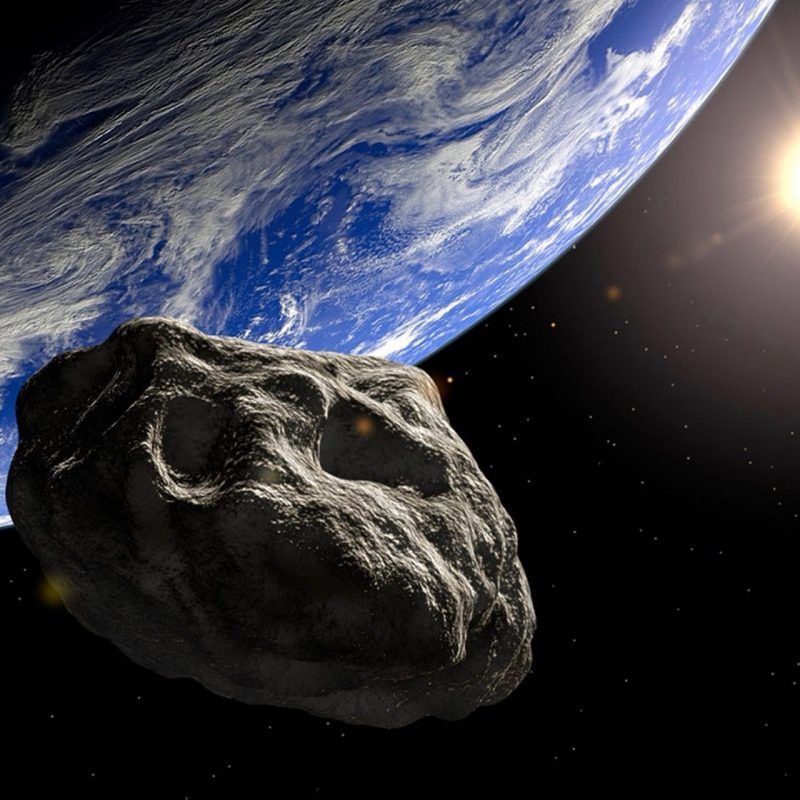
According to data from these early observations, the asteroid came closer to the surface of our planet (without actually colliding with our atmosphere) than any other close approach in NASA's database of known near-Earth objects.
A near-Earth asteroid currently identified as C0PPEV1 was spotted in the early morning hours Thursday by the Catalina Sky Survey, based in Arizona, and shortly thereafter by New Mexico's Magdalena Ridge Observatory and Arizona's Mt. Lemmon Steward Observatory.
Comment: Just to be clear (because the author isn't): it was only FIRST DISCOVERED at this point.
According to data from these early observations, the asteroid came closer to the surface of our planet (without actually colliding with our atmosphere) than any other close approach in NASA's database of known near-Earth objects.
Simulations show the asteroid passing above southern Africa within 3,852 miles (6,200 km) at the moment of closest approach, around 7:45 a.m. PT. To get an idea of how close this is, consider that many telecommunications satellites orbit at an altitude of 22,236 miles (35,786 km).
Of course, some asteroids come closer and actually impact our planet, like the previously unseen bolide that exploded as it smacked into the atmosphere over Russia in 2013. A much smaller asteroid also collided with the atmosphere last year and burned up, leaving little bits of meteorites that are thought to have fallen over Africa.
Just like a Hollywood jump scare though, this late October asteroid poses no actual threat. It has already passed by us at a speed of nearly 27,000 miles per hour (43,452 kph) and is likely only between 2 and 7 meters in diameter, which is too small to do major damage even if it had impacted.
What's really remarkable about this spooky space rock sighting is that it speaks to how astronomers are getting better at spotting incoming asteroids. It's very possible that we're getting buzzed by cosmic boulders on the regs, and always have been, but we're just now getting a sense of how much traffic is really up there.




Comment: No, we were NOT getting pinged like this before.
In just the last couple of decades, there has been a steady increase in:
- the number of 'new moons' acquired by the solar system's planets
- impacts on bodies such as our Moon and Jupiter
- meteor fireball events in our atmosphere
- the number of asteroids/comets circulating the inner solar system
That is NOT all just 'thanks to better detection'. Standards are slipping in every other field, so there's no reason to suppose they're excelling in the other direction in just this one field...These 'newly discovered' space rocks are buzzing by at an alarming frequency:
- Incoming! ANOTHER asteroid - discovered just today - to make fly-by this week
- NASA reveals 2019 SR8, an asteroid the size of London's Nelson's Column just skimmed past Earth
- Asteroid swarm: SEVEN asteroids to zoom past Earth today! NINE more later this week...
- 1,247 ft asteroid 2019 GT3 skims Earth tonight
- 2 asteroids to scream past Earth Wednesday, including one discovered only last week
- NASA researcher warns there is '100 percent chance an asteroid will hit us'
A perfect occasion to read or re-read Witches, Comets and Planetary Cataclysms