
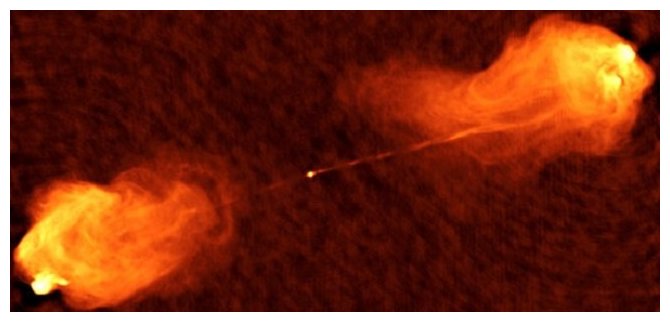
© NRAO/AUIThe galaxy Cygnus A "shines" in radio frequencies (seen here), coming from relativistic electrons zipping along jets shot out from the central black hole and deposited in giant "radio lobes." (The lobes extend outward roughly 10 times farther than the galaxy itself, which is invisible in this image.)
That galaxy is the elliptical Cygnus A. Cygnus A is one of the brightest radio sources in the sky. It lies approximately 800 million light-years from us (redshift of 0.056). In its core sits a supermassive black hole madly eating and cocooned in gas, while two jets shoot out to either side and light up the intergalactic medium. This activity produces the radio radiation that makes Cygnus A so bright.
Using the recently upgraded Karl G. Jansky Very Large Array (VLA) in New Mexico, Rick Perley (NRAO) and colleagues took a gander at Cygnus A — the first time the instrument has looked at the galaxy since 1989. (Apparently astronomers spent so much VLA time observing the galaxy in the 1980s that they didn't feel the need to look again, Perley joked January 6th in his AAS presentation.) The new observations showed a surprise: a new, secondary object just southwest of the central black hole. This object wasn't in the 1989 radio image. Additional, higher-resolution observations with the Very Long Baseline Array also picked up the object, clearly distinct from the galaxy's nucleus. It's roughly 1,300 light-years from the center.
The whatever-it-is is about twice as bright as the brightest known supernova at these frequencies. In fact, it's much brighter than just about any transitory radio signal known, except for accreting supermassive black holes and tidal disruption events, outbursts created when a black hole eats a star.
The team scoured other archives and found the object in 2003 Keck infrared observations and, more iffily, in some images from Hubble. (The object is so red that it doesn't show up well at optical wavelengths, and in this range the space telescope's resolution isn't as good as that of Keck's adaptive optics.)
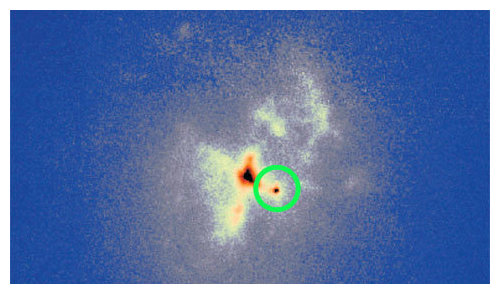
© G. Canalizo et al. / Astrophysical Journal 2003This false-color infrared image from the Keck II telescope shows the galaxy Cygnus A. Its central supermassive black hole is the large red-black splotch, but this 2003 image reveals a second, mystery source (circled) nearby.
The team determined that the whatchamacallit wasn't a foreground object in the Milky Way, nor a cluster of young stars in Cygnus A. Rather, it seemed to be a compact cluster of old, red stars, with all the trappings of being the stripped-down core of a much smaller galaxy that Cygnus A had eaten. That minor merger might also explain why the big galaxy's black hole has "turned on," the astronomers suggested in their 2003 Astrophysical Journal paper.
On the other hand, Canalizo and colleagues went on to suggest in 2004 that the source might instead be a peek at the hot inner rim of the dusty doughnut enshrouding the black hole.
Perley's team favors a merger, too. But he advocated instead that the radiation might come from a second black hole, the leftover core of the eaten galaxy. If so, then Cygnus A is one of a few galaxies that seems to host a central binary black hole.
At the end of his presentation Perley called for others to look through their archival observations so that astronomers can pinpoint when this source appeared. His team is also looking in X-ray, but given that the central nucleus is so bright, they're not optimistic of their chances of seeing something, unless there's some variability. A formal paper and press release (with cool images!) are in the works, and when they're out we'll update you with more info.
References:
Richard A. Perley et al. "Serendipitous Discovery of a Radio Transient in the Luminous Radio Galaxy Cygnus A." 229th American Astronomical Society. Abstract 319.06.
Gabriela Canalizo et al. "Adaptive Optics Imaging and Spectroscopy of Cygnus A. I. Evidence for a Minor Merger." Astrophysical Journal. November 10, 2003.
Gabriela Canalizo et al. "Penetrating Dust Tori in AGN." Penetrating Bars through Masks of Cosmic Dust. 2004.



Reader Comments