
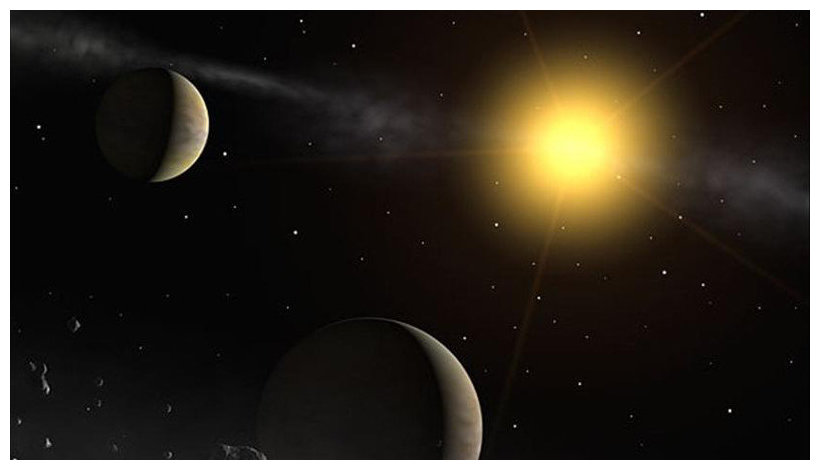
© ESOArtist’s impression of Gliese 710, a sun-like star that will travel through our Solar System’s Oort Cloud in about 1.3 million years.
Gliese 710 is currently 64 light-years from Earth, but for all intents and purposes, it's heading straight for us. A new study published in the journal Astronomy and Physics projects the close encounter will happen about 1.35 million years from now, and that the star will come within 13,365 AU of our sun (where 1 AU is equal to the average distance of the Earth to the sun), or 1.2 trillion miles. At that distance, it would take light 77 days to reach the Earth.
That's obviously far, but not in cosmological terms. That distance is well within the Solar System's Oort Cloud—a large bubble of ice and rock that surrounds the sun to a distance as far as 50,000 to 200,000 AU. So while Gliese 710 is sure to avoid a direct hit with any object in the inner Solar System, it'll likely travel through the Oort Cloud. And with its tremendous gravitational influence (it's about 60 percent the size of our sun), it'll perturb the many large rocks currently sitting idle way out there in the outer reaches. This star is poised to send a shower of comets into the inner Solar System, possibly causing a serious impact event with Earth.
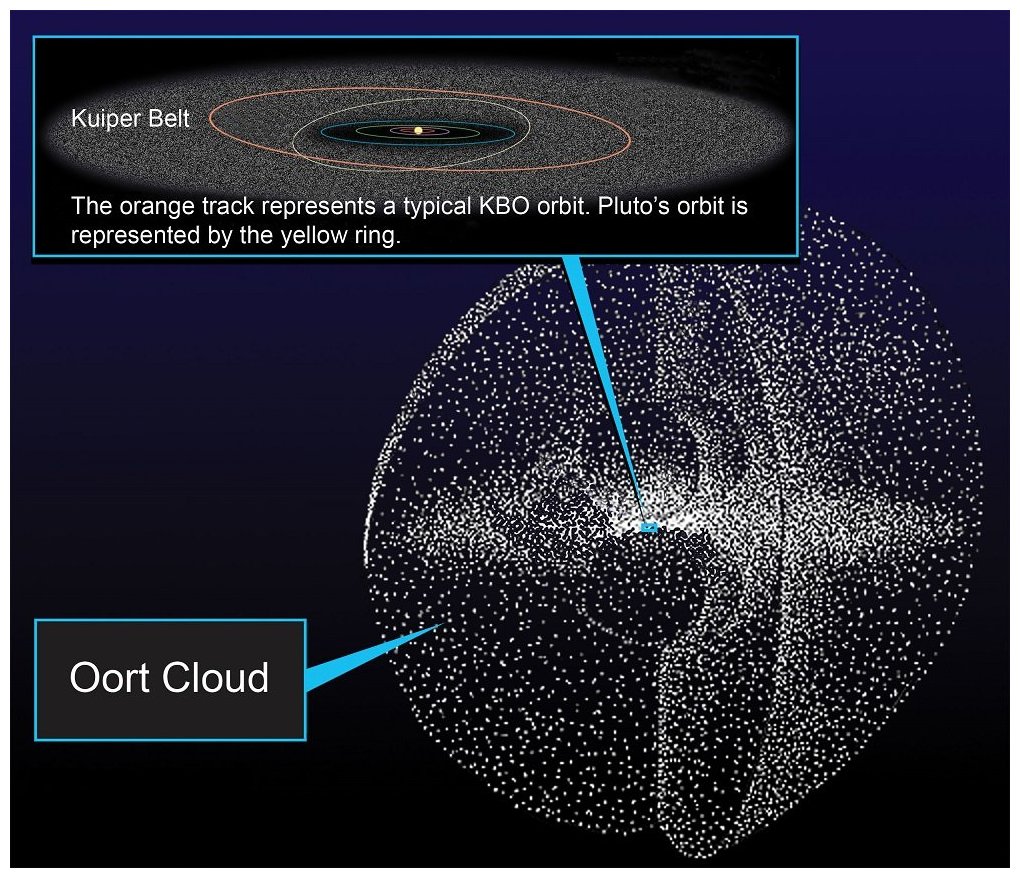
© NASAVisual representation of the Oort Cloud, which is littered with ice and rocks left over from the formation of the Solar System.
During its passage, Gliese 710 will spawn observable comet swarms, and about ten new long-period comets each year—and for a period lasting a whopping three to four million years. This star's influence will be felt on our Solar System for a long, long time. "[This] event [will be] the strongest disrupting encounter in the future and history of the solar system," conclude the authors in their study.
This is obviously bad news for future civilizations on Earth, but our descendants will hopefully have figured out a way to deflect asteroids and comets by then.
As an important aside, Gliese 710 isn't the only star that's scheduled to make a visit. As many as 14 nearby stars could come within three light-years over the next few million years, two of which are likely to traverse through the Oort Cloud.
Reference:
Astronomy and Physics - Gliese 710 will pass the Sun even closer





mankind will have to worry about anything happening to them in 1.3 million years...
There will be no one home.