
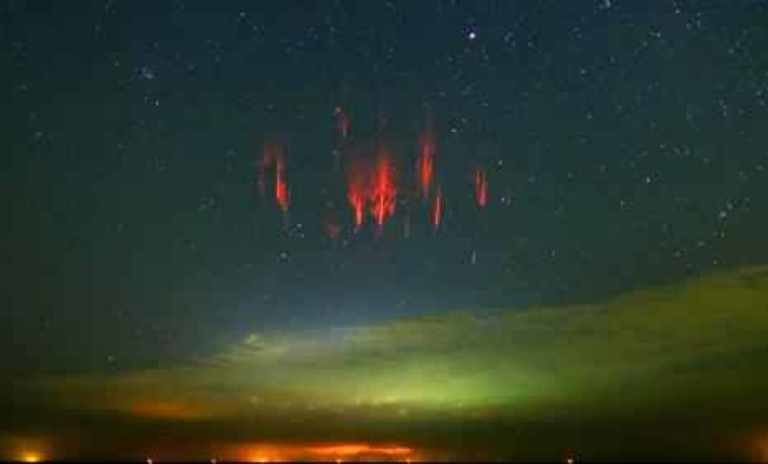
© Yasuo TakedaSprites appear above cumulonimbus clouds off the coast of Hokota, Ibaraki Prefecture, on Nov. 25.
But he was actually lucky enough to witness sprites, a phenomenon that is rarely observed, let alone photographed, as the natural lights are usually obscured by the lightning that often accompanies them.
Sprites occur about 50 to 90 kilometers above ground and become visible when nitrogen molecules emit light after coming into contact with electrical charges released from lightning clouds.
"It happened in an instant as though it was some sort of optical illusion," said Takeda, 56, of his fortunate chance encounter.
It is believed that sprites occur frequently during the winter off the coast of Ibaraki and Chiba prefectures as well as in the Sea of Japan.
Takeda used his meteorological knowledge as a weather forecaster to work out the time and location where the sprites might appear.
Over a period of four to five hours, he continuously photographed cumulonimbus clouds that had developed over waters about 200 kilometers from land. His photograph of the sprites used fast ISO 5000 film that was exposed for three seconds.
"There are very few opportunities to photograph the sprites. The photographing of the detailed structure is a very valuable development," said Hiroshi Fukunishi, a professor emeritus at Tohoku University in Sendai, who has conducted research on aurora and sprites.



Comment: A couple of months ago 28 sprites were captured above hurricane Matthew as it was rapidly intensifying, and an enormous 'jellyfish' sprite was photographed over the Caribbean Sea. Also this year 'rare' red sprites have been recorded over northern Italy, Texas and Arizona.