
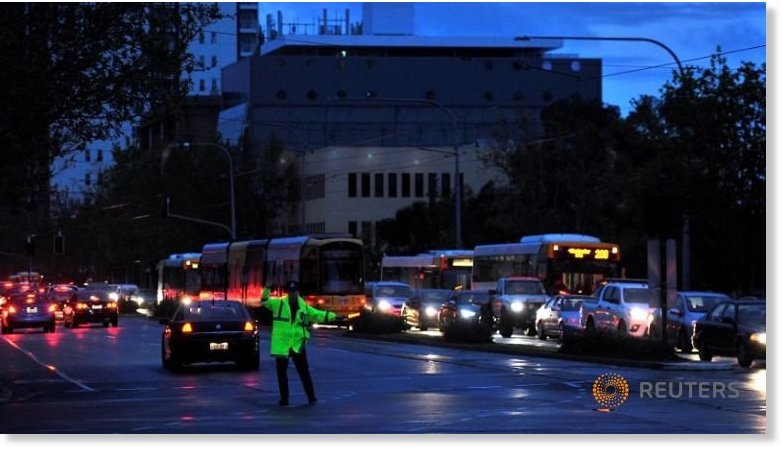
© David MariuzPolice direct traffic in the central business district (CBD) of Adelaide after severe storms and thousands of lightning strikes knocked out power to the entire state of South Australia, September 28, 2016.
South Australia is the country's fifth most populous state, with 1.7 million people, and is a major wine producer and traditional manufacturing hub.
The Bureau of Meteorology said a vigorous cold front was moving across the state with an intense low pressure system due on Thursday.
"We'll have gale force winds and large seas (across the south of the country); also heavy rain and thunderstorms, which will lead to renewed river rises," it said on its website.
SA Power Networks said repairs to its transmission network were underway.
"There were more than 21,000 lightning strikes recorded over a 12-hour period from midday yesterday on the West Coast, and as a result it is likely some damage has occurred to our distribution network," it said.
The state has been brought to a standstill, with ports closed, trains and trams stopped, traffic lights out and long commuter delays, state agencies said.
South Australia was relying on accessing power from Australia's populous east coast via a power interconnector with the neighbouring state of Victoria when there was a failure on Wednesday.
No power was flowing from Victoria into South Australia, said a spokesman for the Australian Energy Market Operator, which operates the power systems in southern and eastern Australia.
When the state tried to compensate, it experienced what is known as a "voltage collapse", Simon Emms, executive manager of network services at network operator ElectraNet, told ABC Radio, due to storm damage to power lines. This led to a statewide outage.
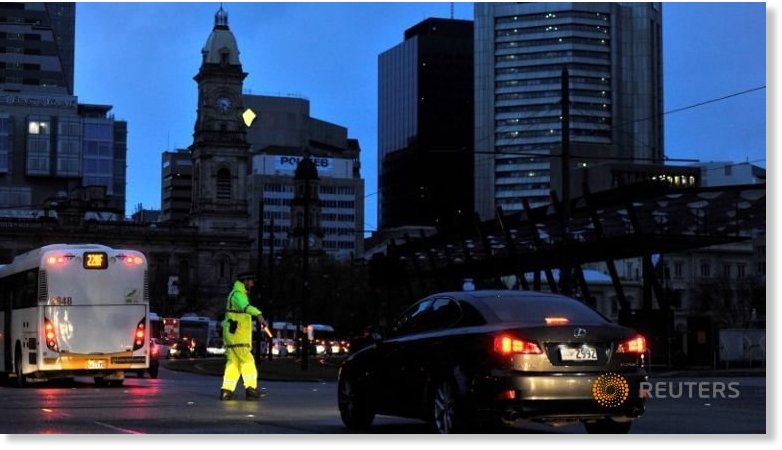
The impact was wide-ranging, with traffic coming to a standstill in the state capital of Adelaide while power supplies were disrupted to BHP Billiton's Olympic Dam copper-uranium mine, a huge mining operation more than 500 km (300 miles) to the northwest.
A BHP spokesman said back-up power generation was being used to run critical infrastructure.
Source: Reuters



There were no major traffic accidents, even though all traffic lights were out. Drivers here have good common sense. Even the Police were impressed with how we handled ourselves!
There was only one house fire due to candles being left unattended.
One of our major Hospitals (Flinders Medical Centre) had a back-up power generator failure due to a faulty petrol pump. Critical care patients were transferred to the Private Hospital next door. Everything went smoothly. Nurses not rostered on for that night came in and simply asked "Where do you need me?"
At least two tornadoes began to form, but didn't touch ground and dissipated, thank goodness!
Supermarkets were inundated with unprepared customers wanting batteries, candles, food, torches (flash lights) and water. Many people had corn chips and salsa dip for dinner. Oh, and chocolate!
22 transmission towers were twisted in on themselves and pulled out of the ground according to an eyewitness.
Probably one of the worst things to come out of this event was the amount of food that has had to be thrown out. I spent Friday night throwing out thousands of dollars worth of food into a giant skip (2.2M wide x 5M long x 1.8M deep). Although our supermarkets have back-up generators to handle emergency lighting and enough power for doors and the checkouts they're not big enough to keep refrigeration going. One skip had already been filled on Thursday, my Nightfill team filled one on Friday and another will be filled this evening.
All in all though we came through this unprecedented event quite well. Very proud of my fellow South Australians!
Can't say the same for our politicians, but then, they're politicians so what do you expect! :/