
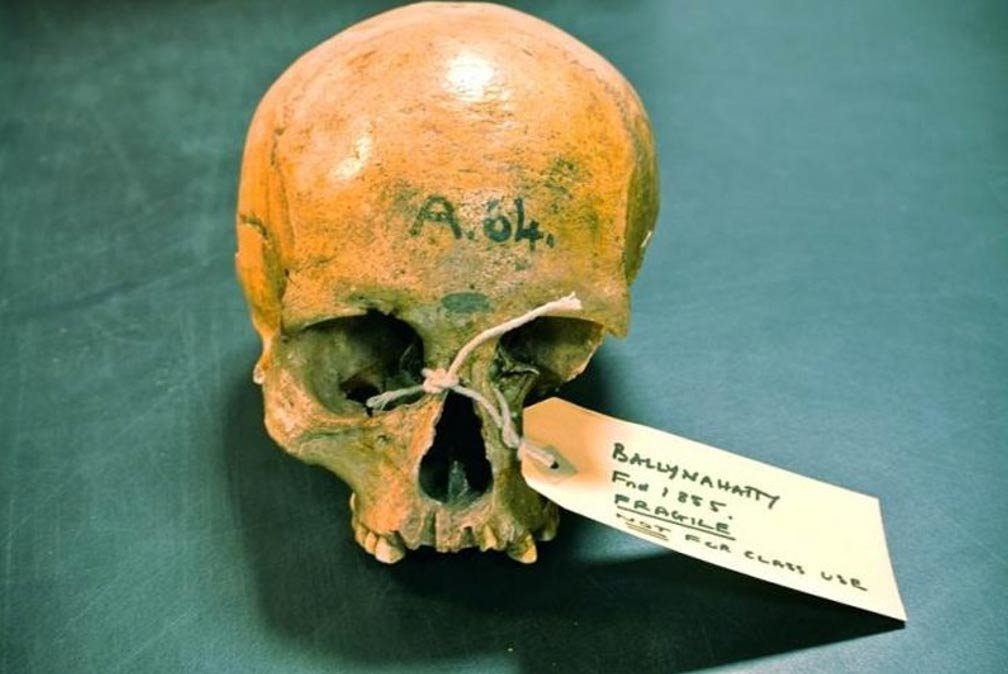
© Daniel BradleyThe skull of the Neolithic woman excavated in 1855 in Ballynahatty, Northern Ireland.
When geneticists at Trinity College in Dublin teamed up with archaeologists at Queen's University of Belfast to study the origins of Ireland's people and culture, they could only imagine the possible outcomes. The team successfully sequenced then compared the genomes of a woman farmer from 5,200 years ago (whose remains were found near Belfast) and three men who lived on Rathlin Island during the Bronze Age. When they analyzed these genes they discovered that a disease often called the "Celtic Curse" arose sometime between the two time periods and that it was related to a massive migration into the region.
The results of their analysis were published in the journal Proceedings of the National Academy of Sciences, and show that the Ballynahatty Neolithic woman "possessed a genome of predominantly Near Eastern origin" and that "she had some hunter - gatherer ancestry but belonged to a population of large effective size, suggesting a substantial influx of early farmers to the island."
Read more here



P Ward's book Thin Air deals with deep time and the evolution of life in which he proposes that times of low O2 produce new species and extinctions and times of high O2 increase speciation.
It may be that this effect survives to modern times in a much reduced appearance that merely turns epigenetic tags on and off. And that this happens only in particularly energized parts of the Earth. Although this cycle may be punctuated by stronger episodes that may be reminisant of extinction.