
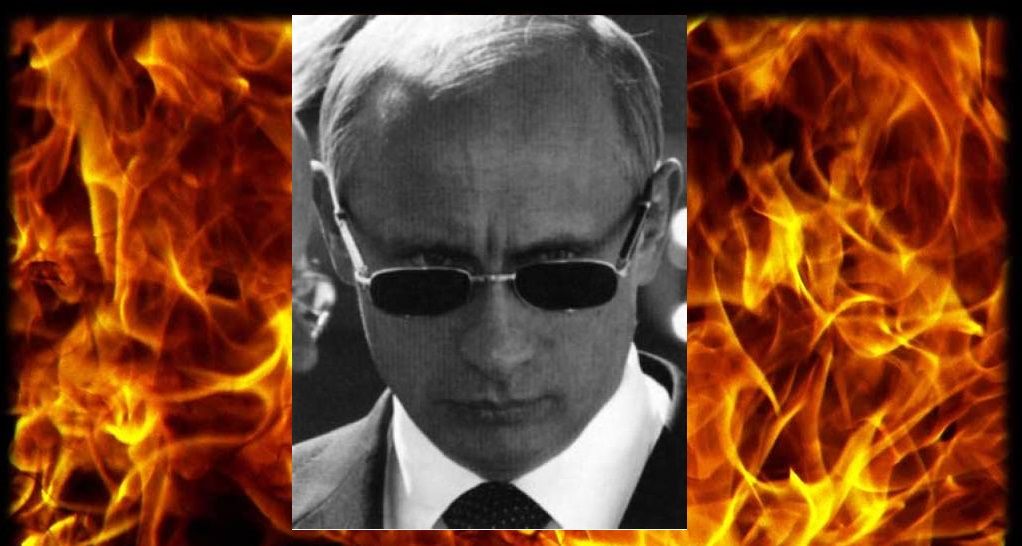
"The bear is not going to ask permission of anyone."
It turns out, though, that the joke's on Washington: Thanks to shrewd tactics plus tailwinds from the Paris attacks, Syria is turning into a major strategic victory for Putin. Here's what he's accomplished and how he did it.
For starters, as Putin explained in both 2013 and during his recent United Nations speech, what he fears most is power vacuums filled by extremists. As Putin stated early in Russia's bombing campaign, Russia did not plan major ground operations, since its goal was simply "to stabilize the legitimate government" to prevent its immediate overthrow. For this reason, as director of the Carnegie Moscow Center Dimitri Trenin argues, Putin never meant to help Bashar al-Assad achieve complete military victory, but rather to stave off Syria's collapse.
Putin has already met this first objective. The Assad regime is no longer in imminent danger, and with Russian air support it has actually re-taken key areas in central Syria and Aleppo. As a result, the regime's key territory in its Alawite heartland no longer faces the risk of being overrun.
Putin's second achievement has been to expand Russian military and political influence throughout the Middle East. Russia established a number of bases in the west of Syria while also expanding its naval base at Tartus — Moscow's only permanent naval presence outside Russia and a key refueling depot for Russia's Black Sea Fleet. Putin can now project Russian military strength throughout the Levant and eastern Mediterranean.
Putin has also succeeded in making himself indispensable to each of the three major power centers in the Middle East. In a move that caught the United States off-guard, Putin established a de facto alliance with the leading Shi'ite powers in the region, including Iran, Iraq, Hezbollah and Syria. The five powers set up joint operation centers in Baghdad and Damascus to share intelligence and coordinate military actions. Iraq also surprised Washington when it allowed Russian planes to transport military gear through its airspace on the way to Syria after NATO member Bulgaria refused Russia entrance to its airspace. On the frontlines, Russia provides aerial cover while the Shi'ite powers focus on the ground war, and the alliance has advanced to the point where Russia even transports Iraqi Shi'ite militias to the fighting in Syria.
Perhaps counterintuitively, Russia's decision to align itself with the Middle East's Shi'ite powers has actually increased Moscow's influence with the Sunnis and Israelis. A number of key figures from the Sunni states recently visited Moscow, and the most powerful man in the Sunni world — Saudi King Salman bin Abdulaziz Al Saud — will likely make the pilgrimage to the Kremlin soon to discuss a solution to the Syrian war.
Israeli Prime Minister Benjamin Netanyahu quickly read the tea leaves, too. Alarmed by Russia's burgeoning alliance with its archenemies Iran and Hezbollah, Netanyahu immediately hopped on a plane to Moscow to meet Putin. Netanyahu's immediate concern was to ask Putin to respect Israel's "red lines" on the transfer of advanced arms to Hezbollah — a request to which Putin agreed. While Netanyahu appeared reassured in Moscow, a leading Israeli commentator described Netanyahu's visit as signaling the start of a "post-American Middle East."
Putin has also broken through the ring of diplomatic isolation imposed on him by the West after Russia's annexation of Crimea. A comparison between last year's G20 summit in Australia and this year's event in Turkey shows the magnitude of the change. Putin was practically persona non grata in Australia, and with Western leaders browbeating him about Ukraine, Putin fled the conference early to — as he put it — get some extra sleep. In Turkey, by contrast, Putin was on every Western leader's "must-see" list, and photos of Putin huddling over coffee with Obama became the defining images of the event.
While the Paris attacks are the proximate cause of this Western interest, Russia's military commitment in Syria positioned it to take advantage of the West's newfound focus on confronting Islamic State. France and Russia already coordinated joint strikes against Islamic State positions in Raqqa, and after speaking with French President François Hollande, Putin ordered the Russian Navy to make contact with the French aircraft carrier Charles de Gaulle heading toward the Persian Gulf, while also suggesting that the French and Russian navies develop joint sea and air strategies.
On the diplomatic front, after long demanding that "Assad must go," Obama now appears willing to compromise. Diplomatic meetings in Vienna between the United States, Russia and other nations produced an agreement on an 18-month plan to establish a new Syrian government based on democratic elections. The parties also agreed to develop a master list of all terrorist groups in Syria — a step Putin had long demanded.
Obama then dropped his generally hostile line towards Putin, praising him as a "constructive partner" in efforts to resolve the Syrian war. Obama even hinted at the possibility of direct American-Russian military coordination in Syria — a step previously rejected by the United States — stating that "more opportunities for coordination" had arisen.
Finally, cooperation in Syria may lead to Putin's ultimate geopolitical goal: an end to the European Union's Ukraine-related sanctions against Russia. The head of the French Senate just demanded an end to sanctions, echoing a number of EU leaders — including Greece and Slovenia — who had called for this previously.
We should not forget the Russian-Western rapprochement remains brand new. Existing Western rifts with Russia may still return to the fore if the two sides diverge on Syria or if the European Union extends sanctions against Russia in December — something which is still on course to occur.
In the short term, though, Putin's bold move into Syria has flipped the world's geopolitical script.








Comment: Even the MSM can't deny that Putin has been a skilled player on the geopolitical chessboard. All the West's attacks on him and Russia tend to backfire. For example: The Struggle for Hearts and Minds: Putin Continues to Call NATO's Bluff