
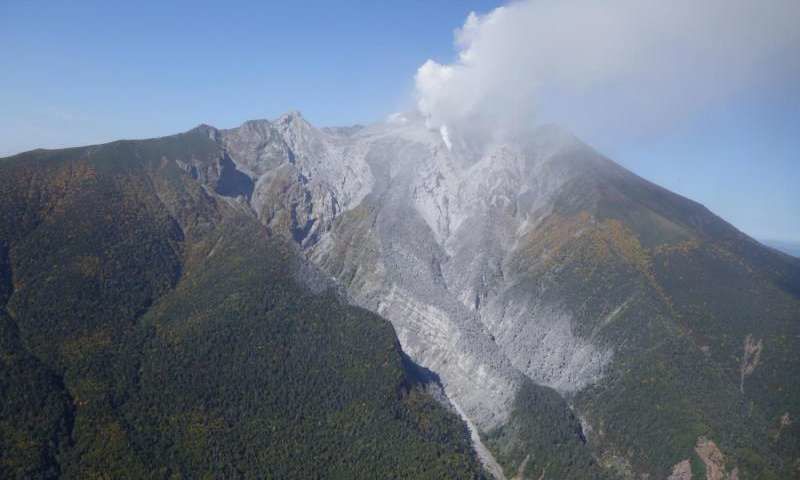
© Earthquake Research Institute, The University of TokyoMount Ontake is located 200 km west of Tokyo on the border of Gifu and Nagano Prefectures. This image shows the continued release of steam and gas from the volcano after the eruption.
Small quantities of the isotope helium-3 are present in the mantle, while helium-4 is produced in the crust and mantle by radioactive decay. A higher ratio of helium-3 to helium-4 therefore indicates that a sample of helium gas originates from the mantle rather than the crust. Previous research suggested that variation of helium isotopic ratios over time in crater fumaroles and hot springs correlates well with volcanic activity.
However, helium anomalies reported in these studies were all related to magmatic eruptions, and not to hydro-volcanic or phreatic eruptions, caused when a heat source such as magma vaporizes water to steam. Because phreatic eruptions are highly local phenomena, they are extremely difficult to predict. Mount Ontake, which erupted unexpectedly on September 27, 2014 just before noon, is believed to have been a phreatic eruption, and resulted in 58 deaths with 5 still missing.
An international research group lead by Professor Yuji Sano at the Atmosphere and Ocean Research Institute, the University of Tokyo, found that prior to the 2014 eruption, the helium-3 to helium-4 ratio at the hot spring closest to the volcanic cone increased significantly from June 2003 to November 2014, while that at distant hot springs showed no significant change. In addition, the helium isotopic ratios of the closest hot spring remained constant from November 1981 to June 2000.
These findings suggest that helium anomalies are also associated with phreatic eruptions. The research group suggests that increased input of magmatic gas over a ten-year period resulted in the slow pressurization of the volcanic conduit and eventually lead to the eruption.
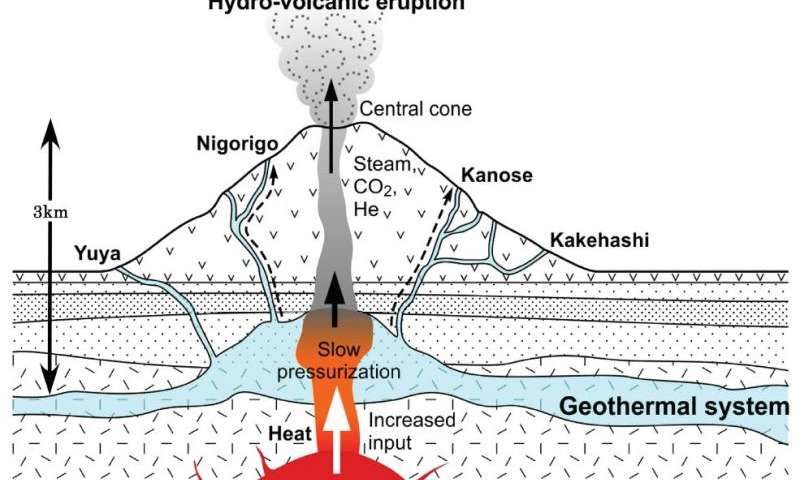
© Original figure was created by Michelle Laithier of University of Quebec at MontrealThe increased input of magmatic volatiles is thought to have resulted in slow pressurization of the volcanic conduit leading to the event.
More information: Yuji Sano, Takanori Kagoshima, Naoto Takahata, Yoshiro Nishio, Emilie Roulleau, Daniele L. Pinti and Tobias P. Fischer, "Ten-year helium anomaly prior to the 2014 Mt Ontake eruption" Scientific Reports 5:13069 2015/08/19
Journal reference: Scientific Reports
Provided by: University of Tokyo



Reader Comments
to our Newsletter