
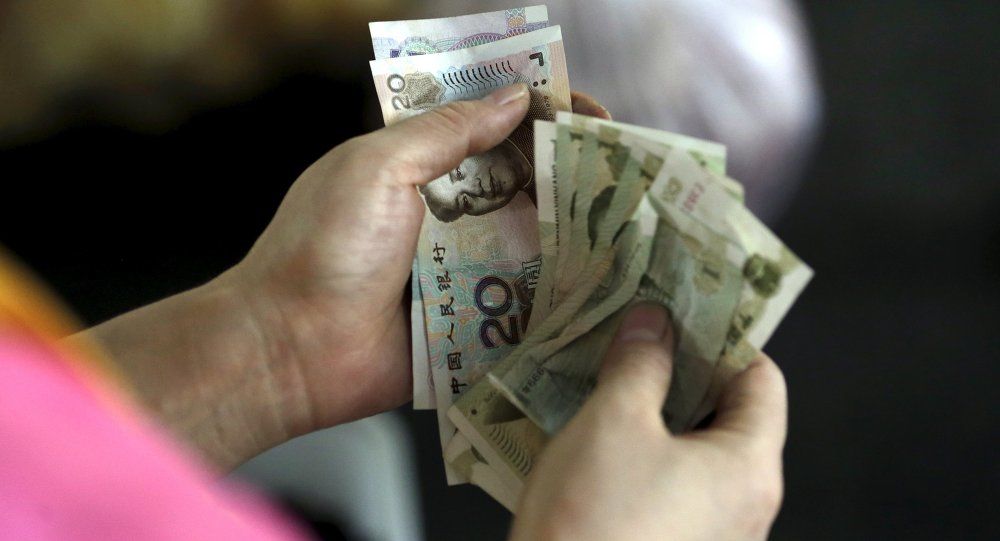
© REUTERS/ Jason Lee
Forget the hysteria. The heart of the matter is that Beijing has stepped on the gas in a quite complex long game; to liberalize the yuan exchange rate; allow it to free float against the US dollar; and establish the yuan as a global reserve currency.
So this is essentially exchange rate policy liberalization — not a currency "war", as the frenetic spin goes from Washington/Wall Street to Tokyo via London and Brussels.
Let's check some expert reaction
Former Morgan Stanley non-executive chairman in Asia, Stephen Roach, delivers the predictable Goddess of the Market orthodoxy, warning about the "distinct possibility of a new and increasingly destabilizing skirmish in the ever-widening global currency war. The race to the bottom just became a good deal more treacherous."
A note written by a group of HSBC analysts is more realistic; "The depreciation pressure on Asian currencies from China's action should fade as the nation isn't aiming at engineering a much weaker yuan. Doing so would contradict the goal of promoting greater global use of the yuan."
But it's Chantavarn Sucharitakul, the Bank of Thailand's assistant governor, who hits the nail on the head Asia-wide; "The long-term impact must be assessed as to whether greater flexibility of the yuan could benefit China's economic reform, while the depreciating yuan could be positive for China's economic growth, which would benefit regional trade as well."
The Bank of China itself, in a statement, stresses it will allow the markets to have more influence over the yuan exchange rate.
And crucially, it also stresses there is no economic basis for the devaluation, pointing to China's enormous current account surplus and humongous foreign exchange reserves.
As Beijing interprets it, keeping a strong link to the US dollar has interfered with China's being competitive with its top trading partners — Japan and Europe.
So now it's time to rock the (wobbly) boat. Thus the "currency war" hysteria — because the practical result, in the medium term, will be a new boost to Chinese exports.
When the US embarks on perennial quantitative easing (QE), that's OK. When the EU does QE as well, that's OK. But when the Bank of China decides it's in the best interest of the nation to let the yuan go down a bit instead of infinitely up, that's Armageddon.
Just do the math
Having the yuan track close to the US dollar served China very well — until now. QEs in the EU and Japan led to a weaker euro and a weaker yen — while the yuan remained stable against the US dollar.
Translation; since over a year ago, in June 2014, the yuan's real exchange rate has been the world's strongest, increasing by 13.5 percent. That was more than that of the US dollar (12.8 percent).
It was not hard for Beijing to do the math; the strong link with the US dollar was eroding China's competitiveness with top trading partners Japan and Europe.
Yet a simple 2 per cent devaluation may not be enough to boost China's exports. After all the yuan appreciated more than 10 percent over the past year relative to China's top trading partners.
Thus the inside word in Beijing about "powerful voices inside the government" pushing for the Bank of China towards an overall 10 per cent devaluation of the yuan. Now that would certainly boost exports.
So the devaluation this week — which has generated so much hysteria — seems to point towards a few more devaluations further on down the road.
This being China, where planning ahead is a matter of years, not a day-to-day frenzy as in Goddess of the Market territory, the whole game is about turning the yuan into an official global reserve currency.
A team of IMF experts has recently been to Shanghai, talking to officials at the Chinese central bank and China Foreign Exchange Trading System, which oversees currency trading in China, to establish whether the yuan can be part of the special drawing rights (SDR) basket.
Not surprisingly, the IMF itself praised the recent devaluation; "China can, and should, aim to achieve an effectively floating exchange rate system within two to three years."
And the IMF also admits that, "a more market-determined exchange rate would facilitate SDR operations in case the Renminbi were included in the currency basket going forward."
So this is what it's all about; Chinese adjustments with an eye to get the yuan ready to qualify for reserve currency status. The IMF's final decision is expected to be made by the end of 2015 or by the fall of 2016.
An internationalized yuan established as a global reserve currency implies a "market-determined" exchange rate policy. That's what the Bank of China is ultimately aiming at. The rest is a tempest in a (US dollar) teacup.







From the Jim Sinclair email newsletter... this one written by Bill Holter:
"The question of our title is very important, "Did the FINAL WAR just start?". If you polled Americans on this question, 99.9% would answer "no" if you took out the Middle East. Last week I wrote "The Rumblings of War" regarding the IMF rebuffing China's entry into the SDR. This was followed up by "The shot heard 'round the world" on Tuesday commenting on China's surprise devaluation. The purpose of this writing is to show you YES, we are in fact at war! Rather than "tell" you we are at war, I feel it is better to point out a few dots, connect some of them and then ask a few questions which might help you understand the war that is in fact being waged. If you can answer some of the questions then connecting dots and forming your own conclusions will be easier.
"As our backdrop, we are "told" the world is in recovery from the very bad experience of 2008. Since then, various central banks have monetized debt on a massive scale, led by the Federal Reserve of the U.S.. Undoubtedly, the greatest "export" from the U.S. has been dollars themselves and financial products known as derivatives. For the most part, the world spun merrily until last fall when Saudi Arabia decided to increase production and lower prices. This was presumably done at the request of the U.S. and meant as a tool to injure Russia's energy sector, economy and financial system. Can the petrodollar which became accustomed to $100 oil be supported with sub $50 oil? There are two sides to this coin, yes the consumer of oil saves but doesn't lower oil price mean less liquidity in the system? Doesn't it mean lower velocity and less demand for dollars?
"Moving along, did anyone really wonder "why" or what (or better yet, WHO) was behind China being put off for acceptance as a component of the SDR? Then just two trading days later, China devalued their currency in a surprise move...followed by two more devaluations! Remember, the U.S. has been prodding China to strengthen their currency and has gone so far as to call them a "currency manipulator"! Now we see China doing the exact opposite of U.S. requests (demands?). World markets have been shaken, and at a time when liquidity is quite tight.
"A stronger dollar since last fall has acted as a constant and nagging "margin call" to the world which has contributed to the lack of liquidity. Have the Chinese finally said "fine, you want to issue a margin call to the world, we will help you issue it. Let's see what happens to your financial system when the margin call fails to be met?". Do you see what I am getting at here? The Chinese are now forcing the dollar higher by devaluing their own currency. They understand the dollar is nothing more than a debt instrument, are they attacking and intending to destroy the dollar with its own strength?
"Follow this through, a stronger dollar will decrease our exports and slow our already slow or negative economy. A too strong dollar can actually undermine itself and even kick off a derivatives chain explosion. Our banks and brokers are very thinly capitalized, can they withstand losses in derivatives caused by a currency crisis? Can they withstand the losses from failed counterparties unable to pay? Do you see? A currency crisis "caused" by China could be a calamity. China has already accused Citadel (Ben Bernanke's new employer) of creating the crash in their equity markets, is a currency crisis retaliation for their equity crash and public shaming by the IMF? If you understand how the Chinese think and also understand the works of Sun Tzu, Jim and I ask if China's strategy is ... "In order to destroy the dollar permanently make it stronger temporarily."?
"Another area to look at is gold and silver. Supplies have recently gotten very tight, not just for retail in the U.S. but all over the world. Has production slowed or have buyers stepped up their hoarding? Or, have Western central banks reduced their "dis hoarding"? Whatever it is, something in the supply/demand dynamics has definitely changed ...and it has not taken much money to do it! Are these separate events or are they tied together somehow?
"This is where it gets weird or some might say "coincidental". Did anyone see the explosion at the Chinese port city of Tianjin yesterday? [Link] "Yesterday" being one day after China devalued their currency? I am no rocket scientist and cannot say for sure, but does this not look like a nuclear explosion? Can someone out there explain to me in simple terms how a chemical explosion could look like this? As for the word "coincidence", the CIA says there is no such thing as a coincidence!
"Speaking of coincidences and I have permission to pass this along to you. Jim Sinclair wrote just a few days ago for the first time in many a moon, he said "gold has very limited downside from here and could move to $2,000 as an initial stop". Do you believe it was a coincidence that he speaks now? No, he was called and was "told" by the same people who guided him in 1980 at the market top. Do you believe it was a coincidence following Jim's writing, the IMF shunned China followed by the shot heard 'round the world of a yuan devaluation ...three times?!!! ...not to mention an explosion that could be seen from space! My mind is made up, no it is not any coincidence at all.
"For months I have been suggesting Mr. Putin would drop a "truth bomb" revealing all sorts of false flag events and fraud perpetrated by the U.S.. I still believe this is to come and now even more likely. Why more likely? Because the financial sparring between East and West may have taken a very serious turn yesterday and I seriously believe a tactical nuke was set off. If this is the case, China will provide proof and they will retaliate. I believe the smoldering stages of what was a financial/technological/trade war have now become hot and the first shot was fired. I truly do ask for comments regarding what happened in Tianjin. Please do not send me opinions, I would like to hear exactly why or why not the explosion was nuclear. I will believe a tactical nuke until someone proves to me it was not. May God help us all with what comes!"
Standing Watch,
Bill Holter
Holter-Sinclair collaboration
Comments welcome!
bholter@Hotmail.com