
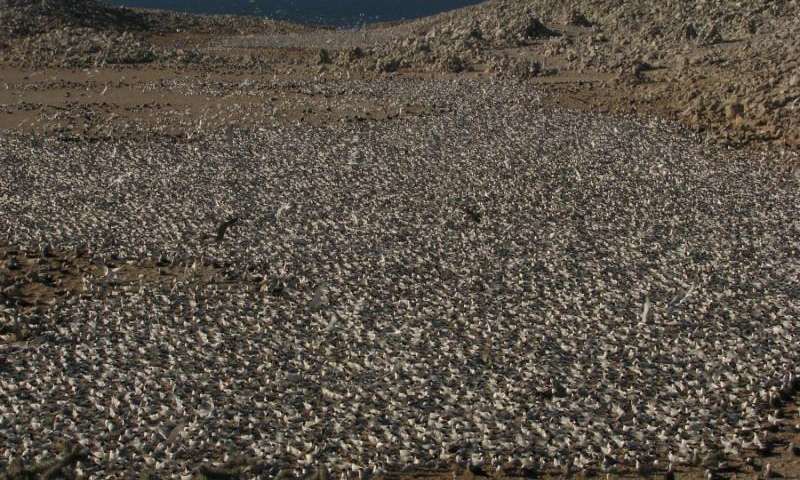
A partial view of healthy Elegant Tern nesting colony in Isla Rasa, in the Midriff Island Region of the Gulf of California in 2011. Credit: E. Velarde.
During some years in the last two decades, however, the seabirds have arrived to the island in April, as they usually do, but leave soon after without nesting. The first event was the 1998 "El Niño", when oceanic productivity collapsed all along the eastern Pacific coast from Chile to California. But then colony desertion happened again in 2003, and since then it has recurred with increasing frequency in 2009, 2010, 2014, and 2015. Researchers and conservationists were asking themselves where are the birds going when they leave their ancestral nesting ground, and what is causing the abandonment of their historic nesting site.
A group of researchers from Mexico and the U.S. set out to analyze what was happening to the nesting Elegant Terns (Thalasseus elegans), a model species to monitor ocean dynamics. Their results, published in the AAAS journal Science Advances show that ocean warming and overfishing are producing the ecological collapse of the Gulf of California's productive Midriff region.
Using nest counts in seabird colonies from Mexico and California, they found that Elegant Terns have expanded from the Gulf of California, in Mexico, into Southern California during the last two decades, but that the expansion fluctuates from year to year. "Whenever the terns perceive the conditions in the Gulf as inadequate to ensure successful reproduction," says Enriqueta Velarde, project leader, "they move to alternative nesting grounds in Southern California including the San Diego Saltworks, Bolsa Chica Ecological Reserve, and Los Angeles Harbor."
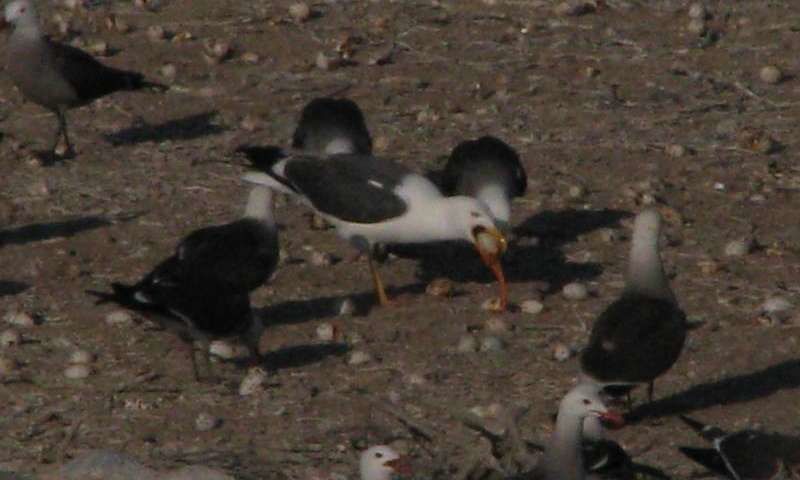
© E. Velarde. Yellow-footed Gull and Heermann´s Gulls feeding on Elegant Tern eggs at the abandoned nesting colony when the terns deserted it after food conditions worsened in May 2009.
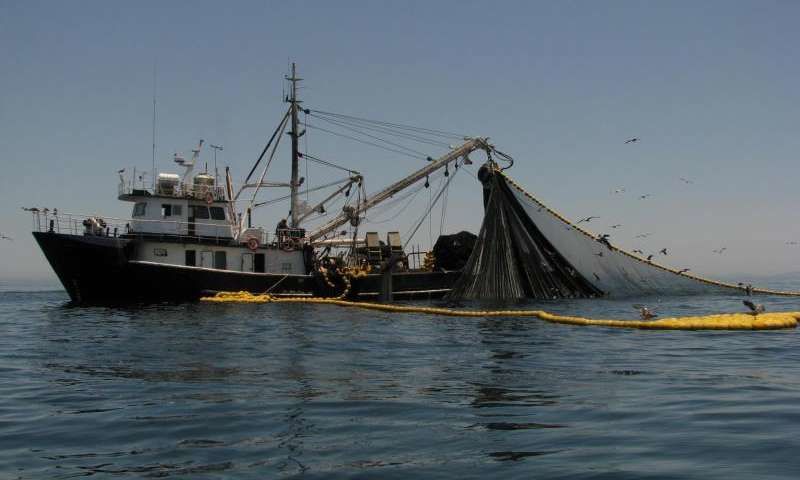
© E. Velarde Sardine fishing boat in the Gulf of California´s Midriff Island Region, hauling the purse-seine net after a fishing operation in 2013, when their catch of Pacific sardine had nearly collapsed.



Comment: What the researchers don't mention is that the oceans may be warming due to undersea volcanoes: