
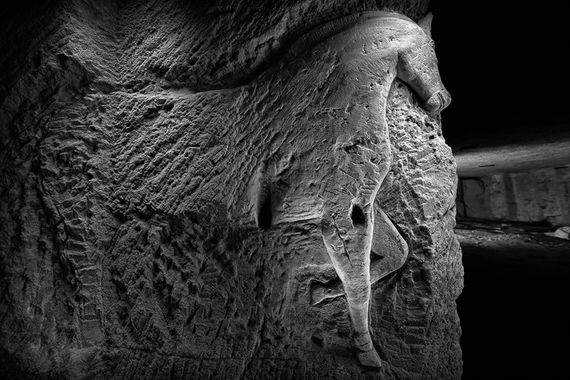
© Jeffrey GuskyThis horse is about two-thirds life size. Hundreds of troops from New England's Yankee Division lived here underground for about six weeks in 1918. The carving was never completed and is now at risk of vandalism or theft.
The locations of these quarries and caves remain relatively secret for now, but the entrances are unprotected.
Dr. Jeffrey Gusky, an emergency room physician and professional photographer, has shot these underground cities in eerie detail and published the images extensively in National Geographic, the New York Times, and other periodicals. The BBC, NPR, CBC and other news outlets have interviewed him about it. This exposure brings the caves' culture and beauty to a large audience, but with that fame comes danger for the sites themselves.
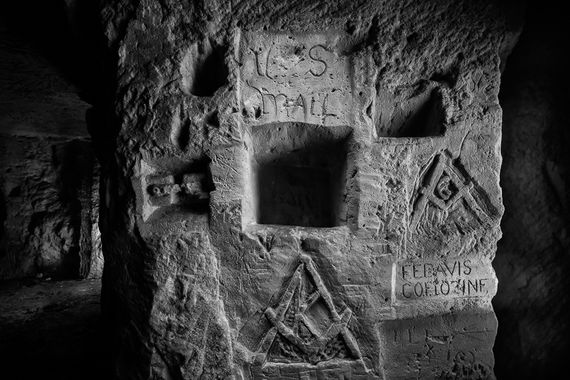
Located in a large underground city, now in total darkness, this US Mailbox was carved in 1918 by US National Guard soldiers from New England, part of the famed 26th "Yankee" Division.
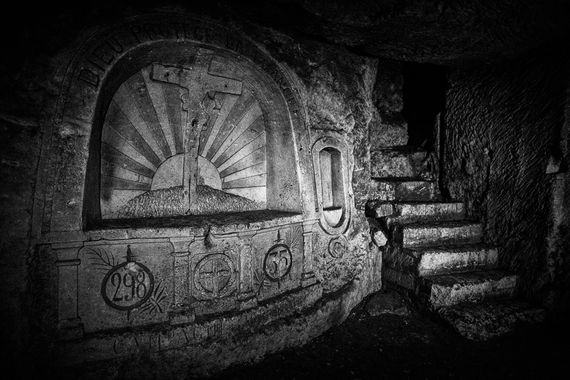
© Jeffrey Gusky French soldiers prayed and then ascended these stairs leading directly to the trenches to fight. Many never returned.
In late 1914, the opening maneuvers of the Great War had stalled, and the armies of France, Germany, and their allies dug into trenches to avoid the unexpected power of modern machine guns and artillery. They also found their way into old quarries and natural caves, sometimes hundreds of feet below the surface. They learned to rotate troops from the front lines down to these huge spaces for rest and recuperation. Long stone stairways, known as "stairways to hell," led back up to the mud, gas and roar of artillery.
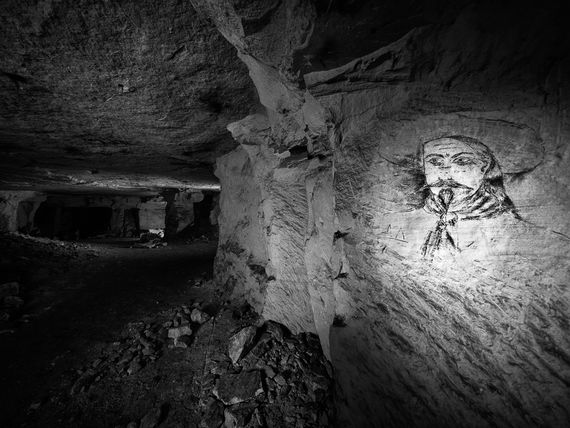
Between bouts of fighting, troops from all over the world marked the walls in elaborate carvings and drawings. The pencil marks look fresh; the boots and the bunk beds remain. They left behind not just their equipment, wine bottles and underground road signs, but traces of their religion, poetry, masonic affiliations, favorite sports teams and more. Gusky has found spaces for outgoing mail hewn into the rock, as well as a bakery and more than one underground theatre, decorated with thoughts of home and echoes of the war above. The Americans, who joined the war in 1917, turned out to be the most prolific artists during their stay underground for six weeks in early 1918.
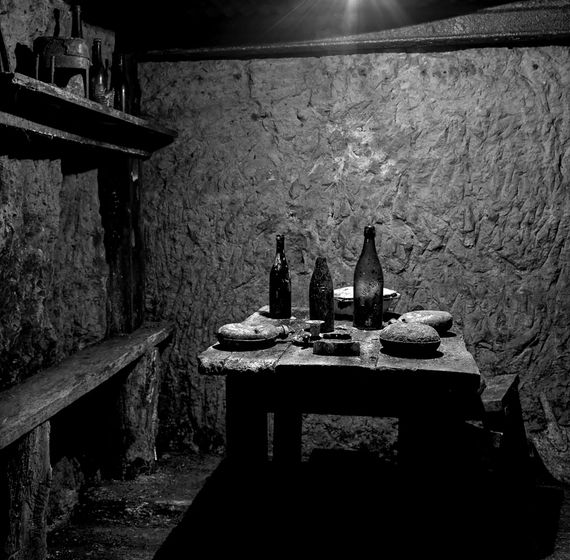
© Jeffrey Gusky French soldier's dining area at Butte de Vauquois. The items on the table were simply placed back on the table after being found by the dedicated volunteers who manage this site. Seven kilometers of tunnels still exist on the French side and 17 kilometers on the German side of this amazing site.
Kondratiuk pointed out that the importance of the Great War and its veterans have often been overshadowed by accidents of circumstance. At each of its major anniversaries, it was pushed aside by more pressing matters. "The World War I veteran never got a thanks from anybody," he said. "They never thanked them because every anniversary period there was another war we were involved in. The 25th anniversary was World War II, the 50th anniversary was the middle of Vietnam, and then these guys started dying by the thousands in the 1960s and 70s."
Shedding Light on How We Learned to Be Modern
We overlook World War I at our peril, according to Kondratiuk, because if we want to understand the modern world, we have to study World War I, the hinge point between the era of Victorian chivalry and the industrial speed of the Twentieth Century. "It started off as a Napoleonic war and ended up as the first modern war," he said. "The French army went into combat wearing light blue, long, Napoleonic uniforms, or tunics, with red trousers and these ridiculously long bayonets. Cavalry was still important in the beginning of the war." Europe's leaders discovered the hard way that horses and bayonets wouldn't stand up to machine guns and heavy artillery. Through that crucible, he said, modern war emerged. "You have the airplane, the tank, gas warfare, heavy artillery, submarine warfare. Everything that becomes important in World War II is invented and used to some extent in World War I."
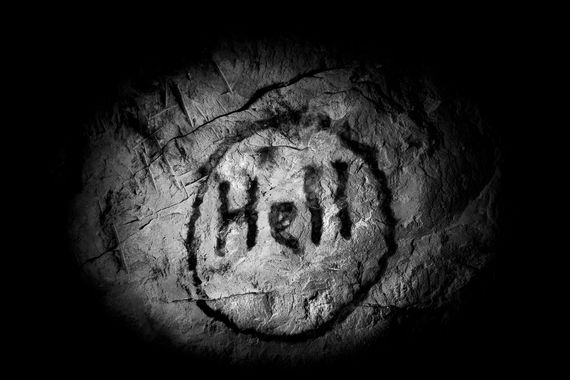
© Jeffrey GuskyA smoke painting on the ceiling of an underground city. The space was occupied at various times during World War I by French, then German and then American soldiers. Evidence of underground combat can be found near the former telecommunications center here.
Names like Verdun, the Somme, Ypres and the Marne are used to conjure atrocious images. The ferocity of those names has waned as the sites of the Great War's hell have been covered, wiped away and regrown. Some sites remain marked by signs that present the now antiseptic names and dates in attempts to remember the carnage that changed the world a century ago. In contrast, the underground cities are some of the precious few places where students of the war can find an all-enveloping sense of it.
"These treasures make World War I real," Gusky said, adding that to many people the war "seems like an ancient abstraction. It seems distant and irrelevant in our lives." That's due in part to those antiseptic signs, photographs, monuments and cemeteries. Although these markers are important and sacred, he said, "on a subliminal level, they communicate distance, especially for young people. It makes World War I seem like something that is far in the past, fought by people that they can't relate to. And in fact it was a modern war. The importance of these treasures is that it enables us to make World War I real to ordinary people around the world."
Preserving these sites is important for another reason, according to Gusky. "World War I has a tremendous impact on who we are inside, our inner lives, and we don't know it." The soldiers who wrote and drew on the walls show us something of how they learned to live with both the Twentieth Century's conveniences and its horrific weapons. The writings, drawings and carvings by the first generation of the modern age can offer wisdom for how to handle our own era's threats and possibilities." He said, "It's not about remembering the past. It's about understanding today through a parallel experience of World War I."
© Jeffrey Gusky
The eerie silence of these caves, the cool air, and the thoughts, carved into the wall, from people long dead bring to mind the much older cave art at places like Lascaux, Chauvet and Altamira. Of the many things written in wonder and appreciation of those sites, one thing stands out as we consider the Great War's underground cities: Those Paleolithic paintings and etchings are a tiny fraction of the earliest European cultures. All the paintings they did aboveground and the vast majority of their carvings and weapons are long gone, to say nothing of their language, songs, hair styles, skin decorations and games.
Thanks to natural caves we have some idea of what Europe's earliest people cared about tens of thousands of years ago. Governments preserve them with extreme care, but that wasn't always so. Lascaux, discovered in 1940, was open to tourists for decades before the wear of visitors' feet and their warm, wet breath forced it to close. Dozens of other, less glorious caves have been vandalized after discovery, their walls tagged or cut apart as souvenirs.
It's a wonderful thing that Chauvet cave, home of some of the most awe inspiring prehistoric paintings in the world, was discovered in 1994 by a group of people who immediately recognized what they had found and took pains to leave it intact. They backed out of the cave carefully and turned it over to historians to secure it and explore those ancient people's traces as gently as possible.
We have the chance, right now, to do the same for the troops who lived in the underground cities. Gusky said, "They are speaking to us, saying, 'I was here. I once was a living, breathing human being.' We need to tell their stories."
For more information on Dr. Jeffrey Gusky's project, go to his site, "The Hidden World of World War I," at: http://jeffgusky.com.
Alisha Hamel is Executive Director of the nonprofit Historical Outreach Foundation and as a Reservist is a Command Historian for the Center of Military History. For more on the Historical Outreach foundation, go to: http://www.historicaloutreach.com.
Paul X. Rutz is a figurative painter in Portland, Oregon, and a researcher for the Oregon Military Museum. His Ph.D. dissertation focused on combat art from the Iraq war. Find more of his work here: http://paulrutz.com.


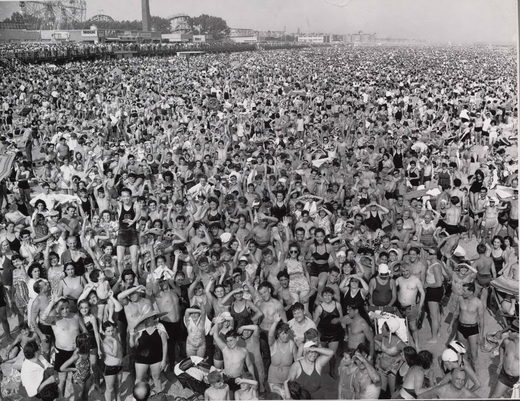
These structures were created almost a century ago, have we learned anything from the time these structures were created, strikes me that they were created in a time of hell, with great loss of life, but within that hell there is the human spirit trying to create some form of normalcy, and an effort to retain there humanity. I find the image of hell poignant and probably that was the reality for most trying to seek refuge from the hell above.
Millions of lives were lost in WW1, for what, the precursor to the hell we are living now. And lets not forget there was also the Worldwide flu pandemic of 1919. Ah! the future, well it's open we can have heaven or hell and to quote the "C's... up to You" right now it looks more like hell