
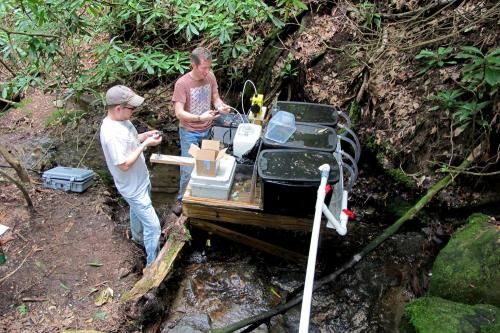
© Jon Benstead/University of Alabama David Manning, a University of Georgia doctoral student, and John Kominoski, a former UGA postdoctoral researcher who is now an assistant professor at Florida International University, perform maintenance on the pump used to add nutrients to one of the streams in their experiment.
In a new study published March 6 in the journal Science, a team of researchers led by University of Georgia ecologists reports that nutrient pollution causes a significant loss of forest-derived carbon from stream ecosystems, reducing the ability of streams to support aquatic life.
The findings show that the in-stream residence time of carbon from leaves, twigs and other forest matter, which provide much of the energy that fuels stream food webs, is cut in half when moderate amounts of nitrogen and phosphorus are added to a stream.
"This study shows how excess nutrients reduce stream health in a way that was previously unknown," said the study's lead author Amy D. Rosemond, an associate professor in the UGA Odum School of Ecology.
Stream food webs are based on carbon from two main sources. One is algae, which produce carbon through photosynthesis. Nutrient pollution has long been known to increase carbon production by algae, often causing nuisance and harmful algal blooms. The second source is leaves and bits of wood from streamside forests. This forest-derived carbon typically persists year-round, making it a staple food resource for stream organisms.
"Most people think of nitrogen and phosphorus pollution in streams as contributing to algae blooms," said Diane Pataki, program director in the National Science Foundation's Division of Environmental Biology, which funded the research. "But streams contain a lot of leaf litter, and this study shows that nutrient pollution can also stimulate carbon losses from streams by accelerating the breakdown of that litter. That helps us better understand how fertilizer runoff affects carbon transport and emissions from streams and rivers."
Nitrogen and phosphorus play essential roles in the breakdown of carbon by microbes and stream-dwelling insects and other invertebrates, but cause problems when they are present in excessive amounts—as they increasingly are. Nutrient pollution is widespread in the U.S. and globally, due primarily to land use changes like deforestation, agriculture and urbanization.
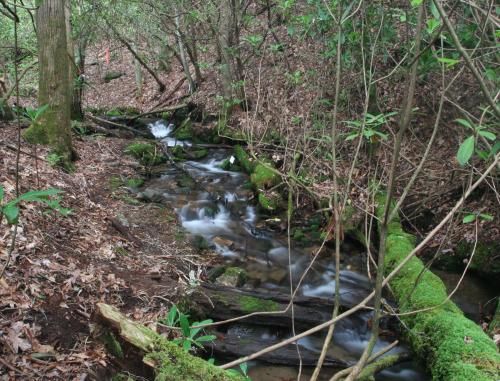
© Phillip M. Bumpers/University of Georgia Forest-derived carbon, such as leaves and wood, provides essential ecosystem services in streams. The effects of nutrient pollution on this carbon source are poorly understood compared to the well-known effects of nutrients on algae.
Working at the Coweeta Hydrological Laboratory, a U.S. Department of Agriculture Forest Service and National Science Foundation Long Term Ecological Research site in North Carolina, they set up a system to continuously add nutrients to several small headwater streams. The first experiment ran for six years in two streams, and the second for three years in five streams, with different combinations of nitrogen and phosphorus to mimic the effects of different land uses.
The researchers found that the additional nutrients reduced forest-derived carbon in whole stream reaches by half.
"We were frankly shocked at how quickly leaves disappeared when we added nutrients," said Rosemond. "By summer, the streams looked unnaturally bare."
"It's very apparent when excess nutrients lead to algal blooms in rivers and other aquatic ecosystems," said study co-author Jon Benstead, an associate professor of biological sciences at the University of Alabama. "But their impact on accelerating the breakdown of dead organic matter, such as leaves and twigs, is a significant but under-appreciated effect on the health of freshwater ecosystems across large areas of the world."
Rosemond likened the impact of the loss of forest-derived carbon to the doubling of algal carbon that nutrient pollution can cause.
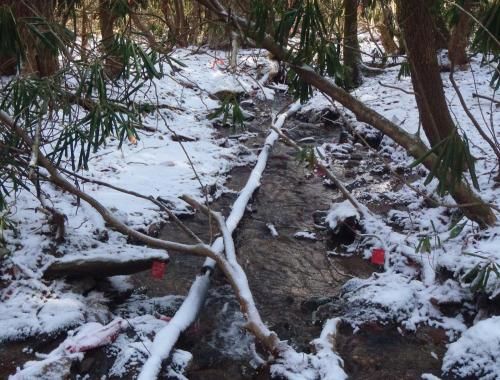
© Phillip M. Bumpers/University of Georgia The researchers maintained additions of nitrogen and phosphorus to streams year-round, including during snowy winter months.
Many streams lack sufficient light for algae to grow, making forest-derived carbon their main source of energy. But forest-derived carbon is more than a source of food.
"Leaves and twigs and the microbes that live on them are also particularly important in taking up pollutants like nitrogen and phosphorus," Rosemond said. "Ironically, by stimulating the loss of these resources with nutrients, we lose a lot of their capacity to reduce the nutrients' effects. This means that more nutrients head downstream where they can cause problems in lakes and estuaries."
Rosemond said she hopes the study's findings will be incorporated into policies aimed at reducing nutrient pollution, which currently focus on algae.
"There has been limited national progress in efforts to reduce the impact of nutrient pollution in the U.S., according to a U.S. Geological Survey study," she said. "Our results provide a more complete picture of nutrient effects in streams, suggesting that increased efforts at addressing their impacts can now improve stream health in more than one way."



The first paragraph of this article is atrocious bunk. No one 'noticed', until now?
I remember when I was a kid in suburban Illinois back in the 60's. I have already written here on Sott about what I saw of the Du Page River and watershed and its destruction.
Another story from back then: We (my dad and I) drove many miles to go fishing at some lake. I'm about 7 or 8 or maybe 9. We get there, and the lake is surrounded by dead trees. There are no fish in the lake. We try to catch a few, do not catch any because there are no fish and then we go home. The lake stunk, there was a bad smell.
I hated Illinois. I hated Chicago. I think my family all did. We were glad to move to Minnesota.
ned