
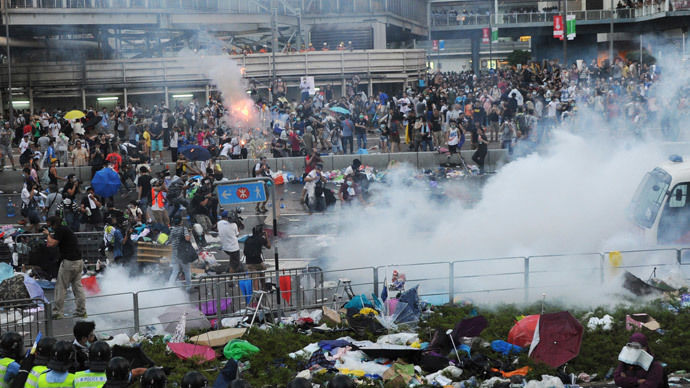
© Reuters/StringerRiot police fire tear gas to disperse protesters after thousands of protesters blocked the main street to the financial Central district outside the government headquarters in Hong Kong September 28, 2014.
Tens of thousands of pro-democracy protesters have besieged the Hong Kong government headquarters in a protest against Beijing's decision to restrict a democratic election in the city.
Local law enforcement had to use force to disperse protesters in the city's Admiralty district near the main government offices, where they have been camping out throughout the weekend.
As the crowd ignored police warnings, charging barricades and refused to leave, blocking a key road, security forces went ahead and used tear gas and pepper spray. The measure, however, turned out to be counterproductive as protesters regrouped and spread briefly after the crackdown.
TEAR GAS #OccupyCentralpic.twitter.com/tHqNuXtaVKMany of the protesters had goggles or covered faces with masks, and protected themselves with raincoats and umbrellas against the pepper spray.
- Phila Siu (@phila_siu) September 28, 2014
Protesters all the way to Central now; very tense standoff. Crowd angry as tear gas fired again. #OccupyCentralpic.twitter.com/eGzYKTmAfoStudents started their protest September 22, but by early Sunday they were supported by leaders of the broader Occupy Central civil movement, who said they were joining them to start a longer mass sit-in.
- Tesa Arcilla (@TesaArcilla) September 28, 2014
"@MengJiangAle: #hongkong#protest#OccupyCentral#hk926 causeway bay 11pm more and more people joining the sit in pic.twitter.com/JO3FBublQU""Occupy Central has formally begun," the movement said in a statement Sunday. "The two nights of occupation of Civic Square in Admiralty have completely embodied the awakening of Hong Kong people's desire to decide their own lives."
- Tesa Arcilla (@TesaArcilla) September 28, 2014
Following the night clashes, police arrested more than 70 people. Nearly 30 people were injured, according to security forces.

© AFP/Xaume OllerosPro-democracy demonstrators are sprayed with pepper spray during clashes with police officers in riot gear during a rally near the Hong Kong government headquarters on September 28, 2014.(
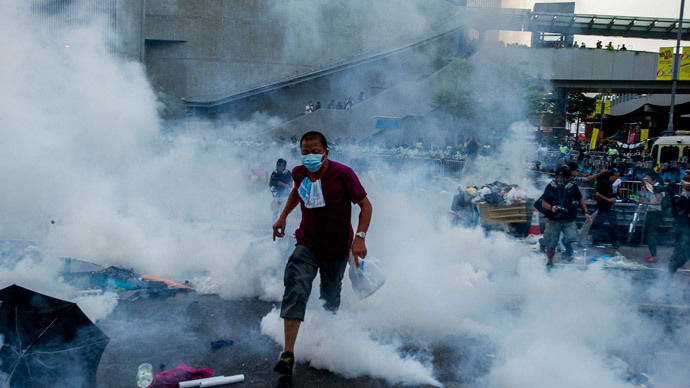
© AFP/Xaume OllerosA pro-democracy demonstrator runs as police fired tear gas towards protesters near the Hong Kong government headquarters on September 28, 2014.
"I and my government will, in accordance with the Basic Law and the relevant decision of the NPCSC, try our very best to implement the election of the chief executive by universal suffrage in 2017," he said, calling Beijing's order an "important step towards the constitutional development of Hong Kong."
CY Leung vowed to handle the protest in accordance with the law, while police threatened to use "a higher degree of force" in case protesters do not obey the order.
"The police are determined to handle the situation appropriately in accordance with the law," Leung said.
Reuters reports that some student organizers warned the crowd that police could return with rubber bullets.
This recent violence is seen in Hong Kong as the most serious civil disobedience action since 1997, when the area joined China under agreement to have "one country, two systems".
According to Reuters, Hong Kong police had not used tear gas in Hong Kong since breaking up World Trade Organization protests against South Korean farmers in 2005.


Reader Comments