
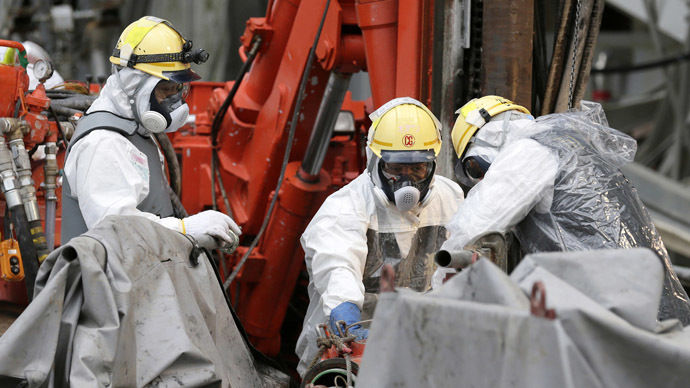
© ReutersWorkers conduct operations to construct an underground ice wall at Tokyo Electric Power Co.'s (Tepco) tsunami-crippled Fukushima Daiichi nuclear power plant in Fukushima Prefecture July 9, 2014.
"It's a difficult decision, but I want to accept the construction plan," Governor Yuhei Sato told journalists on Saturday.
Sato told The Japan Times he accepted the plan because he sees it as "necessary to advance decontamination and realize recovery of the environment."
The mayor's formal acceptance should be also sent to Environment Minister Nobuteru Ishihara and Reconstruction Minister Takumi Nemoto on Monday, and he is also set to meet with the country's premier Shinzo Abe in Tokyo.
On Wednesday, two Fukushima prefecture municipalities made the decision that they would accept the government's package of subsidies, allowing to build the storages.
"We succeeded in greatly deepening (local officials') understanding (of our storage facility plan)," Nobuteru Ishihara, environment minister, told journalists on Tuesday, as quoted by The Asahi Shimbun media outlet, following his meeting with members of the town assemblies of Futaba and Okuma.
The central government is to pay subsidies totaling 301 billion yen ($2.89 billion) to support the locals and revive the community.
Documents containing explanations of the government assistance are set to be provided for local residents. A telephone line will also be set up to answer questions from locals.
The contaminated waste is to be stored near the nuclear facility crippled in March 2011 by a tsunami that was triggered by a 9.0 earthquake. To make it happen, it is also necessary to carry out talks with around 2,000 landowners to buy around 16 square kilometers of their land: that land will host the nuclear waste storages. The talks on that are expected to start by the end of September.
The central and prefectural authorities have been negotiating the terms and conditions of storing waste since last December, when the environment minister introduced the idea that Fukushima should do it for up to 30 years.




This is over $22,000 per person for the entire population of Japan, or nearly 100,000 per household. Just for one small part of the cost of nuclear energy. Every household in Japan could have had their own personal wind generator, solar panels and extensive energy saving designs added to their houses.
The people (and I use the term loosely) in charge of everything need to be removed and put into social housing which they can pay for by doing tasks where they can do no harm, e.g. cleaning streets, mending park benches, etc. A large rock should be placed in each set of government, which can be worshipped by authoritarian followers as they go about their jobs.