
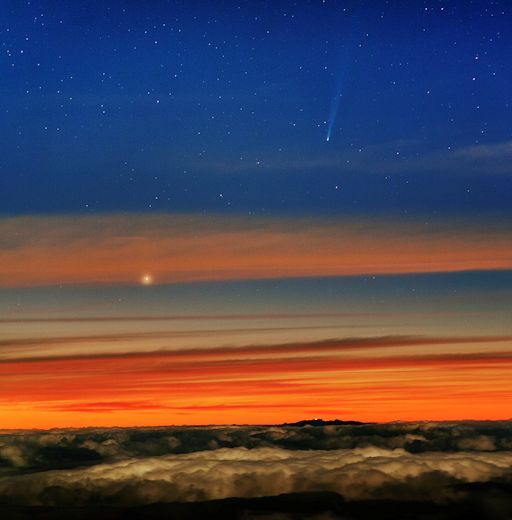
© Juan Carlos CasadaComet ISON seen from Gran Canaria at dawn, 21 November 2013. Visible at lower left is Mercury.
The comet's entrance coincides with a bright CME racing away from the sun's southwestern limb. Astronomers have been wondering what might happen if a CME strikes Comet ISON. This CME, however, will probably miss. The source of the cloud is a farside active region, which is not directly facing the comet.
NASA's STEREO-A spacecraft is also monitoring the comet.
"I will admit that I was pretty worried yesterday morning when reports of lower production rates came in," says Matthew Knight of the Lowell Observatory and NASA's Comet ISON Observation Campaign. "However, the STEREO-A brightness has increased steadily over the subsequent 36 hr, and I'm more optimistic again. My off-the-cuff thought is that there was an [outburst of dust, which dampened the emission lines] from roughly Nov 20-22, and it has returned to brightening again."
Astronomer Karl Battams of NASA's Comet ISON Observing Campaign urges readers to remember the following: "Comet ISON is a dynamically new sungrazing comet, fresh in from the Oort Cloud, and the last time we saw an object like this was never! Furthermore, a sungrazing comet just days from perihelion has never been studied in this kind of detail - we're breaking new ground! When we factor in your standard 'comets are unpredictable' disclaimer, what we have is a huge recipe for the unknown."



Reader Comments
JPL have updated details re Ison again - the orbit period is now 581,480 Years
There were some original figures of 10,000 years, which was freaky enough ... now they are saying it orbits every 581K years ... and it still comes from the Oort cloud?
Latest news is that the comet has not survived it's brush with the sun.